Largest Metropolitan Areas in the Americas: Population Rankings and Trends
The Americas are home to some of the most expansive and populous urban centers in the world. From the sprawling coastlines of Brazil to the dense hubs of North America, these metropolitan areas serve as the primary engines of economic growth and cultural exchange. However, measuring these giants is complex, as each country employs its own definition of a metropolitan area—typically defined as a region consisting of a single urban core and its immediate surroundings, rather than polycentric conurbations (clusters of multiple cities that have merged).
By analyzing the most recent census results and official projections from national demographic agencies, we can identify the top 50 most populous metropolitan regions across the Western Hemisphere.
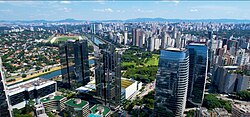
Key Facts
- São Paulo is the most populous metropolitan area in the Americas, with a 2025 projection of 21,555,260 residents.
- The top three metropolitan areas—São Paulo, Mexico City, and New York—all exceed 20 million people.
- Brazil and the United States have the highest number of cities appearing in the top 50 list.
- Some rankings include cross-border regions, such as the San Diego–Tijuana and Detroit–Windsor areas.
- Population data varies by year, with some figures based on 2025 projections and others on older census data (e.g., Maracaibo 2010).
The Top Tier: Mega-Cities of the Americas
The landscape of the Americas is dominated by a few massive urban centers. São Paulo leads the rankings, followed closely by Mexico City and New York. These cities function as global hubs, managing populations that exceed the total populations of many individual countries.
South American Giants
South America shows a high concentration of population in a few key capitals and coastal cities. Beyond São Paulo, Buenos Aires and Rio de Janeiro maintain significant populations. Notably, Bogotá and Lima also rank within the top ten, reflecting the intense urbanization of Colombia and Peru.
North American Hubs
In North America, the United States dominates the list with numerous entries. New York remains the largest, followed by Los Angeles, Chicago, and the rapidly growing Dallas–Fort Worth area. Canada's largest presence is Toronto, which ranks as the 13th largest metropolitan area in the Americas.
Comparative Population Data
The following table provides a detailed look at the top 20 most populous metropolitan areas, based on the most recent available data.
| Rank | Metropolitan Area | Country | Population | Year |
|---|---|---|---|---|
| 1 | São Paulo | Brazil | 21,555,260 | 2025 |
| 2 | Mexico City | Mexico | 21,436,911 | 2020 |
| 3 | New York | United States | 20,112,448 | 2025 |
| 4 | Buenos Aires | Argentina | 16,700,000 | 2022 |
| 5 | Rio de Janeiro | Brazil | 12,937,950 | 2025 |
| 6 | Los Angeles | United States | 12,844,441 | 2025 |
| 7 | Bogotá | Colombia | 12,772,828 | 2022 |
| 8 | Lima | Perú | 11,283,787 | 2022 |
| 9 | Chicago | United States | 9,434,123 | 2025 |
| 10 | Dallas–Fort Worth | United States | 8,477,157 | 2025 |
| 11 | Houston | United States | 7,904,627 | 2025 |
| 12 | Santiago | Chile | 7,400,741 | 2024 |
| 13 | Toronto | Canada | 7,108,874 | 2025 |
| 14 | Atlanta | United States | 6,482,182 | 2025 |
| 15 | Washington | United States | 6,465,724 | 2025 |
| 16 | Miami | United States | 6,391,072 | 2025 |
| 17 | Philadelphia | United States | 6,329,118 | 2025 |
| 18 | Belo Horizonte | Brazil | 5,383,386 | 2025 |
| 19 | San Diego–Tijuana | US / Mexico | 5,433,988 | 2025 |
| 20 | Monterrey | Mexico | 5,322,117 | 2020 |
Defining the Boundaries
One of the primary challenges in ranking these cities is the lack of a universal definition. For example, the Greater Buenos Aires area is defined by INDEC as the Autonomous City of Buenos Aires plus 24 specific partidos of the Buenos Aires Province. Similarly, the Bogotá metropolitan area is defined by DANE as the Capital District and 17 municipalities in Cundinamarca.
In some cases, metropolitan areas transcend national borders. The San Diego–Tijuana area combines the San Diego Metropolitan Statistical Area (MSA) with the Tijuana metro population, while the Detroit–Windsor area combines the MSA of Detroit with the metropolitan population of Windsor, Canada.
Frequently Asked Questions
Which is the largest metropolitan area in the Americas?
São Paulo, Brazil, is the largest, with a projected population of 21,555,260 as of 2025.
How is a metropolitan area defined in these rankings?
The rankings generally use official national definitions based on one urban core and its immediate surroundings, rather than polycentric conurbations.
Are there any cross-border metropolitan areas listed?
Yes, the list includes binational areas such as San Diego–Tijuana (United States and Mexico) and Detroit–Windsor (United States and Canada).
Why do the population years vary between cities?
The data relies on the most recent available census results or projections from each country's authoritative national demographic agency, which are updated at different intervals.
Which North American city is the largest outside the United States?
Toronto, Canada, is the largest non-U.S. metropolitan area in North America, ranking 13th overall with a population of 7,108,874 in 2025.