Greater São Paulo: Brazil's Economic and Urban Powerhouse
Greater São Paulo (Portuguese: Grande São Paulo) is a term used to describe the massive urban agglomeration centered around the city of São Paulo in Brazil. As the financial and economic heart of the country, this region represents one of the most densely populated and industrialized areas in the world, serving as a critical hub for global trade and domestic industry.
Depending on the definition used, the region can be viewed as a legally defined metropolitan area or a broader extended complex that integrates several neighboring urban centers.
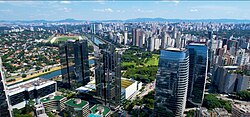
Key Facts
- Core City: São Paulo, the state capital.
- Metro Population: Approximately 21,555,260 inhabitants (2025 estimates).
- Economic Power: Metro GDP of US$ 319.3 billion (2023).
- Urban Scale: The urban area covers 2,139 km², while the total metropolitan area spans 7,947 km².
- Regional Influence: The extended metropolitan area (Macrometropolis) houses over 33 million people, roughly 75% of the state's population.
The Metropolitan Region of São Paulo (RMSP)
The Região Metropolitana de São Paulo (RMSP) is the legally defined metropolitan area. It consists of 39 municipalities, with the city of São Paulo serving as the primary core. This region is characterized by its immense population density and its role as Brazil's primary financial center.
While the capital city is the largest with 11,451,245 residents, other significant municipalities include Guarulhos (1,291,784), São Bernardo do Campo (810,729), and Santo André (748,919). A particularly vital sector is the ABC Region—comprising Santo André, São Bernardo do Campo, and São Caetano do Sul—which is a major industrial corridor hosting global corporations such as Ford and Volkswagen.
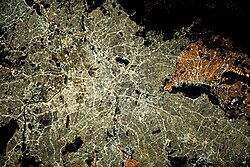
The Extended Metropolitan Area
Beyond the legal boundaries of the RMSP lies the Complexo Metropolitano Estendido de São Paulo, also known as the São Paulo Macrometropolis. This is an expansive agglomeration where five contiguous metropolitan areas and three microregions have merged through urban growth.
This extended region is dominated by São Paulo but integrates other major hubs such as Campinas, Sorocaba, and Santos. This network creates a massive urban corridor that accounts for the vast majority of the state's population.
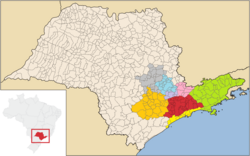
| Region | Total Population | Seat City | Seat City Population |
|---|---|---|---|
| Metropolitan Region of São Paulo | 21,860,000 | São Paulo | 12,310,000 |
| Metropolitan Region of Campinas | 3,300,000 | Campinas | 1,215,000 |
| Metropolitan Region of Vale do Paraíba e Litoral Norte | 2,550,000 | São José dos Campos | 725,000 |
| Metropolitan Region of Sorocaba | 2,150,000 | Sorocaba | 685,000 |
| Metropolitan Region of Baixada Santista | 1,880,000 | Santos | 435,000 |
| Metropolitan Region of Piracicaba | 1,500,000 | Piracicaba | 410,000 |
| Metropolitan Region of Jundiaí | 825,000 | Jundiaí | 425,000 |
| Regional Unit of Bragança Paulista city | 480,000 | Bragança Paulista | 170,000 |
| Total Macrometropolis | 34,500,000 | - | - |
Infrastructure and Transport
Given its status as the most populated and industrialized region in Brazil, transportation is vital for the movement of goods and people. The region is served by an extensive network of rodovias (highways), including the Rodovia Anhanguera, Rodovia dos Bandeirantes, Rodovia Presidente Dutra, and the Rodoanel Mário Covas, which helps divert traffic around the urban core.
For urban transit, the region relies on the São Paulo Metro and the Companhia Paulista de Trens Metropolitanos, providing essential rail-based connectivity across the metropolitan sprawl.
Frequently Asked Questions
What is the difference between the RMSP and the Extended Metropolitan Area?
The Região Metropolitana de São Paulo (RMSP) is a legally defined area consisting of 39 municipalities. The Extended Metropolitan Area (Macrometropolis) is a broader geographic concept that includes the RMSP plus several other contiguous metropolitan regions and microregions, totaling over 33 million people.
What is the ABC Region?
The ABC Region consists of the cities of Santo André, São Bernardo do Campo, and São Caetano do Sul. It is a critical industrial hub in the south of Greater São Paulo, known for hosting major automotive corporations like Volkswagen and Ford.
How large is the population of Greater São Paulo?
The legally defined metropolitan area (RMSP) has a population estimate of approximately 21,555,260 inhabitants as of 2025.
What are the primary modes of public transport in the region?
The region is served by a comprehensive network of highways (rodovias) for road transport, and the São Paulo Metro and Companhia Paulista de Trens Metropolitanos for rail-based transit.
What is the economic output of the metropolitan area?
As of 2023, the metropolitan GDP was US$ 319.3 billion, with a per capita GDP of US$ 14,300.