Western Genre: The Evolution of the American Frontier in Media
The Western is more than just a setting; it is a cultural touchstone that captures the spirit, struggle, and eventual demise of the new American frontier. Defined by the American Film Institute as stories set in the American West, the genre—originally known as "Wild West dramas"—has evolved from simple short films into a complex narrative style spanning cinema, television, literature, and digital media.
At its core, the Western relies on a set of iconic archetypes. Protagonists are typically seminomadic wanderers, such as cowboys, bounty hunters, and gunslingers. These characters are instantly recognizable by their attire—Stetson hats, buckskins, spurs, and bandannas—and their reliance on revolvers or rifles to navigate a lawless land through frontier justice (the practice of dispensing justice without formal legal proceedings).
Key Facts
- Origin: The term "Western" first appeared in a July 1912 issue of Motion Picture World magazine.
- Golden Age: The period between 1940 and 1960 is considered the "Golden Age of the Western."
- Peak Popularity: In the 1950s, Westerns were the most produced film genre, outnumbering all others combined.
- TV Dominance: 1959 marked the peak of television Westerns, with 26 primetime shows airing.
- Modern Success: Red Dead Redemption 2 (2018) became one of the best-selling video games of all time, selling over 64 million copies by 2025.
The Cinematic Journey of the Western
Early Silents and the Pattern of Action
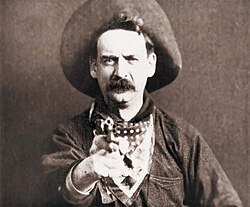
The genre began in 1894 with short, single-reel silent films produced by Edison Studios at the Black Maria studio in New Jersey. These early clips featured real-life figures from Buffalo Bill's Wild West show, including the sharpshooter Annie Oakley. While the British short Kidnapping by Indians (1899) is the earliest known narrative Western, Edwin S. Porter's The Great Train Robbery (1903) is credited with establishing the genre's narrative blueprint: crime, pursuit, and retribution.
From Pulp to the Golden Age
After a period of decline following the arrival of sound in the late 1920s, the genre was largely relegated to low-budget "B Westerns." However, 1939 sparked a massive revival. Major studio hits like Dodge City and John Ford's Stagecoach brought the Western back to the mainstream, cementing John Wayne as a superstar.
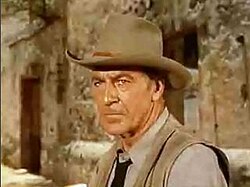
This momentum led to the "Golden Age" (1940–1960), characterized by the work of directors like John Ford and Robert Aldrich. Following this peak, the 1960s and 70s saw the rise of "Spaghetti Westerns"—films produced in Italy that gained global fame through the storytelling of Sergio Leone.
Westerns on the Small Screen
Television adopted the Western with fervor in the late 1940s. Early shows often featured movie cowboys, but original series soon followed. The Life and Legend of Wyatt Earp (1955) was the first Western series specifically written for adults, debuting just days before the legendary Gunsmoke.
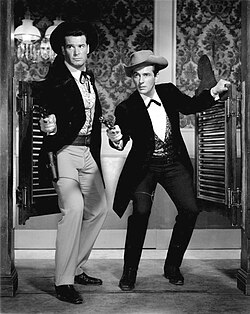
While traditional Westerns faded in the late 1960s due to changing demographics and parental pressure, the genre adapted. It evolved into the "space Western" (such as Firefly) and the neo-Western—modern stories that retain Western themes. A prime example is Breaking Bad, which uses the New Mexico desert as a pivotal character, mirroring the isolation and lawlessness of the Old West.
Literature, Art, and Other Media
Literature and Visual Arts
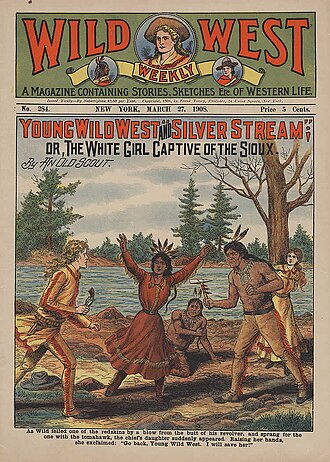
Western fiction typically focuses on the period between 1860 and 1900. Owen Wister's The Virginian (1902) is recognized as the first critically acclaimed Western novel. In the visual arts, painters like Frederic Remington and Charles M. Russell captured the grit and grandeur of the frontier, with their works now housed in institutions like the Buffalo Bill Center of the West.
Comics, Anime, and Gaming
The Western influence extends globally. In Japan, anime and manga often blend the genre with science fiction, as seen in Cowboy Bebop and Trigun. In the world of gaming, the genre evolved from the educational The Oregon Trail (1971) and early arcade duels like Gun Fight to the hyper-realistic open worlds of Rockstar Games.
Radio and Web Series
From the 1930s to the 1960s, radio dramas were a primary source of entertainment, ranging from juvenile adventures like Hopalong Cassidy to adult-oriented soap operas like Cactus Kate. Today, the genre persists in short-episodic web series such as League of STEAM.
Western Media Summary
| Medium | Key Example/Figure | Defining Characteristic |
|---|---|---|
| Film | John Ford / John Wayne | Pattern of crime, pursuit, and retribution. |
| Television | Gunsmoke / Breaking Bad | Transition from traditional to neo-Western. |
| Literature | The Virginian (Owen Wister) | Focus on the 1860–1900 frontier era. |
| Video Games | Red Dead Redemption 2 | Use of mythic West imagery and open worlds. |
| Visual Art | Frederic Remington | Capturing the "Wild West" in painting/sculpture. |
Frequently Asked Questions
What is the definition of a Western film?
According to the American Film Institute, Westerns are films set in the American West that embody the spirit, struggle, and demise of the new frontier.
When was the Golden Age of the Western?
The Golden Age occurred between 1940 and 1960, a period marked by high production volume and the influence of directors like John Ford.
What are Spaghetti Westerns?
Spaghetti Westerns are Western films produced in Italy during the 1960s and 1970s, largely popularized by the storytelling methods of Sergio Leone.
How did the Western genre evolve on television?
It began with movie rebroadcasts and traditional series in the 1950s, shifted toward hour-long color shows in the 60s, and eventually evolved into neo-Westerns and space Westerns in later decades.
Which was the first critically recognized Western novel?
The first critically recognized Western novel was The Virginian, published in 1902 by Owen Wister.