Wesel: A Journey Through Centuries of Trade and Conflict
The city of Wesel possesses a storied past, evolving from a modest manor into one of the most significant commercial hubs of the lower Rhine region. Its strategic location made it a prize for empires and a center for international trade, though this same geography eventually made it a primary target during the devastation of the 20th century.
Origins and the Golden Age of Trade
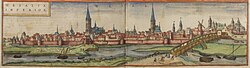
Wesel's roots trace back to the 8th century, originating from a Franconian manor. By the 12th century, the Duke of Clèves took possession of the settlement, setting the stage for its growth. The city's influence expanded significantly in the 15th century when it joined the Hanseatic League, a powerful commercial and defensive confederation of merchant guilds and market towns.
During this era, Wesel established itself as a premier entrepôt—a commercial center where goods are imported, stored, and transshipped. In the lower Rhine region, Wesel's importance as a clearing station for trade was surpassed only by the city of Cologne.
Early Modern Struggles and Imperial Shifts
The early modern period was marked by shifting alliances and religious diversity. In 1545, the city recorded a Walloon community that conducted church services in French. However, geopolitical instability followed; in 1590, the Spanish captured Wesel after a grueling four-year siege. Throughout the Eighty Years War, the city frequently changed hands between Dutch and Spanish forces.
The Hohenzollerns of the Margraviate of Brandenburg inherited Wesel in 1609, though they did not gain actual control until the Treaty of Nijmegen in 1678. The city continued to be a site of migration and conflict, welcoming a French Huguenot commune in 1688 and enduring French occupation during the Seven Years' War before returning to Prussian rule. Friedrich Wilhelm von Dossow served as the Prussian Governor during the 18th century.
The Napoleonic Era
In 1805, the Treaty of Schönbrunn ceded Wesel to the French. Napoleon recognized the city's strategic value, ordering the construction of heavy fortifications, including the Citadelle Napoleon at Büderich and the Citadelle Bonaparte on a Rhine island. Despite an Allied blockade in 1813, the French held the city until after the Battle of Waterloo. Following the Napoleonic Wars, Wesel became part of the Prussian Rhine Province, and the Citadelle Napoleon was renamed Fort Blücher.
The Devastation of World War II
The 20th century brought unprecedented destruction to Wesel. By 1943, the town was used to house forced laborers from the 3rd SS construction brigade. Because it served as a strategic depot, it became a primary target for Allied air raids.
Between February 16 and 19, 1945, a series of air raids using impact and air-burst bombs destroyed 97% of the town. In an attempt to halt the Allied advance, the Wehrmacht demolished bridges along the Rhine and Lippe, including the final 1,950m-long railway bridge on March 10.
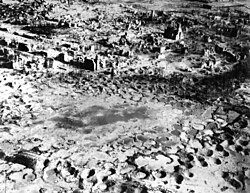
The final assault began on March 23, when over 3,000 guns bombarded the city in preparation for Operation Plunder. This was supported by RAF bombers, including a night raid where ten bombers each dropped a 10,000 kg bomb. Despite the intensity of the shelling, the town was eventually taken with minimal casualties because so much of the infrastructure had already been leveled.
The liberation involved Operation Varsity, the largest single-day airborne landing of the war, which dropped 18,000 troops into the hills behind Wesel. Simultaneously, the British 1st Commando Brigade attacked using LVT Buffalos (amphibious tractors), while other Allied forces crossed the Rhine in amphibious vehicles.
Key Facts
- Hanseatic Status: Wesel was the second most important entrepôt in the lower Rhine region after Cologne.
- Napoleonic Forts: The city featured the Citadelle Napoleon and Citadelle Bonaparte.
- WWII Destruction: 97% of the city's structures were destroyed by February 1945.
- Population Collapse: The population plummeted from nearly 25,000 in 1939 to just 1,900 by May 1945.
- Operation Varsity: Involved 18,000 airborne troops in one of the war's largest landings.
| Period/Event | Controlling Power/Status | Key Outcome |
|---|---|---|
| 15th Century | Hanseatic League | Became a major commercial entrepôt |
| 1590 | Spain | Captured after a four-year siege |
| 1678 | Prussia (Hohenzollerns) | Control established via Treaty of Nijmegen |
| 1805 | France (Napoleon) | Construction of major citadelles |
| 1945 | Allied Forces | Liberated via Operation Plunder and Varsity |
| 1946 | West Germany | Joined state of North Rhine-Westphalia |
Frequently Asked Questions
What was Wesel's role in the Hanseatic League?
Wesel served as a vital commercial center and entrepôt for the transshipment and trading of goods, ranking as the second most important such hub in the lower Rhine region, behind only Cologne.
How did the Napoleonic Wars change the city's landscape?
The French heavily fortified the city, building the Citadelle Napoleon at Büderich and the Citadelle Bonaparte on an island in the Rhine. After the wars, the Citadelle Napoleon was renamed Fort Blücher.
What caused the near-total destruction of Wesel in 1945?
As a strategic depot, Wesel was targeted by massive Allied bombing raids between February 16 and 19, 1945, followed by heavy artillery bombardment from over 3,000 guns and RAF raids involving 10,000 kg bombs.
What was Operation Varsity?
Operation Varsity was the largest airborne landing of World War II in a single day and location, dropping 18,000 troops into the hills behind Wesel to support the Allied advance.
How severely was the population affected by World War II?
The population of Wesel saw a catastrophic decline, dropping from nearly 25,000 residents in 1939 to only 1,900 by May 1945.