Watertown History: From Industrial Powerhouse to Regional Hub
Watertown, New York, owes its existence and early prosperity to the geography of the Black River. Strategically positioned to harness the power of rushing water, the city was envisioned from its inception as an industrial center. From its early days as a frontier settlement to its era as a manufacturing giant, Watertown has evolved into a vital hub for the surrounding rural landscape of Jefferson County.
The Foundations of a City
The land that would become Watertown was part of a massive purchase in 1791 by Alexander Macomb, a resident of New York City. Macomb employed surveyors to divide and sell the land to settlers moving into the region. In 1796, surveyor Benjamin Wright identified the area as an excellent township, noting the rapid, rocky river and the presence of "falls" and "rapids" that would serve as ideal mill seats.
By 1798, pioneers Hart Massey, Henry Coffeen, and Zachariah Butterfield established cabins in the area now known as Public Square. This migration was part of a larger movement of New Englanders into New York following the Revolutionary War. Because the territory was uneven, the area underwent one of the first landfill projects in the United States to create a level foundation for the town.
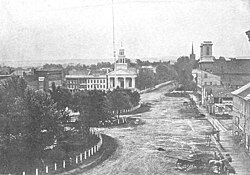
In 1800, the area was separated from the town of Mexico. The settlers' vision was to build an industrial center powered by the Black River, which flows west into Lake Ontario. By 1805, the center of town was cleared to create Public Square, which later became the heart of the city and is now listed as a historic district on the National Register of Historic Places (NRHP).
Industrial Growth and Economic Evolution
Watertown's economy was initially bolstered by its proximity to Lake Ontario, making it a key transit point for supplies heading into Canada. However, this trade was disrupted by the Embargo Act of 1807, which prohibited trade with Britain and France (including Canada). This economic strain led to smuggling and contributed to the tensions of the War of 1812.
The city's true growth came from its water power. The Black River drops 40 feet in the center of town and 120 feet over a span of 2.5 miles, providing immense energy for early industry. By 1850, various mills were operating throughout the city. Notable achievements included the manufacture of the first portable steam engine in 1847.
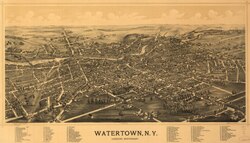
Infrastructure expanded rapidly in the mid-19th century. The Rome, Watertown and Ogdensburg Railroad connected the city to Albany, Syracuse, and Rochester in 1851. This connectivity, combined with mill revenue, funded early public works, including a water system and illuminating gas works in 1853, followed by a telephone system in 1879.
Notable Businesses and Innovations
- Paddock Arcade: Built in 1850, it remains the oldest continuously operating enclosed mall in the United States.
- Frank W. Woolworth: While working as a clerk at Moore's Store in 1878, Woolworth conceived the idea for his fixed-price, cut-rate mercantile chain.
- Davis Sewing Machine Company: A local manufacturer that served as the predecessor to the Huffy Corporation.
Challenges and Modern Transition
The late 19th century saw a population surge of over 17,000 people in 30 years, though the city also gained a reputation for gambling and prostitution. While a professional class of lawyers and doctors emerged, the economic center of the U.S. began shifting toward the Midwest. The Wall Street Crash of 1929 brought severe economic hardship, which only subsided when industries pivoted to produce war materiel during World War II.
In the post-war era, Watertown saw the 1951 development of "Little Trees" by the Car-Freshner Corporation, which maintains its headquarters in the city. However, the 1960s and 1970s brought a period of de-industrialization—the process of social and economic decline caused by the removal or reduction of industrial capacity. This era saw the loss of historic landmarks like the Hotel Woodruff and a rise in unemployment, which hit 20 percent by the 1980s.
In the 21st century, Watertown has focused on revitalization. A $7.4 million project between 2006 and 2008 restored several buildings and improved city infrastructure. Today, the city serves as a central hub for its rural surroundings.
Key Facts
- Water Power: The Black River drops 120 feet over 2.5 miles, fueling early industrialization.
- Historic Firsts: Home to the Paddock Arcade, the oldest continuously operating enclosed mall in the U.S.
- Retail Legacy: The concept for the Woolworth's chain was developed here in 1878.
- Landfill: One of the first landfill projects in the U.S. was used to level the Public Square area.
- Modern Industry: Headquarters of the Car-Freshner Corporation (Little Trees).
| Year/Era | Event |
|---|---|
| 1796 | Benjamin Wright surveys the land for Alexander Macomb. |
| 1800 | Watertown is separated from the town of Mexico. |
| 1816 | Incorporated as a village. |
| 1847 | First portable steam engine manufactured. |
| 1869 | Reincorporated as a city. |
| 1920 | Adoption of city manager-style government. |
| 1951 | Development of Little Trees (Car-Freshner Corporation). |
Frequently Asked Questions
Why was Watertown founded in its specific location?
Watertown was established where it is primarily to utilize the Black River. The river's rapids and falls provided the necessary water power to attract and operate mills, which were the backbone of early industry.
What is the significance of the Paddock Arcade?
Built in 1850, the Paddock Arcade is historically significant as the oldest continuously operating enclosed mall in the United States and is listed on the National Register of Historic Places.
How did Frank W. Woolworth contribute to the city's legacy?
While working as a clerk at Moore's Store in Watertown in 1878, Woolworth developed the idea of a store specializing in fixed-price, cut-rate merchandise, which led to the creation of his famous mercantile chain.
What caused the economic decline in the 1960s and 70s?
The city experienced a period of de-industrialization, where many factories closed and historic buildings were demolished. Additionally, many young professionals moved to booming cities like Chicago for better opportunities.
What is the current role of Watertown in its region?
In the 21st century, Watertown serves as a primary commercial and service hub for a large surrounding rural area, supported by recent infrastructure and building restoration projects.