War of the Pacific: The Conflict Between Chile, Bolivia, and Peru
The War of the Pacific (1879–1884) was a defining geopolitical struggle in South America, pitting Chile against the allied forces of Bolivia and Peru. Fought primarily over the resource-rich Atacama Desert, the conflict reshaped the borders of three nations and left a lasting legacy of territorial disputes and national identity.
At its core, the war was driven by the economic value of nitrate (saltpeter) and guano, which were essential for fertilizer and gunpowder. The struggle for control over these deposits transformed a regional border dispute into a full-scale military campaign involving naval battles and grueling land warfare.
Key Facts
- Duration: March 1, 1879, to April 4, 1884.
- Belligerents: Chile vs. Bolivia and Peru.
- Primary Cause: Disputes over nitrate deposits and a 10-cent tax imposed by Bolivia.
- Outcome: Chilean victory; Bolivia lost its coastline, and Peru ceded southern territories.
- Major Treaties: Treaty of Ancón (Chile-Peru) and Pact of Valparaiso (Chile-Bolivia).
The Roots of Conflict
Border Disputes and Secret Alliances
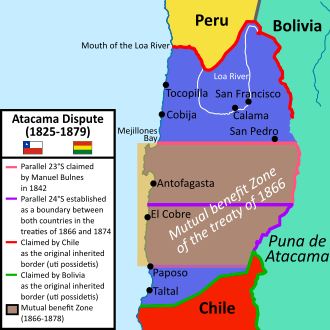
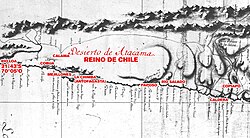
The tension began with ambiguous borders in the Atacama Desert. While a 1793 map showed certain boundaries within the Spanish Empire, the independent republics struggled to agree on limits. A 1866 Boundary Treaty attempted to resolve this, but tensions remained.
In 1873, Peru and Bolivia entered into a Secret Treaty of Alliance. This pact was designed as a mutual defense agreement, though Chile only learned of its existence through leaks in the Argentine Congress. Meanwhile, a 1874 Boundary Treaty between Chile and Bolivia explicitly forbade tax increases on Chilean enterprises for 25 years.
The "Ten Cents" Crisis
The spark for the war was economic. Peru sought to monopolize nitrate works to stabilize its economy, which was suffering from a decline in guano exports. In 1878, Bolivia approved a tax of 10 cents per quintal on nitrate exports. Chilean companies, citing the 1874 treaty, refused to pay, prompting the Chilean government to intervene and eventually invade Antofagasta.
Military Capabilities and Technology
None of the three nations were fully prepared for a prolonged conflict. They lacked formal General Staffs, medical corps, and robust logistics. However, Chile possessed a more modernized military structure and better-equipped forces.
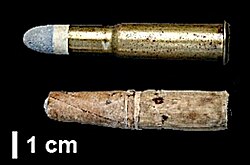
Technological shifts played a role in the fighting. The transition from paper cartridges, which produced smoke and ash, to metallic brass cartridges (such as those for the Fusil Gras mle 1874) improved efficiency and visibility on the battlefield.
The Course of the War
The Struggle for the Sea
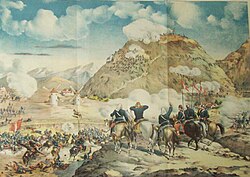
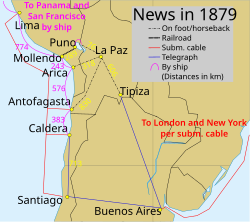
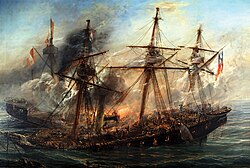
Control of the Pacific coast was vital for transporting troops and supplies. The naval campaign saw intense clashes, including the Battle of Iquique, as Chile sought to neutralize the Peruvian Navy's ironclads to secure landing zones for its army.
Land Campaigns
The war progressed through several brutal phases:
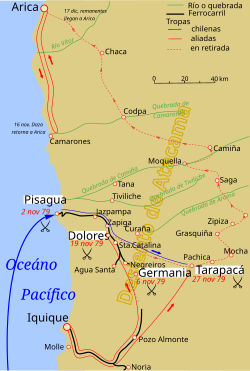
- Tarapacá Campaign: Chilean and Allied troops deployed in November 1879, leading to the Battle of Tarapacá.
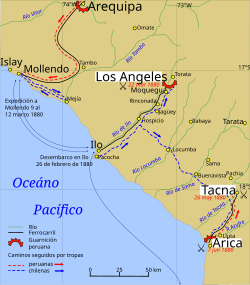
- Tacna and Arica: From January to June 1880, fighting intensified in these regions, resulting in significant casualties.
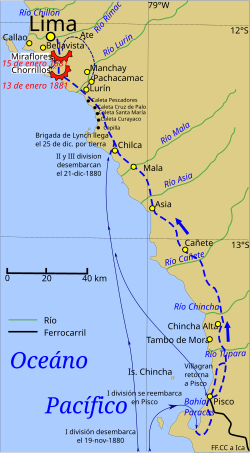
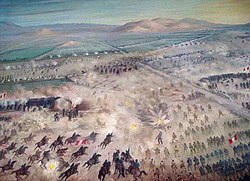
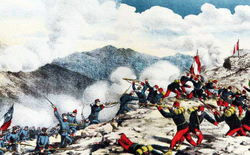
- Campaign of Lima: Chilean forces landed at Pisco and Chilca, eventually engaging in the devastating Battles of Chorrillos and Miraflores.
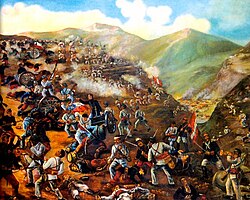
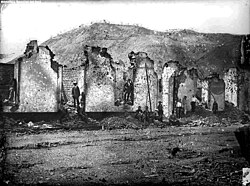
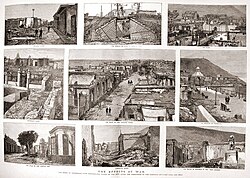
The Battle of Chorrillos was particularly destructive; the seaside resort, once a haven for Lima's aristocracy, was reduced to rubble during the fighting.
The Sierra Campaign
Following the fall of Lima, the conflict shifted to the Peruvian highlands (the Sierra). This phase was characterized by guerrilla warfare and harsh conditions. Soldiers faced not only combat but also diseases like Carrion's disease, known as the "Peruvian wart."
![A Chilean soldier with the "Peruvian wart," or Carrion's disease, who was probably infected in the valleys of the Rimac River during the war in the sierra.[164]](/images/7c/b4/7cb4bd40d6208ee1afc7bf9a7ad441576b65babaf68ccab93ee5e5ca5ebe52d2.jpg)
Human Cost and Atrocities
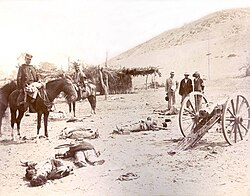
The war was marked by significant human suffering. Approximately 25,000 soldiers were killed. In Chile, 4,081 soldiers (10% of the expeditionary force) returned disabled. The conflict also saw the expulsion of 30,000 Chileans from Peru and Bolivia at the start of the war, many of whom later joined the Chilean army.
![Photo of Chilean private first class Tránsito Diaz, injured during the landing on Pisagua. The photo belongs to the "Álbum de inválidos de la Guerra del Pacífico", 130 photographic records ordered by the D. Santa María government to demonstrate the pensions and orthopedic devices given to disabled war veterans.[126] Ten percent of the expeditionary force, 4,081 Chilean soldiers, returned disabled from the war. In 2008, 280 women were receiving a pension as the daughter or wife of a veteran.[127]: 20, 30](/images/8c/ed/8ced363964c69a45ed3d5626ef67cf4166fb37b289dbbc309b5ba8b6914a31a1.jpg)
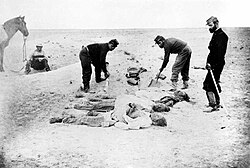
![Human remains of Bolivian, Chilean and Peruvian soldiers exhumed from makeshift graves after the Battle of Tacna before their definitive interment in the Mausoleum of the Tacna cemetery in 1910.[186]](/images/d1/7c/d17cd00716ca17ac21c6e0e94c27e7df0ce9a03da6a654c8c5fa6616564a93e3.jpg)
Peace and Aftermath
The war ended with the Treaty of Ancón (1883) between Chile and Peru, and the Pact of Valparaiso (1884) between Chile and Bolivia. The territorial changes were profound:
| Nation | Outcome | Territorial Change |
|---|---|---|
| Chile | Victory | Acquired Antofagasta (from Bolivia) and Tarapacá (from Peru). |
| Bolivia | Defeat | Lost its entire coastline (Litoral), becoming landlocked. |
| Peru | Defeat | Ceded Tarapacá; Arica was later ceded in 1929, while Tacna was returned. |
To ensure Argentine neutrality during the conflict, Chile dropped claims to over 1,000,000 km² of Patagonia in an 1881 treaty.
Frequently Asked Questions
What was the primary cause of the War of the Pacific?
The war was primarily caused by disputes over the ownership and taxation of nitrate (saltpeter) deposits in the Atacama Desert, specifically triggered by Bolivia's imposition of a 10-cent tax on Chilean nitrate companies.
How did the war affect Bolivia's geography?
Bolivia suffered the most significant geographical loss, losing its entire coastal territory to Chile, which rendered the country landlocked.
What was the significance of the Treaty of Ancón?
The Treaty of Ancón ended the war between Chile and Peru in 1883, resulting in Peru ceding the province of Tarapacá to Chile and establishing a long-term dispute over Tacna and Arica.
Who won the War of the Pacific?
Chile emerged as the victor, successfully seizing nitrate-rich territories from both Bolivia and Peru and establishing dominance over the southeastern Pacific coast.
What was the "Peruvian wart" mentioned in historical records?
The "Peruvian wart" refers to Carrion's disease, an infection that affected soldiers, particularly during the Sierra Campaign in the valleys of the Rimac River.