Atacama Desert: The World's Driest Non-Polar Landscape
Stretching along the Pacific coast of South America, the Atacama Desert is a vast plateau in northern Chile that holds the title of the driest non-polar desert on Earth. Spanning a 1,600-kilometre (1,000-mile) strip of land west of the Andes, this extraordinary region is characterized by extreme aridity and otherworldly landscapes that mirror the surface of Mars.
Covering approximately 105,000 square kilometres—and up to 128,000 square kilometres if the lower slopes of the Andes are included—the Atacama is more than just a barren wasteland. It is a unique intersection of geological forces, astronomical clarity, and resilient biological life.
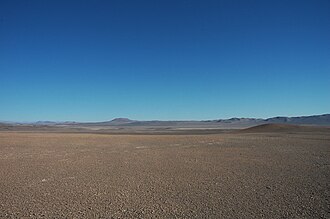
Key Facts
- Location: Northern Chile, between the Andes and the Chilean Coast Range.
- Climate: The driest non-polar desert globally, with average annual rainfall of about 15 mm (0.6 in).
- Mars Analog: Used by NASA to test instruments due to soil similarities with the Red Planet.
- Astronomy: Home to some of the world's most advanced observatories, including ALMA.
- Unique Weather: Experiences the camanchaca, a dense marine fog that supports specialized life.
Geography and the Science of Aridity
The Atacama's extreme dryness is the result of a phenomenon known as a two-sided rain shadow. The desert is sandwiched between two high mountain chains: the Andes to the east and the Chilean Coast Range to the west. These barriers effectively block moisture from both the Atlantic and Pacific oceans.
This effect is further intensified by the South Pacific anticyclone and the cool, north-flowing Humboldt Current. The result is a landscape where some weather stations have never recorded a single drop of rain. Evidence suggests that the region may have seen no significant rainfall between 1570 and 1971, with hyper-arid conditions persisting since the Miocene epoch.
![The lack of humidity, rain, and light pollution together produce a dusty, rocky landscape.[36]](/images/92/ed/92ed50e6557cd6f824e84b8faa4b926e4729900c2993556e8df4a67a920bb3fe.jpg)
The Role of the Camanchaca
Despite the lack of rain, the desert is not entirely devoid of moisture. A thick marine fog called the camanchaca rolls in from the coast. This fog provides the critical hydration necessary for hypolithic algae (organisms living under rocks), lichens, and specialized cacti, such as those in the Copiapoa genus.
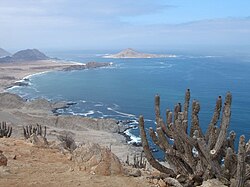
A Terrestrial Mirror to Mars
Because of its extreme dryness and mineral composition, specific regions of the Atacama—particularly around Yungay and María Elena South—are considered Mars analogs. The soil in these areas is so similar to Martian soil that NASA uses the desert to test instruments for future Mars missions.
In 2003, researchers attempted to duplicate the life-detection tests used by the Viking 1 and 2 Mars landers in the Yungay region and found no signs of life, highlighting the region's status as one of the most sterile environments on Earth.
![ALMA and the center of the Milky Way[71]](/images/89/1d/891de9be5b34e3103bca9e07d5c971b3d2ce8a6dc7430a2bd261bb1ccad44f82.jpg)
Flora, Fauna, and Rare Phenomena
Life in the Atacama is sparse but highly adapted. While much of the landscape is rocky and dusty, rare rainfall events can trigger the flowering desert phenomenon, where the southern Atacama suddenly erupts in a carpet of blooms.
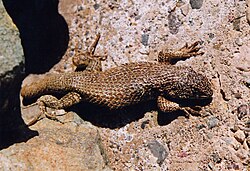
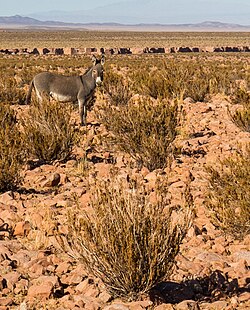
The fauna is equally specialized, ranging from Andean flamingos in the Salar de Atacama to the Liolaemus nitidus lizard in the southern reaches. Even feral donkeys have found a way to survive in this harsh environment.
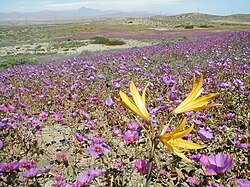
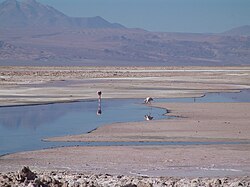
Human History and Modern Use
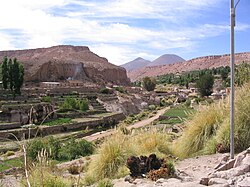
Long before modern borders, the interior of the desert was inhabited by the Atacameño people, who built fortified towns known as pucarás. Later, the region saw the influence of the Inca Empire and the Spanish, who established towns like San Pedro de Atacama.
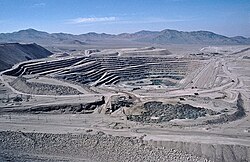
In more recent history, the desert became a hub for nitrate mining, leaving behind a trail of abandoned mining towns. Today, the region is a center for global industry and science, featuring massive copper mines like Chuquicamata and world-class astronomical facilities.
A Window to the Universe
The combination of high altitude, low humidity, and minimal light pollution makes the Atacama the premier location for astronomy. The European Southern Observatory (ESO) operates several major sites here:
- La Silla Observatory
- Paranal Observatory (home to the Very Large Telescope)
- Llano de Chajnantor Observatory (hosting the ALMA radio observatory)
- Cerro Armazones Observatory (site of the future Extremely Large Telescope)
![Snow in Paranal Observatory at 2,600 masl[19]](/images/bc/80/bc8001f3bb1c6bd50cb1841c22b25de41a2f0384b507baa021878cdf6cd22697.jpg)
Sports and Adventure
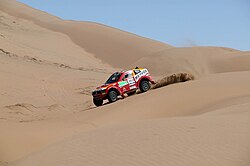
The desert's vast dunes and rugged terrain attract all-terrain sports enthusiasts. It has hosted the Patagonia-Atacama Rally and various editions of the Dakar Rally. Additionally, the region is a popular destination for sandboarding and solar-powered car racing.
Atacama Desert Summary
| Feature | Details |
|---|---|
| Total Area | 105,000 km² to 128,000 km² |
| Average Rainfall | ~15 mm (0.6 in) per year |
| Primary Country | Chile |
| Key Ecosystems | Deserts and xeric shrublands |
| Notable Flora | Copiapoa cacti, hypolithic algae |
| Major Industry | Copper mining, Astronomy, Tourism |
Frequently Asked Questions
Why is the Atacama Desert so dry?
The dryness is caused by a two-sided rain shadow. The Andes Mountains block moisture from the Atlantic, while the Chilean Coast Range blocks moisture from the Pacific. This is reinforced by the cool Humboldt Current and the South Pacific anticyclone.
How does life survive in the Atacama?
Many species rely on the camanchaca, a dense marine fog that provides essential moisture. Some plants, like the Copiapoa cacti, and various lichens and algae have adapted to survive on this fog alone.
Why is the Atacama compared to Mars?
Certain areas, such as Yungay, have soil chemistry and extreme aridity that closely mimic the conditions on Mars. This makes it an ideal location for NASA to test planetary landers and life-detection instruments.
What is the "flowering desert"?
The flowering desert is a rare phenomenon in the southern Atacama where unusual rainfall events trigger the mass germination of seeds, turning the arid landscape into a field of flowers.
Which astronomical observatories are located there?
The region hosts several major facilities, including the ALMA radio observatory at Llano de Chajnantor, the Very Large Telescope at Paranal, and the upcoming Extremely Large Telescope at Cerro Armazones.