Walter Hickel: A Legacy of Alaskan Leadership and Federal Service
Walter Hickel stands as one of the most influential figures in the political history of Alaska. From his early days shaping the state's Republican Party to serving in the United States Cabinet, Hickel's career was defined by a complex balance of industrial development and environmental stewardship. His journey reflects the growing pains of a young state navigating the discovery of vast natural resources and the tensions of national politics during the Cold War era.
Early Political Ascent in the 1950s
During the 1950s, Hickel became a pivotal force in shifting the center of power within Alaska's Republican Party from Juneau to Anchorage. Serving as the finance chairman of the party, he gained significant support from Anchorage businessmen. In 1952, he sought the territorial governorship, though Benjamin Heintzleman was ultimately appointed to the role.
Hickel continued to build his influence, serving as the head of the Anchorage Republican Club and acting as the Republican National Committeeman for Alaska. His early political activity was marked by a drive for local representation; in 1953, he and eighteen other prominent Republicans urged Governor Heintzleman to replace Robert DeArmond with a representative from Anchorage.
The First Governorship (1966–1969)
In the 1966 general elections, Hickel made history by becoming Alaska's first Republican governor after defeating incumbent Bill Egan. His tenure was marked by a defining moment in Alaskan history: the 1968 discovery of oilfields at Prudhoe Bay.
While Hickel was a moderate Republican and an environmentalist who avoided pushing for aggressive oil exploitation, his administration did approve oil leases on 37,000 acres of the North Slope, despite opposition from Alaskan Natives. He also prioritized infrastructure, initiating the construction of a 400-mile road from Livengood to Prudhoe Bay, now known as the Hickel Highway.
Beyond industry, Hickel focused on social cohesion and governance. He worked to improve relations with Alaskan Natives regarding land claims, supported by key figures such as Morris Thompson and Don and Jules Wright. Additionally, he appointed Ted Stevens to the U.S. Senate to fill the vacancy left by Bob Bartlett.
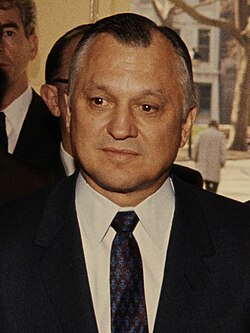
Service as U.S. Secretary of the Interior
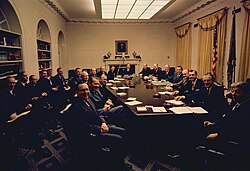
Following the 1968 election of Richard Nixon, Hickel was offered a seat in the U.S. Cabinet as the Secretary of the Interior. Despite an initial refusal, Hickel eventually accepted the position and moved to Washington.
His nomination was contentious, facing a "smear" campaign in major publications like the New York Times and Los Angeles Times, with critics including columnists Drew Pearson and Jack Anderson. Despite opposition from Democratic senators Walter Mondale and George McGovern, as well as testimony from Sierra Club director David Brower, the Senate confirmed him on January 23, 1969.
As Secretary, Hickel championed environmental protections, demanding safeguards for Alaska's oil industry and establishing liabilities for offshore oil rig operators. However, his centrist views eventually clashed with President Nixon. In 1970, following the Kent State shootings, Hickel wrote a letter criticizing Nixon's Vietnam War policy and urging the administration to respect the views of the youth. This act of dissent led to his firing on November 25, 1970, along with undersecretaries such as Leslie Glasgow.
Return to the Governorship (1990s)
Hickel's return to the governor's office occurred under unusual political circumstances. In 1990, the Republican nomination went to Arliss Sturgulewski, but internal party friction over her stances on abortion and capital punishment created a rift. Jack Coghill, the Republican nominee for lieutenant governor, felt he could no longer run on the same ticket.
In a strategic move, Hickel and Coghill ran as a slate under the Alaskan Independence Party (AIP) banner, after the original AIP nominees stepped aside. Although Hickel shared the AIP's opposition to federal land-use restrictions, he remained a staunch proponent of statehood and never endorsed the party's secessionist goals. He won the general election and eventually rejoined the Republican Party in April 1994.
During this second term, Hickel proposed an ambitious project in 1991: the construction of a water pipeline from Alaska to California.
Key Facts
- First Republican Governor: Hickel was the first Republican to serve as Governor of Alaska.
- Oil Discovery: His first term oversaw the discovery of oil at Prudhoe Bay in 1968.
- Infrastructure: He initiated the 400-mile road now called the Hickel Highway.
- Federal Role: Served as U.S. Secretary of the Interior under Richard Nixon from 1969 to 1970.
- Political Versatility: Served as governor under both the Republican and Alaskan Independence Party banners.
| Role | Period/Year | Key Achievement/Event |
|---|---|---|
| Governor of Alaska (1st Term) | 1966–1969 | Prudhoe Bay oil discovery; Hickel Highway construction |
| U.S. Secretary of the Interior | 1969–1970 | Environmental safeguards for oil; dissent on Vietnam War |
| Governor of Alaska (2nd Term) | 1990s | Elected via Alaskan Independence Party; proposed water pipeline |
Frequently Asked Questions
Why was Walter Hickel fired from the Nixon administration?
Hickel was fired on November 25, 1970, after writing a letter critical of President Nixon's Vietnam War policy, specifically urging the administration to show more concern for the attitudes of young Americans.
What is the Hickel Highway?
The Hickel Highway is a 400-mile road running from Livengood to Prudhoe Bay, with construction beginning in November 1968 under Hickel's department of transportation.
How did Hickel become governor a second time?
Hickel ran on a ticket with Jack Coghill under the Alaskan Independence Party (AIP) banner after a rift developed within the Republican Party regarding the original nominee, Arliss Sturgulewski.
Did Walter Hickel support Alaskan secession?
No. Despite running under the Alaskan Independence Party, Hickel was a historical proponent of Alaska statehood and never endorsed the party's secessionist platform.
What was Hickel's approach to the environment?
Hickel described himself as an environmentalist. As Secretary of the Interior, he supported legislation placing liabilities on offshore oil companies and demanded environmental safeguards for the oil industry.