Volleyball Terminology: A Comprehensive Glossary of Gameplay and Strategy
Whether you are a beginner stepping onto the court for the first time or an aspiring coach, mastering the language of volleyball is essential. From the explosive power of a spike to the strategic nuances of a 6-2 offensive system, the sport relies on a specific vocabulary to coordinate fast-paced plays and precise defensive movements.
This guide breaks down the most common terms used in modern volleyball, moving from basic scoring and contacts to advanced tactical formations.
Key Facts
- Rally Scoring is the current standard where a point is awarded at the end of every rally.
- The Three-Contact Rule typically involves a pass, a set (the second touch), and an attack (the third touch).
- Offensive Systems (like 5-1 or 6-2) are defined by the number of designated setters and their positions on the court.
- Defensive Specialists (DS) and Liberos focus on back-row play, though they have different substitution rules.
The Basics: Scoring and General Play
Before diving into complex strategies, it is important to understand how points are scored and the basic nature of the game's flow.
In the current rally scoring system, every rally results in a point. A side out occurs when the receiving team wins the rally, gaining the right to serve. A breakpoint is a point scored while a team is already serving. Historically, prior to 1999, only breakpoints counted toward the score.
A let occurs when a serve hits the net but still lands in the opponent's court; since 2001, this is considered a legal play and results in a point if it lands in. Conversely, an ace is a serve that lands untouched or is mishandled by the receiving team, resulting in an immediate point.
Offensive Actions and Techniques
Offense in volleyball is designed to put the ball on the floor of the opponent's court through a variety of attacks.
The Attack Sequence
Most attacks follow a sequence: the first touch receives the ball, the set (the second touch) positions the ball high above the net, and the attack (the third touch) attempts to score. A successful, point-scoring play is called a kill, which can be achieved via a spike (a powerful one-arm overhead hit), a tip, or a dump (a surprise attack by the setter).
Hitters use specific footwork to generate power, such as the three-step approach (left-right-left for right-handers) or the four-step approach (right-left-right-left for right-handers). If a player jumps with the wrong foot first, it is colloquially known as being goofy.
Specialized Shots
- Cross-court shot: An attack directed diagonally to the opposite sideline.
- Cut shot (Cutty): An attack with an extreme angle, nearly parallel to the net.
- Roll Shot: A hit where the player contacts the ball from underneath, sending it high enough to avoid a block but not too deep.
- Shot: A precision play directed to an open area rather than spiked with full power.
- Tool: When an attacker intentionally hits the ball off the blocker's hands so it lands out of bounds.
Defensive Maneuvers and Errors
Defense is about keeping the ball playable and preventing the opponent from scoring a kill.
A dig is a defensive contact on a downward trajectory that keeps the ball in play. This can be done with a platform (forearms) or an overhead position.
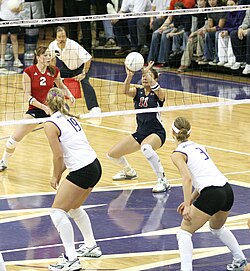
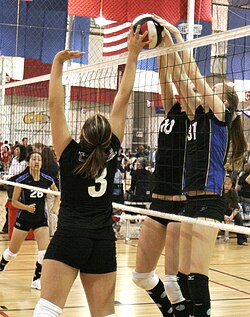
For desperate plays, a player may use a pancake, flattening their hand on the floor so the ball bounces off the back of the hand. When two opposing players push against a ball falling directly on the net, it is called a joust.
Common Defensive Errors
- Shank: An unintentional, wild pass that is unplayable.
- Over pass: A pass that accidentally goes back over the net, allowing the opponent to score.
- Double contact: A fault where a player touches the ball twice consecutively.
- Whiff: When a hitter swings and misses the ball entirely.
- Spatch: An incorrect contact during a hit that causes the ball to travel unpredictably.
Advanced Systems and Formations
Competitive volleyball utilizes specific systems to maximize the strengths of the players.
Offensive Systems
| System | Setters | Description |
|---|---|---|
| Five-One | 1 | A single setter handles every second touch regardless of position. |
| Four-Two | 2 | Two setters; the one in the front row performs the setting. |
| Six-Two | 2 | Two setters; the one in the back row sets, allowing three front-row attackers. |
| Six-Zero | None (Fixed) | No designated positions; the player in position 3 (or 2) sets. |
Defensive Formations
Teams use different setups based on the opponent's attack. Perimeter defense places players along the edges, leaving a hole in the center. Rotation defense shifts players to cover deep line shots, closing the center but leaving space over the block. The Six-back system places the middle back player deep to cover seams and high blocks, while Six-up positions them closer to the block to defend against tips.
Blocking Techniques
Blockers use shuffle blocking (keeping shoulders square and side-stepping) for simplicity, or swing blocking (turning parallel to the net and using arm momentum) to reach a greater maximum height.
Frequently Asked Questions
What is the difference between a DS and a Libero?
A Defensive Specialist (DS) is a player skilled in back-row defense and passing who can switch positions with any player on the court. A Libero is also a defensive specialist but is subject to more restrictive substitution rules.
What happens during a "let" serve?
A let serve occurs when the ball hits the net on the server's side but still crosses over and lands in the opponent's court. In modern rules, this is a legal play and results in a point if the ball lands in.
What is a "pancake" in volleyball?
A pancake is a desperation defensive move where a player slides their hand flat on the floor, palm down, so the ball bounces off the back of the hand instead of hitting the floor.
What is the "W" formation?
The "W" is a serve-receive formation common at lower levels where five players are positioned to resemble the letter W, leaving one designated setter to handle the second touch.
What does it mean to "tool" a blocker?
Tooling occurs when an attacker intentionally hits the ball off the blocker's hands or arms so that it deflects out of bounds, awarding the point to the attacking team.