Viscount Cobham: A History of the Temple, Grenville, and Lyttelton Lineages
The title of Viscount Cobham represents a complex journey through British nobility, spanning three distinct families: the Temples, the Grenvilles, and the Lytteltons. Established in the early 18th century, the title is notable for its unique legal remainders—provisions that allowed the peerage to pass to female lines and their descendants when direct male heirs were absent.
The Creation of the Title
The viscountcy was created in 1718 for Field Marshal Sir Richard Temple, who was already the 1st Baron Cobham and 4th Baronet of Stowe. As the eldest son of Sir Richard Temple, 3rd Baronet, the Field Marshal was granted three distinct titles in the Peerage of Great Britain during his career.
In 1714, he was first made Baron Cobham of Cobham in the County of Kent. In 1718, he was granted a second barony of Cobham and the title of Viscount Cobham. Crucially, these 1718 titles included a special remainder: if he died without male heirs, the titles would pass to his sister Hester and her male heirs, and failing that, to his third sister Christian (wife of Sir Thomas Lyttelton, 4th Baronet) and her male heirs.
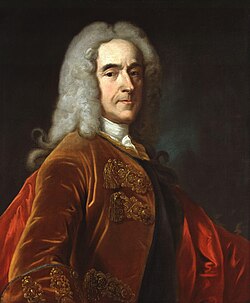
Field Marshal Lord Cobham died childless in 1749. Consequently, the 1714 barony became extinct. However, the 1718 barony and viscountcy passed to his sister Hester, while the Temple baronetcy of 1611 passed to his cousin, Sir William Temple, 5th Baronet.
The Temple Family Foundations
The Temple lineage traces back to Peter Temple of Burton Dassett. While historical theories once suggested his son Anthony founded the Irish branch of the family (leading to the Viscounts Palmerston), modern research indicates that Sir William Temple, the founder of the Irish branch, actually descended from Robert Temple of Coughton.
The family's prominence grew as Peter Temple's elder son, John Temple, acquired the Stowe estate in Buckinghamshire. His descendants served in Parliament, including Thomas Temple (created a Baronet in 1613) and Sir Peter Temple, 2nd Baronet. The lineage continued through Sir Richard Temple, 3rd Baronet, until the 4th Baronet received the Cobham titles. The Temple baronetcy eventually became dormant in 1786 upon the death of the 7th Baronet.
The Grenville Era and the Dukes of Buckingham
Following the death of the 1st Viscount Cobham, the title passed to his sister Hester, who was later created Countess Temple in 1749. Her family rose to significant political power; her younger son, George Grenville, served as Prime Minister.
The titles and the Stowe House estate were inherited by Hester's eldest son, the 2nd Earl, who assumed the surname Temple. The lineage continued to the 3rd Earl, who served as Lord Lieutenant of Ireland and was created Marquess of Buckingham in 1784. Through his marriage to Lady Mary Nugent, he also became the 2nd Earl Nugent, adding the surname Nugent to his own.
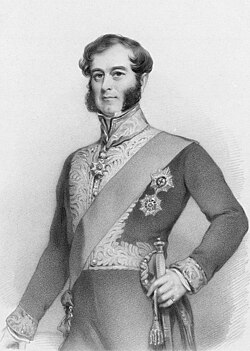
The 2nd Marquess further expanded the family's prestige. After marrying Lady Anne Eliza Brydges, he added the surnames Brydges-Chandos. In 1822, he was created Duke of Buckingham and Chandos. This era saw the family reach its zenith of titles and influence, though it also resulted in an incredibly complex heraldic history.
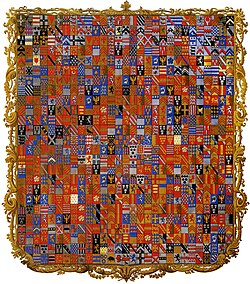
The 3rd Duke, a prominent politician and Secretary of State for the Colonies, died in 1889 without male issue. This led to the extinction of the dukedom and several subsidiary titles, including the marquessates of Buckingham and Chandos. Only the lordship of Kinloss passed to his daughter Mary, and the earldom of Temple of Stowe passed to his nephew, William Temple-Gore-Langton.
The Lyttelton Succession
Because the barony and viscountcy of Cobham were restricted to the patrilineal descendants of either Hester Temple or Christian Lyttelton, the titles reverted to the Lyttelton family in 1889. They were inherited by Charles Lyttelton, 5th Baron Lyttelton, the great-great-grandson of Lady Christian and Sir Thomas Lyttelton.
The Lyttelton family seat is Hagley Hall in Worcestershire. Since 1889, the holders of these titles have used the style of Viscount Cobham. Notable later holders include the 10th Viscount, who served as Governor-General of New Zealand from 1957 to 1962. As of 2010, the titles are held by the 12th Viscount.
Key Facts
- Origin: Created in 1718 for Field Marshal Sir Richard Temple.
- Special Remainder: Allowed the title to pass to the sisters of the 1st Viscount (Hester and Christian) in the absence of male heirs.
- Family Transitions: The title moved from the Temple family to the Grenville family and finally to the Lyttelton family.
- Extinctions: The Dukedom of Buckingham and Chandos became extinct in 1889.
- Family Seats: Historically associated with Stowe House (Buckinghamshire) and Hagley Hall (Worcestershire).
Summary of Title Transitions
| Period | Primary Family | Key Title Held | Notable Estate |
|---|---|---|---|
| 1718–1749 | Temple | Viscount Cobham | Stowe House |
| 1749–1889 | Grenville | Duke of Buckingham and Chandos | Stowe House |
| 1889–Present | Lyttelton | Viscount Cobham | Hagley Hall |
Frequently Asked Questions
Why did the title of Viscount Cobham move between different families?
The title had a special remainder in its original letters patent, which allowed it to pass to the 1st Viscount's sisters and their male heirs if he died without sons.
What happened to the Dukedom of Buckingham and Chandos?
The dukedom and several other subsidiary titles became extinct in 1889 upon the death of the 3rd Duke, who had no male heirs.
Who is the current holder of the title?
As of 2010, the titles are held by the 12th Viscount Cobham, who succeeded his elder brother in 2006.
What is the significance of Hagley Hall?
Hagley Hall in Worcestershire serves as the family seat for the Lyttelton family, the current holders of the Viscount Cobham title.
Which Prime Ministers were associated with these families?
Both George Grenville and William Wyndham Grenville (1st Baron Grenville) served as Prime Minister.