Victoria Cross: The History and Legacy of Britain's Highest Military Honor
The Victoria Cross (VC) stands as the most prestigious award for gallantry in the British honors system. Established to recognize exceptional bravery, it is a decoration that transcends military rank and social class, focusing solely on the courage of the individual. Since its inception, it has become a global symbol of selfless devotion and extreme valor in the face of the enemy.
Introduced by Queen Victoria on 29 January 1856, the medal was created to honor the heroic acts performed during the Crimean War. To date, the VC has been awarded 1,358 times to 1,355 individual recipients. Its prestige is such that it remains active today, though it is awarded far less frequently than in previous centuries; only 15 medals have been granted since the Second World War, with 11 going to the British Army and four to the Australian Army.
![Prototype Victoria Cross submitted to Queen Victoria for her approval in February 1856, now in the National Army Museum[11]](/images/ef/9e/ef9e1c185605bd039155e92b572fc9b727d885b0c97138aa0eb8120de2dc6886.jpg)
Key Facts
- Established: 29 January 1856 by Queen Victoria.
- Criteria: Awarded for acts of valour "in the face of the enemy."
- Material: Bronze (historically attributed to Russian cannons, though research suggests Chinese origins for most medals post-1914).
- Total Awards: 1,358 medals awarded to 1,355 recipients.
- Design: A bronze cross pattée featuring a lion and the crown of Saint Edward.
- Motto: "For Valour."
The Origin and Philosophy of the Award
When Queen Victoria instructed the War Office to create the medal, she insisted on a design that would not recognize birth or class. The goal was a simple decoration that would be highly prized by all military personnel, regardless of their status. Under the guidance of Prince Albert, the Queen vetoed a more formal title, "The Military Order of Victoria," opting instead for the straightforward name Victoria Cross.
The original warrant specified that the VC be awarded to officers and men who performed a signal act of valour or devotion while serving in the presence of the enemy. The first official investment ceremony took place on 26 June 1857 in Hyde Park, London, where Queen Victoria personally presented the medal to 62 of the 111 Crimean War recipients.
Design and Manufacture
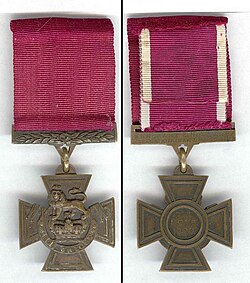
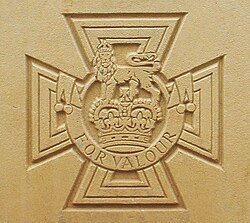
The Victoria Cross is a cross pattée (a type of Christian cross with arms that narrow toward the center) made of bronze. It measures approximately 41 mm in height and 36 mm in width. The decoration features the crown of Saint Edward surmounted by a lion, with the inscription "for valour." Interestingly, the original proposed inscription was "for the brave," but Queen Victoria requested the change because "for the brave" implied that only those who received the medal were brave.
The medal, including its suspension bar and link, weighs roughly 0.87 troy ounces (27 g). While tradition long held that the bronze was sourced from Russian cannons captured at the siege of Sevastopol, historian John Glanfield has established that most medals produced after December 1914 were actually cast from two Chinese cannons.
Ribbon Variations
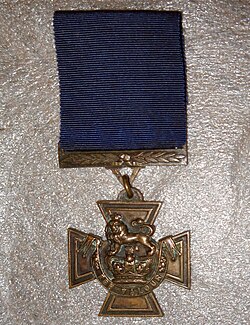
The ribbon attached to the cross is 1.5 inches (38 mm) wide and crimson. However, for naval awards issued between 1856 and 1918, a dark blue ribbon was used to distinguish naval personnel.
Evolution of Award Criteria
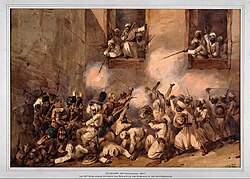
The requirements for earning a Victoria Cross have shifted over time. Between 1858 and 1881, the medal could be awarded for actions taken under "circumstances of extreme danger," even if the recipient was not facing an enemy. Only six such awards were made during this window, five of which stemmed from a single incident during an 1867 expedition to the Andaman Islands.
In 1881, the criteria were tightened, restricting the VC exclusively to acts of valour performed "in the face of the enemy." Many historians, including Lord Ashcroft, suggest that the evolving nature of modern warfare has contributed to the decreasing number of VCs awarded in recent decades.
Collections and Public Legacy
Due to its rarity and historical significance, the Victoria Cross is highly valued, with some specimens fetching over £400,000 at auction. Many medals are preserved in public and private collections. The most significant private collection is held by Lord Ashcroft, who has amassed 162 medals—more than one-tenth of all VCs ever awarded.
The Lord Ashcroft Gallery at the Imperial War Museum, which opened in 2010, displayed 210 VCs and 31 George Crosses (an award of equal stature). However, this gallery is scheduled to close on 1 June 2025, with the collection returning to Lord Ashcroft.
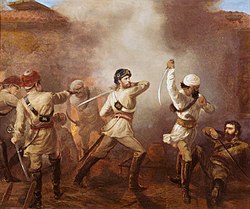
Major Museum Holdings
Numerous museums worldwide preserve these decorations to honor the bravery of the recipients.
| Museum | Location | Approximate Number of VCs |
|---|---|---|
| Lord Ashcroft Gallery (IWM) | London, UK | 210 |
| Australian War Memorial | Canberra, Australia | ~70 |
| The National Army Museum | London, UK | 39 |
| Canadian War Museum | Ottawa, Canada | 39 |
| The Rifleman's Museum | Winchester, UK | 34 |
| The Royal Engineers Museum | Kent, UK | 26 |
Frequently Asked Questions
What is the difference between the Victoria Cross and the George Cross?
While both are of equal stature, the Victoria Cross is awarded for valour in the face of the enemy, whereas the George Cross is awarded for acts of the greatest heroism or courage in other circumstances.
Is the Victoria Cross still awarded today?
Yes, the award remains active, although it is now very rare. Only 15 have been awarded since the end of the Second World War.
Where does the metal for the Victoria Cross come from?
While traditionally believed to come from Russian cannons at Sevastopol, research by John Glanfield indicates that most medals made since December 1914 were cast from two Chinese cannons.
Can a person receive more than one Victoria Cross?
Yes. While rare, bars (clasps) can be awarded to a recipient for further acts of valour.
Who is eligible to receive the Victoria Cross?
The VC is awarded to members of the military services who perform signal acts of valour or devotion while in the presence of the enemy, regardless of their rank or social class.