Vanity Height in Skyscraper Architecture
When we look at the world's most iconic skylines, we often judge a building's dominance by its highest point. However, in the world of architectural measurement, there is a significant difference between how high a building reaches and how much of that space is actually usable. This gap is known as vanity height.
Defined by the Council on Tall Buildings and Urban Habitat (CTBUH), vanity height is the vertical distance between a skyscraper's pinnacle—its highest architectural point—and its highest occupied floor. These occupied floors typically include observatories, offices, restaurants, retail spaces, or residential units. Because the CTBUH ranks the world's tallest buildings based on the height to the pinnacle, many structures climb the rankings thanks to the addition of extremely long spires rather than additional usable floors.
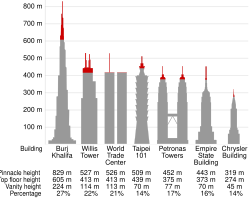
Key Facts
- Definition: Vanity height is the difference between the architectural pinnacle and the highest usable floor.
- The 50% Rule: To be classified as a "building" rather than a communications tower, vanity height must be under 50% of the total height.
- Global Averages: The top 100 tallest buildings average a vanity height of 12.6%, while "megatall" buildings average 20.2%.
- Regional Trends: The Middle East has the highest average vanity height (17.0%), while China has the lowest (10.7%).
The Impact of Vanity Height on Global Rankings
The debate over vanity height gained prominence in 1998 when the Petronas Towers were named the world's tallest buildings. This sparked controversy because their roof was actually 63.4 meters (208 ft) lower than that of the Willis Tower.
Modern megastructures continue this trend. The Burj Khalifa, currently the world's tallest building at 828 meters, has its highest usable floor at 585 meters. This results in a vanity height of 244 meters, representing 29% of the building's total height. While the Burj Khalifa would remain the tallest building even without this spire, it would only exceed the highest usable floor of the Shanghai Tower by 2 meters.
Looking toward future projects, the Jeddah Tower is planned to exceed 1,000 meters. However, its highest floor is expected to be at 630 meters. This means the top 370 meters—a distance equivalent to an 85-story building, or 37% of the total height—will be unusable. When these architectural additions are excluded, the progression of height among the world's tallest buildings appears much more modest.
Comparative Analysis of Tallest Spires
The following table illustrates how vanity height varies across some of the world's most prominent skyscrapers, highlighting the percentage of the structure that serves no functional occupancy purpose.
| Building | Architectural Top | Highest Occupied Floor | Spire Height | Vanity Height % |
|---|---|---|---|---|
| Burj Khalifa | 828.4 m | 585.4 m | 242.6 m | 29.3% |
| Merdeka 118 | 678.9 m | 502.8 m | 176.1 m | 25.9% |
| One World Trade Center | 541.3 m | 386.5 m | 154.8 m | 28.6% |
| Zifeng Tower | 450.0 m | 316.6 m | 133.4 m | 29.6% |
| Bank of America Tower | 356.8 m | 234.5 m | 131.3 m | 35.9% |
Frequently Asked Questions
What exactly is vanity height?
Vanity height is the measurement between the highest architectural point (the pinnacle) of a building and the highest floor that is actually used for a purpose, such as an office or observatory.
Why do architects include vanity height?
Spires and pinnacles are often used to increase the overall height of a building, allowing it to rank higher in global lists of the world's tallest buildings.
Can a building be too "vain" to be called a building?
Yes. According to the CTBUH, if the vanity height exceeds 50% of the total structure, it is classified as a communications tower rather than a building, making it ineligible for building height rankings.
Which region uses the most vanity height?
Based on data from September 2023, the Middle East has the highest average vanity height at 17.0%, while China has the lowest at 10.7%.
How does vanity height affect the Burj Khalifa's record?
While the Burj Khalifa is 828 meters tall, 244 meters of that is vanity height. Without it, the building would still be the tallest in the world, but only by a narrow margin of 2 meters over the Shanghai Tower's highest usable floor.