Vangidae: The Remarkable Adaptive Radiation of Vangas
The Vangidae are a diverse family of medium-sized, often shrike-like birds found across Asia and Africa. While they are distributed across these vast regions, the family is most famous for the vangas of Madagascar, from which the family derives its name (the Malagasy word for the hook-billed vanga). These birds serve as a textbook example of adaptive radiation—a process where a single ancestral species evolves into a wide array of forms to fill different ecological niches.
Key Facts
- Species Count: 40 species divided into 21 genera.
- Distribution: Primarily endemic to Madagascar, with other members in Sub-Saharan Africa and the Indomalayan realm.
- Defining Feature: Extreme variation in bill shape adapted to specific feeding habits.
- Taxonomy: Part of the superfamily Malaconotoidea, closely related to butcherbirds and woodswallows.
- Conservation: Several species are vulnerable or endangered due to habitat loss in Madagascar.
Taxonomy and Evolutionary History
Historically, the classification of vangas was a taxonomic puzzle. Many species were previously placed in other families because they resembled Old World warblers, flycatchers, or babblers. However, modern molecular techniques have resolved these enigmas, confirming that these diverse birds belong to the Vangidae family.
The family is part of a larger clade of corvid birds known as the superfamily Malaconotoidea. This group includes the bushshrikes (Malaconotidae), ioras (Aegithinidae), woodswallows (Artamidae), and the Australian butcherbirds, magpies, and currawongs (Cracticidae). They also share close ties with African groups like the helmetshrikes (Prionops) and shrike-flycatchers (Bias and Megabyas).
Beyond Madagascar, the family includes Asian groups such as the woodshrikes (Tephrodornis), flycatcher-shrikes (Hemipus), and philentomas.
Physical Characteristics
Vangas range in length from 12 to 32 cm. While they vary significantly in color and bill shape, they maintain a consistent skull shape and bony palate structure. Many species possess strong, hooked bills similar to those of shrikes, though the variations are striking:
- Helmet Vanga: Features a particularly large bill with a distinct casque on top.
- Sickle-billed Vanga: Possesses a long, curved bill designed for probing holes and cracks.
- Newtonias: Characterized by smaller, thinner bills.
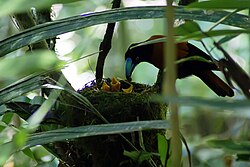
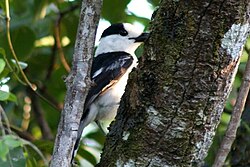
Plumage typically consists of black, brown, or grey upperparts with white underparts. Some exceptions include the blue and white blue vanga and the blue-grey nuthatch vanga. In some species, such as Bernier's vanga, there is distinct sexual dimorphism: males are entirely black, while females are brown. Most species are known for their whistling calls.
Distribution and Habitat
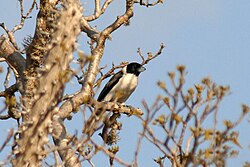
While found in Sub-Saharan Africa and the Indomalayan realm, the majority of Vangidae are endemic to Madagascar. They occupy a variety of forest and scrub environments across the island:
- Dry Deciduous Forests (West): Home to the sickle-billed vanga and Van Dam's vanga.
- Rainforests (East): Habitat for the helmet vanga, Bernier's vanga, and Crossley's vanga.
- Subarid Thorn Scrub (South-west): Where Lafresnaye's vanga and the red-shouldered vanga are found.
Behavior and Diet
The diet of vangas is primarily insectivorous, including earthworms, millipedes, lizards, and amphibians, though the chabert vanga and blue vanga occasionally consume fruit. Their foraging strategies are as diverse as their bills:
- Gleaning: Many species pick food from branches as they move.
- Climbing: The nuthatch vanga climbs up trunks and branches (though unlike true nuthatches, it does not climb downward).
- Ground Foraging: Crossley's vanga walks along the forest floor through leaf litter.
- Aerial Hunting: The tylas and chabert vangas fly into the air to capture prey.
- Bark Stripping: The three Xenopirostris vangas use laterally flattened bills to strip bark to find hidden food.
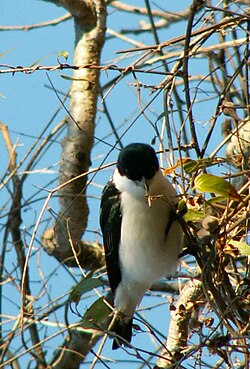
Most vangas nest in pairs, constructing cup-shaped nests from twigs, bark, roots, and leaves. A notable exception is the sickle-billed vanga, which nests in groups and builds larger structures of sticks.
Conservation Status
The conservation status of Vangidae varies by species. The chabert vanga is common and adaptable, surviving even in secondary woodlands and plantations. However, many others are threatened by the rapid loss of forest habitat in Madagascar.
| Species | Status (BirdLife International) | Primary Threat |
|---|---|---|
| Van Dam's Vanga | Endangered | Agricultural clearance and bushfires |
| Pollen's Vanga | Near-threatened | Habitat loss |
| Helmet Vanga | Vulnerable | Habitat loss |
| Bernier's Vanga | Vulnerable | Habitat loss |
| Red-shouldered Vanga | Vulnerable | Habitat loss |
| Red-tailed Newtonia | Vulnerable | Habitat loss |
Frequently Asked Questions
What is adaptive radiation in vangas?
Adaptive radiation is the evolutionary process where a single ancestral population evolves into many different species to fill various ecological niches. In vangas, this is most evident in their diverse bill shapes, which allow different species to exploit different food sources.
Where are vangas primarily found?
While some members of the Vangidae family are found in Asia and Sub-Saharan Africa, the vast majority are endemic to the island of Madagascar.
How do vangas differ from shrikes?
Although they are shrike-like in appearance and often have hooked bills, vangas belong to the superfamily Malaconotoidea. They are more closely related to butcherbirds and woodswallows than to true shrikes.
Which vanga species is most threatened?
Van Dam's vanga is classed as endangered due to its restricted range in north-west Madagascar and the rapid disappearance of its forest habitat caused by agriculture and uncontrolled fires.
Do all vangas look the same?
No, they vary significantly. While most are grey, brown, or black, some are blue. Their bills range from the massive, casqued bill of the helmet vanga to the long, curved bill of the sickle-billed vanga.