US Route 10: The Evolution of a Historic American Highway
The story of US Route 10 is a reflection of the broader evolution of American transportation. Once envisioned as a massive transcontinental artery stretching from the Pacific Northwest to the industrial heart of Detroit, the highway has undergone significant transformations, truncations, and redesignations as the Interstate Highway System rose to prominence.
From its early planning in the 1920s to its current configuration, US 10 has served as a vital link across the northern United States, adapting to the changing needs of motorists and the development of modern infrastructure.
The Origins and Early Planning
The foundation of US Route 10 began in October 1925, when the Joint Board on Interstate Highways proposed the United States Numbered Highway System. The original plan envisioned Route 10 as a sweeping journey starting in Seattle, traveling east to Minneapolis–St. Paul, heading southeast to Chicago, and finally turning northeast to terminate in Detroit.
Interestingly, the initial plan for US Route 12 was to cross US 10 near Minneapolis and utilize a ferry between Manitowoc, Wisconsin, and Ludington, Michigan. However, when the system was finalized on November 11, 1926, these designations were swapped. US 10 became the route utilizing the ferry, while US 12 was routed around the southern tip of Lake Michigan via Chicago.
The Impact of the Interstate Era
The rise of the Interstate Highway System in the 1960s fundamentally altered the trajectory of US 10. Much of its original path, particularly the stretch from Seattle to Fargo, was supplanted by I-90 and I-94.
This shift led to a series of decommissionings over several decades:
- 1970: Washington state replaced its segment of US 10 with State Route 10.
- 1977: The section running through the Idaho Panhandle and western Montana (from east of Coeur d'Alene to Wye, near Missoula) was decommissioned.
- 1986: The segment between Wye and West Fargo, North Dakota, was removed, establishing the route's current western terminus.
Legacy Routes and Alternates
Despite these changes, remnants of the old highway persist. Sections of the original road remain in cities such as Spokane, Missoula, and Bismarck. In Washington, the stretch between Cle Elum and Ellensburg continues as State Route 10 (SR 10).
Historically, the highway also featured several US 10 Alternate (US 10 Alt.) routes. Notable examples include a path from Spokane to Missoula via Sandpoint (now represented by US 2, US 93, and state highways), a route from Seattle to Everett along US 99, and the Pintler Scenic Route through Anaconda and Philipsburg, which became MT 1 in 1986.
Between 1936 and 1960, the highway even split into US 10N (passing through Helena) and US 10S (passing through Deer Lodge and Butte) to navigate the Rocky Mountains.
The Eastern Terminus and Michigan Transitions
In its early years, the eastern end of US 10 followed a complex path through Michigan. It originally traveled from Midland to Saginaw via what is now M-47, joined US 23, and eventually followed the Dixie Highway to Pontiac. From Pontiac, it traveled along Woodward Avenue (now M-1) directly into downtown Detroit, where it met US 12, US 16, and US 25.
The 1960s and 70s brought significant rerouting. The highway bypassed downtown Pontiac to the west and was later moved off Woodward Avenue onto the John C. Lodge Freeway and Telegraph Road. By 1985, the segment between Detroit and Bay City was decommissioned. This resulted in the Lodge Freeway becoming M-10 and portions of the old route becoming extensions of US 24.
The SS Badger Ferry Connection
A unique characteristic of US 10 is its integration of maritime travel. In 2015, the American Association of State Highway and Transportation Officials officially designated the SS Badger car ferry as part of the highway's official route. This makes US 10 one of only two highway routes in the United States to include a ferry connection.
Key Facts
- Original Scope: Planned to run from Seattle, Washington, to Detroit, Michigan.
- Major Replacements: Largely replaced by I-90 and I-94 starting in the 1960s.
- Unique Feature: Includes the SS Badger car ferry as an official part of the route.
- Key Transitions: The Detroit-to-Bay City segment was decommissioned in 1985.
- Mountain Routing: Once split into US 10N and US 10S between 1936 and 1960.
Route Summary Table
| Region/Segment | Original Status | Current Status/Replacement |
|---|---|---|
| Seattle to Fargo | Primary US 10 | I-90 and I-94 |
| Washington State | US 10 | State Route 10 (SR 10) |
| Idaho/Montana (Wye) | US 10 | Decommissioned (1977/1986) |
| Detroit to Bay City | US 10 | Decommissioned (1985) / M-10 / US 24 |
| Lake Michigan Crossing | Ferry Connection | SS Badger (Official Route) |
Frequently Asked Questions
Where does US Route 10 end today?
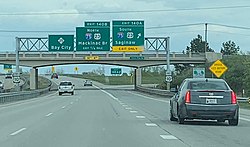
While it originally reached Detroit, the decommissioning of the segment between Detroit and Bay City in 1985 shifted its eastern terminus to Bay City, Michigan.
What happened to the western portion of US 10?
Much of the western route from Seattle to Fargo was replaced by I-90 and I-94. Washington replaced its section with State Route 10, and other segments in Idaho and Montana were decommissioned by 1986.
What is the significance of the SS Badger ferry?
The SS Badger is officially designated as part of the US 10 route, making it one of only two U.S. highways to include a ferry as part of its official designation.
What were US 10N and US 10S?
These were split designations used between 1936 and 1960 to provide two different paths across the Rocky Mountains in Montana, with US 10N passing through Helena and US 10S passing through Butte and Deer Lodge.
Does any part of the original US 10 still exist?
Yes, sections of the old road still exist in cities like Bismarck, Missoula, and Spokane, as well as the stretch between Cle Elum and Ellensburg in Washington.