United Nations Security Council
The United Nations Security Council (UNSC) is a principal organ of the United Nations, established on October 24, 1945. Tasked with the primary responsibility of maintaining international peace and security, the Council operates as the only UN body with the authority to issue binding resolutions that member states are legally obligated to follow.
From its inception following World War II, the Council has evolved through the Cold War and into the 21st century, adapting its role to address everything from interstate conflict to global terrorism and humanitarian crises.
Key Facts
- Established: October 24, 1945.
- Permanent Members (P5): China, France, Russia, United Kingdom, and United States.
- Non-Permanent Members: 10 members elected for two-year terms.
- Veto Power: Held exclusively by the five permanent members.
- Presidency: Rotates monthly among all member states.
- Primary Mandate: Maintenance of international peace and security.
Membership and Structure
The Council consists of 15 members divided into two distinct categories: permanent and non-permanent.
Permanent Members (P5)
The five permanent members were granted their status based on their roles in the aftermath of World War II. These nations possess the veto power, meaning a single negative vote from any P5 member can block the adoption of any substantive resolution, regardless of overall support.
| Country | Regional Group | Current Representation | Former Representation |
|---|---|---|---|
| China | Asia-Pacific | People's Republic of China | Republic of China (1945–1971) |
| France | Western Europe and Others | French Republic | Provisional Govt. (1945–1946) |
| Russia | Eastern Europe | Russian Federation | USSR (1945–1991) |
| United Kingdom | Western Europe and Others | United Kingdom | N/A |
| United States | Western Europe and Others | United States of America | N/A |
Non-Permanent Members
Ten non-permanent members are elected by the General Assembly for two-year terms. These seats are distributed geographically to ensure global representation:
- African States: 3 seats
- Asia-Pacific States: 3 seats
- Eastern European States: 2 seats
- Latin American and Caribbean States: 2 seats
- Western European and Other States: 5 seats
Powers and Role in Global Security
The Council's authority is derived from the UN Charter, specifically through two primary mechanisms for handling disputes.
Pacific Settlement of Disputes (Chapter VI)
Under Chapter VI, the Council focuses on the peaceful resolution of conflicts. This involves recommending procedures or methods of adjustment to parties in dispute to prevent escalation.
Threats to Peace and Enforcement (Chapter VII)
Chapter VII grants the Council significantly more power. If the Council determines there is a threat to peace, breach of peace, or act of aggression, it can authorize:
- Economic sanctions or trade embargoes.
- Diplomatic restrictions.
- Military intervention to restore international security.
Additional Responsibilities
The Council also manages International Criminal Court (ICC) referrals, allowing it to send situations to the ICC prosecutor for investigation of war crimes. Furthermore, it upholds the Responsibility to Protect, a principle asserting that the international community must intervene when a state fails to protect its population from mass atrocities.
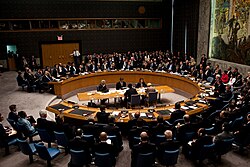
Operations and Administration
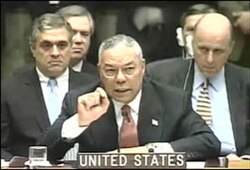
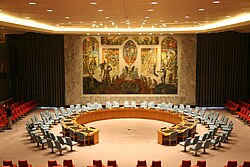
The Council meets regularly at its headquarters in New York. The meeting room is notable for its 1952 mural, Untitled (Mural for Peace) by Per Krohg.
To execute its mandates, the Council utilizes several tools:
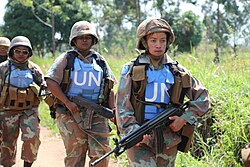
- Peacekeeping Operations: Deploying military and police personnel to maintain ceasefires and protect civilians.
- Sanctions Committees: Specialized bodies that monitor the implementation of specific sanctions.
- Counter-Terrorism Committee: A standing body dedicated to combating global terrorism.
Criticism and Proposals for Reform
The Council has faced criticism for "paralysis" caused by the frequent use of the veto by permanent members, particularly during the Cold War and in recent conflicts in Ukraine and Gaza. This has led to several reform proposals:
The G4 Proposal
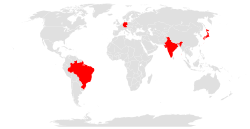
Brazil, Germany, India, and Japan (the G4) seek permanent seats on the Council to better reflect the current geopolitical reality.
Uniting for Consensus
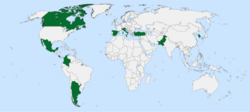
A group including Italy, Pakistan, Spain, Canada, Mexico, Argentina, and Turkey opposes the G4's bid, advocating instead for an expansion of non-permanent seats to increase democratic representation.
Other Initiatives
The African Union has proposed its own reform model, while other members have suggested veto restraint—a voluntary agreement by the P5 to not use the veto in cases of mass atrocities. Most recently, the 2024 Pact for the Future continues to address these systemic challenges.
Frequently Asked Questions
What happens if a permanent member vetoes a resolution?
If any of the five permanent members (China, France, Russia, UK, or USA) casts a negative vote on a substantive resolution, the resolution fails, regardless of how many other members voted in favor.
How are non-permanent members elected?
They are elected by the United Nations General Assembly for two-year terms, with five new members elected each year to ensure a rotating membership based on regional quotas.
What is the difference between Chapter VI and Chapter VII?
Chapter VI deals with the peaceful settlement of disputes through recommendations, while Chapter VII allows the Council to take enforcement actions, including sanctions and military force.
Who leads the Security Council?
The presidency of the Council rotates monthly among its 15 members in alphabetical order of their English names.
Can the Security Council authorize the use of force?
Yes, under Chapter VII of the UN Charter, the Council can authorize "all necessary measures," including military action, to maintain or restore international peace and security.