United Nations Headquarters: A Global Hub of Diplomacy in New York City
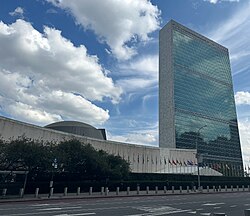
Standing as a beacon of international cooperation, the United Nations Headquarters is more than just a complex of buildings; it is a symbol of global peace and diplomacy. Located in Manhattan, New York, this architectural landmark serves as the primary center for the UN's worldwide operations, hosting delegates from member states to address the most pressing issues of our time.
The complex is situated on an international zone, meaning it possesses a unique legal status that grants it a degree of independence from the jurisdiction of the United States, ensuring that diplomats can operate freely and securely.
Key Facts
- Location: 760 United Nations Plaza, Manhattan, New York City.
- Architectural Style: Modern architecture.
- Construction Period: Groundbreaking on September 14, 1948; completed October 9, 1952.
- Total Cost: US$65 million (approximately $610 million in 2024).
- Main Structure Height: 510 feet (155.3 meters) with 39 floors.
- Legal Status: Extraterritorial international zone.
History and Design
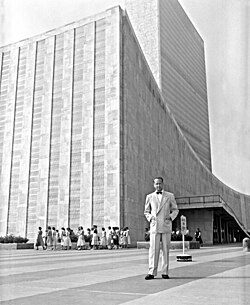
The creation of the headquarters was a massive undertaking involving a board of designers mediated by Harrison & Abramovitz. The construction was carried out by a consortium of four companies: Fuller, Turner, Slattery, and Walsh. The project aimed to create a space that reflected the forward-looking, inclusive nature of the organization.
From its early years, the site has evolved through various refurbishments to keep pace with the growing needs of the UN. The complex has also become a fixture in popular culture, appearing in various media, including the 1959 Alfred Hitchcock thriller North by Northwest.
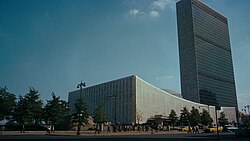
The Complex Layout
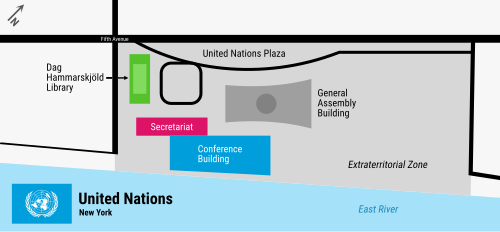
The headquarters consists of several distinct structures, each serving a specific function in the administration of global affairs.
The Secretariat Building
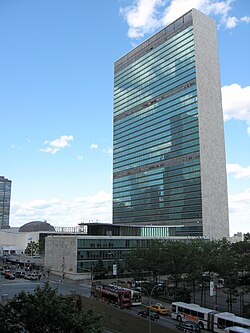
The most recognizable feature of the complex is the Secretariat, a 39-story skyscraper that houses the administrative offices of the United Nations.
The General Assembly Building
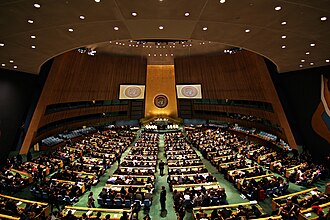
This building is the heart of the UN's deliberative process, containing the General Assembly Hall where representatives from all member states meet to vote on resolutions.
The Conference Building
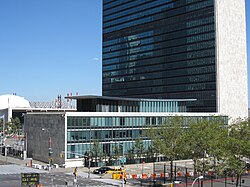
Designed to facilitate smaller meetings and specialized committees, the Conference Building provides the necessary infrastructure for diplomatic negotiations.
The Dag Hammarskjöld Library
Named after the second Secretary-General of the UN, this library serves as a vital research hub for diplomats and the public alike.
International Character and Art
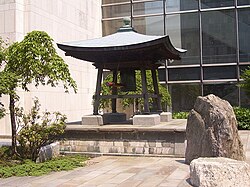
To reflect its global mission, the UN headquarters incorporates art and symbols from around the world. The grounds feature the Japanese Peace Bell, which was cast from coins donated by children from many different nations.
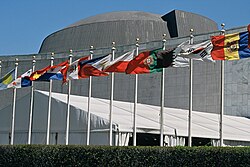
The complex also hosts an extensive art collection, including a piece of the Berlin Wall and the famous "Chagall Window." Outside, the flags of member states are flown in alphabetical order, symbolizing the equality of all nations regardless of size or power.
Summary of Headquarters Specifications
| Feature | Detail |
|---|---|
| Address | 760 United Nations Plaza, New York, U.S. |
| Groundbreaking Date | September 14, 1948 |
| Completion Date | October 9, 1952 |
| Total Height | 510 feet (155.3 m) |
| Number of Floors | 39 |
| Original Cost | US$65 million |
Frequently Asked Questions
What is the legal status of the UN Headquarters?
The headquarters is located on an international zone, granting it extraterritoriality. This means it is not subject to the domestic laws of the United States in the same way as other New York City properties, allowing it to function as an independent international territory.
Who designed the United Nations buildings?
The design was the result of a collaborative effort by a board of designers, with the process mediated by the architectural firm Harrison & Abramovitz.
What is the significance of the Japanese Peace Bell?
The Japanese Peace Bell is a symbol of global harmony, uniquely crafted from coins donated by children from various countries to promote a message of peace.
How much did the construction of the headquarters cost?
The original construction cost was US$65 million, which is equivalent to approximately $610 million in 2024 currency.
Which buildings make up the main complex?
The main complex consists of the Secretariat Building, the General Assembly Building, the Conference Building, and the Dag Hammarskjöld Library.