Peking Legation Quarter: A History of Diplomacy and Conflict in Beijing
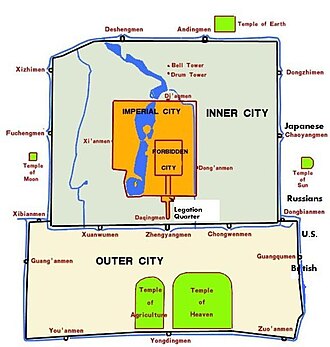
Between 1861 and 1959, a unique enclave known as the Peking Legation Quarter served as the diplomatic heart of foreign presence in Beijing, China. Known in Chinese as Dong Jiaomin Xiang (East Foreign Residents Alley), this area in the Dongcheng District, located just east of Tiananmen Square, was more than just a collection of embassies. It was a sovereign bubble where foreign diplomats, soldiers, and expatriates lived under their own laws, separate from the jurisdiction of the Chinese state.
From its origins as a concession forced upon the Qing dynasty to its role as a fortress during the Boxer Rebellion, the Legation Quarter mirrored the turbulent relationship between China and the West. Today, while many of its European-style buildings have vanished, the area remains a significant historical landmark and a tourist destination.
Key Facts
- Location: Dongcheng District, Beijing, immediately east of Tiananmen Square.
- Active Period: 1861 to 1959.
- Major Event: The 55-day Siege of the International Legations during the 1900 Boxer Rebellion.
- Governance: After 1901, the area was under exclusive foreign control, exempt from Chinese law.
- Dimensions: Approximately 1,300 meters east-to-west and 700 meters north-to-south.
- Key Landmark: St. Michael's Church (Dongjiaomin Catholic Church).
Origins and Layout of the Quarter
For years, the Chinese government resisted allowing foreign diplomats to reside in the imperial capital. This changed following the Second Opium War (1856–60), when the Convention of Peking forced the Qing dynasty to permit diplomatic representatives in Beijing. To manage these relations, the Qing government established the Zongli Yamen, a dedicated foreign office.
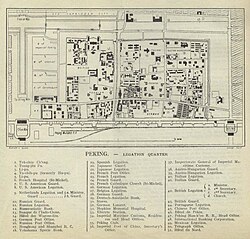
The first legations were established in 1861 and 1862, often occupying the former residences of Manchu princes. By 1900, eleven nations maintained a presence: the United Kingdom, France, Germany, Japan, Russia, Italy, Spain, Austria, Belgium, the Netherlands, and the United States.
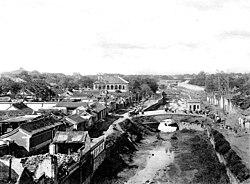
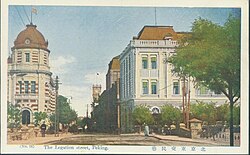
The geography of the quarter was defined by massive boundaries. To the south lay the inner city wall, known to foreigners as the "Tartar Wall," which stood 13 meters high and thick. The area was bisected from east to west by Legation Street (Dongjiaomin Xiang) and cut north-to-south by the Grand Canal. Despite the opulent palaces, the area was initially described as a dilapidated slum with unpaved roads and muddy thoroughfares.
Commercial and Social Infrastructure
Beyond diplomacy, the quarter became a hub for foreign enterprise. It hosted the Jardine Matheson trading house, the Imperial Maritime Customs offices managed by Robert Hart, the Swiss-run Hotel de Pekin, and various foreign banks and stores catering to European tastes.
The Boxer Rebellion and the 55-Day Siege
The most defining moment in the quarter's history occurred in 1900 during the Boxer Rebellion. For 55 days, the Legation Quarter was besieged by the "Boxers" (anti-foreign militants) and the Qing army. Approximately 900 foreign nationals, including 400 soldiers, took refuge inside. The siege ended on August 14, 1900, when the Eight-Nation Alliance—a multi-national military force—marched from the coast to liberate the quarter.
The aftermath was codified in the Boxer Protocol of 1901. This agreement forced China to pay a heavy indemnity and granted the foreign powers exclusive control over the Legation Quarter. The protocol allowed the area to be made "defensible," leading to the construction of a perimeter wall and a glacis (a sloped open area) to provide soldiers with a clear line of sight against attackers.
The Golden Era and Social Dynamics
Following the rebellion, the quarter entered a "golden era." It became a magnet for scholars, artists, and Sinophiles (people with a deep interest in Chinese culture) who were attracted by the city's ancient heritage and low cost of living. While Shanghai remained the primary mercantile center, Beijing's quarter was a center for aesthetics and diplomacy.
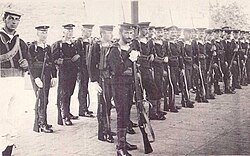
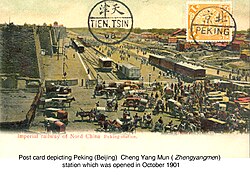
To ensure security, foreign nations stationed guards in the quarter. The United States typically provided the largest contingent, primarily consisting of Marines. These guards were tasked with preventing another siege and securing the railroad line to Tianjin, the primary escape route from China.
The Plight of the White Russians
Not all foreigners enjoyed the privileges of extraterritoriality (exemption from local laws). "White Russians," who fled to China after the Russian Civil War, often found themselves stateless after the Chinese government recognized the Soviet Union in 1924. Lacking English skills and facing ethnic prejudice, many struggled in poverty; a significant number of Russian women were forced into prostitution to survive.
World War II and the End of an Era
The stability of the quarter eroded with the rise of Japanese aggression. Following the Marco Polo Bridge Incident in 1937, Japanese forces occupied Beijing. While foreign residents initially remained undisturbed, the attack on Pearl Harbor in December 1941 changed everything. The remaining American Marine guards were captured as prisoners of war.
In February 1943, the Japanese interned the remaining civilian foreigners—including doctors, missionaries, and businessmen—at the Weixian Civilian Assembly Center, where they remained until the end of the war.
The People's Republic and Modern Legacy
After 1945, a steady outflow of foreigners occurred as the Chinese Civil War intensified. When the People's Republic of China was established in 1949, several legations remained, but by 1959, all foreign missions were relocated to Sanlitun, outside the old city walls.
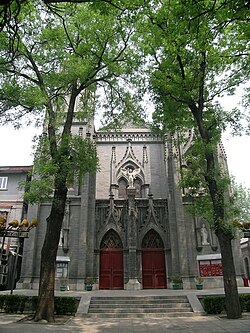
The area suffered significant damage during the Cultural Revolution and subsequent urban redevelopment. However, several landmarks survive, including the 1903 Beijing Railway Station building and St. Michael's Church.
| Feature | Details |
|---|---|
| Primary Function | Diplomatic enclave for foreign powers in Beijing |
| Key Conflict | Siege of the Legations (1900) |
| Legal Status | Extraterritorial (Foreign jurisdiction) post-1901 |
| Major Powers Present | UK, USA, France, Germany, Japan, Russia, Italy, Spain, Austria, Belgium, Netherlands |
| Modern Status | Tourist destination with protected Western-style architecture |
Frequently Asked Questions
What was the purpose of the Legation Quarter?
It served as a designated area for foreign diplomatic missions (legations) to reside and operate in Beijing, providing a centralized location for international diplomacy and a secure enclave for foreign nationals.
What happened during the 55-day siege?
During the Boxer Rebellion of 1900, the quarter was surrounded by the Qing army and Boxer militants. It was eventually liberated by the Eight-Nation Alliance, a coalition of international militaries.
Why were White Russians treated differently than other foreigners?
Unlike other Europeans or Americans, White Russians became stateless after the Chinese government recognized the Soviet Union in 1924, meaning they lost their extraterritorial privileges and became subject to Chinese law.
What is the Legation Quarter called today?
The area is known as Dongjiaomin Xiang, which translates to "East Foreign Residents Alley."
What happened to the foreign residents during World War II?
Following the Japanese occupation and the attack on Pearl Harbor, many foreign civilians were interned at the Weixian Civilian Assembly Center until the war ended.