Ulster and Delaware Railroad: A History of Catskill Mountain Transit
In the early 19th century, New York's transportation relied heavily on its vast network of waterways. A critical hub in this system was Rondout, located where Rondout Creek meets the Hudson River. By 1828, it served as the eastern terminus of the Delaware and Hudson Canal, acting as a vital transfer point where cargo and passengers moved from canal boats to larger Hudson River vessels.
However, by the end of the American Civil War, railroads began to replace waterways as the primary mode of transport. Thomas Cornell, founder of the Cornell Steamboat Company, recognized this shift. To bring supplies from central and western New York to his port at Rondout, Cornell chartered the Rondout and Oswego Railroad on April 3, 1866.
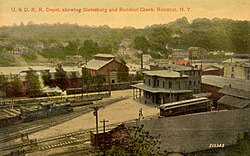
The Rondout and Oswego Railroad
Construction began in 1868 using 62- and 70-pound rail. The ambitious plan was to connect Rondout to Oneonta on the upper Susquehanna River, and eventually reach Oswego on the shore of Lake Ontario. The line first reached the resort of Olive Branch near Shokan on September 30, 1869, and became fully operational the following year.
The railroad expanded rapidly: it reached Phoenicia in 1870 and Big Indian shortly after under the ownership of John C. Brodhead. By 1871, the tracks reached Dean's Corners (now known as Arkville). Despite this growth, the company struggled financially upon reaching Roxbury, leading to its collapse and reorganization as the New York, Kingston & Syracuse (NYK&S).
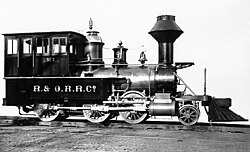
Economic Drivers and Challenges
The railroad initially thrived by transporting passengers from steamboats at Rondout and connecting with other lines in Kingston, such as the Wallkill Valley Railroad (1872) and the West Shore Railroad (1883). Freight was equally important, with significant income generated from coal shipped from the Moosic Mountains of Pennsylvania, as well as local Catskill produce like milk, fruit, and vegetables.
Despite this, the geography of the region proved costly. The high number of steep grades and sharp curves required excessive digging and materials. By 1872, the company could not service its debts. Even after John A. Greene was appointed president pro tempore to clear debts and reach Oneonta by 1874, the railroad continued to lose money and eventually declared bankruptcy.
The New York, Kingston and Syracuse Railroad
Following the 1872 bankruptcy, George Sharpe directed the reorganized New York, Kingston and Syracuse Railroad (NYK&S). The original goal of reaching Oswego was abandoned in favor of a route to Oneonta, with a northward turn toward Earlville to connect with the Syracuse and Chenango Valley Railroad.
This era marked the first true rail access into the Catskill Mountains. Enhanced connectivity allowed travelers from New York City to visit the region via the Erie Railroad. Additionally, a ferry from Rhinecliff connected the line to the New York Central and Hudson River Railroad, linking the Catskills to major cities like Boston, Providence, and Hartford.

Kingston became a profitable hub due to its local industries, specifically the production of bluestone, bricks, concrete, and cement. However, the NYK&S remained financially unstable. After a brief period of trust management by the Farmers Loan and Trust Company starting in 1873, the railroad failed again in 1875. It was sold via foreclosure and reorganized as the Ulster and Delaware Railroad.
The Stony Clove and Catskill Mountain Railroad
Thomas Cornell later envisioned a secondary line starting at the junction in Phoenicia and heading up the Stony Clove Valley to Hunter. This venture, the Stony Clove and Catskill Mountain Railroad, utilized a narrow gauge (3 ft / 914 mm) track to reduce construction and operating costs.
Supervised by Samuel Decker Coykendall, construction began in 1881. While originally intended as a seasonal summer service for communities like Lanesville, Edgewood, and Chichester, it eventually expanded to year-round operations. The line served several key industries, including the Fenwick Lumber Company and the furniture factories of William O. Schwartzwalder and Horatio Lockwood.
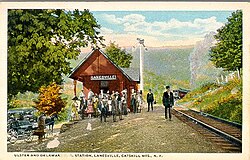
Overcoming Gauge Differences
Because the Stony Clove line used narrow gauge and the main U&D line used standard gauge, transferring rolling stock was difficult. To solve this, the companies installed a Ramsey car-transfer apparatus at the Phoenicia yard in 1882. This innovative device allowed standard-gauge equipment to operate on narrow-gauge tracks in just eight minutes. The U&D eventually acquired the Stony Clove line in 1892.
The Decline and Final Years of Service
The Ulster and Delaware reached its zenith in 1913, transporting 676,000 passengers and vast quantities of freight. However, the rise of the automobile, improved highways, buses, and "hacks" (shared limousines) eroded passenger numbers. Trucks similarly took over the non-commodity freight business.
Facing severe financial distress, the U&D was acquired by the New York Central on February 1, 1932. By the early 1950s, service had dwindled to a single daily train in each direction between Kingston and Oneonta. Passenger service officially ended on March 31, 1954.
Key Facts
- Founding: Started as the Rondout and Oswego in 1866 by Thomas Cornell.
- Peak Traffic: Carried 676,000 passengers in 1913.
- Technical Innovation: Used a Ramsey car-transfer apparatus to bridge standard and narrow gauge tracks.
- Key Industries: Transported coal, bluestone, cement, and furniture.
- Final Closure: Passenger service ceased on March 31, 1954.
| Entity Name | Period | Primary Goal/Outcome |
|---|---|---|
| Rondout and Oswego | 1866–1872 | Connect Rondout to Oswego; ended in bankruptcy. |
| New York, Kingston & Syracuse | 1872–1875 | Connect to Oneonta and Earlville; ended in foreclosure. |
| Ulster and Delaware | 1875–1932 | Mainline Catskill service; acquired by New York Central. |
| Stony Clove & Catskill Mountain | 1881–1892 | Narrow gauge service to Hunter; acquired by U&D. |
Frequently Asked Questions
Why did the Rondout and Oswego Railroad fail?
The railroad faced immense costs due to the difficult geography of the region. The high number of steep grades and sharp curves required more digging, ties, and rails than anticipated, leading to debts the company could not repay.
What was the purpose of the Ramsey car-transfer apparatus?
It was used at the Phoenicia yard to allow standard-gauge railroad cars from the U&D mainline to be transferred onto the narrow-gauge tracks of the Stony Clove and Catskill Mountain Railroad, reducing transfer time to about eight minutes.
Which industries relied on the railroad in the Kingston area?
The railroad was vital for the transport of heavy materials produced in Kingston, including cement, concrete, bricks, and bluestone.
How did the rise of the automobile affect the U&D?
Private cars, improved highways, buses, and shared limousines (hacks) diverted passengers away from the rail line, while trucks took over the majority of the non-commodity freight business, leading to financial decline.
When did passenger service officially end on the route?
Passenger service on the Ulster and Delaware route ended on March 31, 1954.