Lincolnshire Coast Light Railway: From Potato Farms to Tourist Attraction
The Lincolnshire Coast Light Railway (LCLR) represents a unique chapter in British industrial and leisure history. What began as a functional network for agricultural transport has evolved into a cherished heritage attraction, preserving the legacy of the narrow-gauge railways that once crisscrossed the Lincolnshire countryside.
The Origins: The Nocton Estate Light Railway
The roots of the LCLR lie in the Nocton Estate Light Railway, which was among the largest of the "potato railways" in Lincolnshire. These industrial rail networks were essential for transporting produce across vast farm estates during the early twentieth century. At its peak, the Nocton network was extensive, featuring over 30 miles of track.
As agricultural technology advanced after the Second World War, the introduction of tractors reduced the reliance on rail transport. By 1960, portions of the network were abandoned, and the remaining sections were fully closed by 1969.
The Cleethorpes Era (1960–1985)
In April 1960, railway enthusiasts acquired track and rolling stock from the potato farms to create a tourist attraction. Leased from the Grimsby Rural District at Humberston, near Cleethorpes, the Lincolnshire Coast Light Railway officially opened on 27 August 1960. It holds the distinction of being the first heritage railway in the world built on a greenfield site (land that has never been developed).
The initial service utilized a Motor Rail "Simplex" locomotive and a single open bogie carriage converted from a wagon. The line connected the Humberston bus terminus to the beach and the Humberston Fitties holiday camp.
Throughout the 1960s, the railway expanded its fleet. In 1961, a second Motor Rail locomotive and the steam locomotive Jurassic arrived. The railway also integrated restored vehicles from the Sand Hutton Light Railway and the Ashover Light Railway. By 1964, the line was a popular destination, carrying 60,000 passengers annually.
Operational changes occurred in 1966 when the line was rebuilt on a new alignment. While the steam locomotive Elin was added, it proved too heavy for the lightweight track. Following an accident, the Railway Inspectorate mandated the installation of air brakes and run-round loops—sections of track that allow a locomotive to move from one end of a train to the other—to ensure the engine always led the train.
The railway also preserved artifacts from the Great Northern Railway, including "somersault" signals at North Sea Lane station and platform furniture from the East Lincolnshire Railway.
Challenges and Closure at Humberston
The early 1980s saw a surge in traffic due to Sunday car boot sales at the Fitties holiday camp, often requiring all three covered carriages to be in use. However, midweek traffic plummeted outside the summer season.
Two major factors led to the site's demise: the 1984 miners' strike, which reduced holidaymaker numbers, and a council requirement to install 6-foot-high (1.8 m) fences. These fences would have created a "cage-like" environment for passengers in the low-slung coaches. Consequently, the railway closed in September 1985, and the track was lifted.
Preservation and the Move to Skegness
Following the closure, the locomotive Jurassic visited the Leighton Buzzard Light Railway in 1986, while other equipment was stored near the former Burgh-le-Marsh railway station. In 1983, the Lincolnshire Coast Light Railway Historic Vehicles Trust was formed to preserve ex-Nocton War Department Light Railways rolling stock.
In 1992, the LCLR was offered a new location at the Skegness Water Leisure Park. After a period of development and storage, a new line was constructed and officially opened on 3 May 2009.
The Trust has since focused on accessibility and restoration. In 2015, using a £43,400 grant from ITV's "Peoples Millions" competition, the Trust converted an ex-Nocton Class D bogie wagon into a disabled-friendly passenger vehicle. This coach features safety rails, a specialized loading door, and seating designed to look like World War I ammunition boxes. To support this, the platform at Wall's Lane (formerly Lakeview) was upgraded for disabled access and two-coach trains.
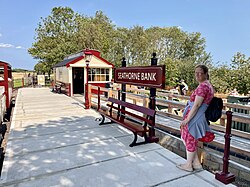
The Peckett locomotive Jurassic returned to service in September 2017 after a "Back to Steam" appeal and the installation of air brakes. Most recently, on 28 June 2025, the Mayor of Skegness, Cllr. Jimmy Brookes, opened the second station at Seathorne Bank, allowing passengers to board and alight at both ends of the line.
Key Facts
- Origin: Derived from the Nocton Estate Light Railway, a potato farm network exceeding 30 miles.
- World First: The first heritage railway built on a greenfield site.
- Key Locomotives: Includes the steam locomotive Jurassic and Motor Rail "Simplex" engines.
- Modern Location: Currently operates at the Skegness Water Leisure Park.
- Accessibility: Features a specially converted Class D wagon for disabled passengers.
| Year | Event | Location |
|---|---|---|
| 1960 | Railway opens on 27 August | Humberston |
| 1964 | Passenger traffic reaches 60,000 per year | Humberston |
| 1985 | Railway closes in September | Humberston |
| 1992 | Offered new home at Water Leisure Park | Skegness |
| 2009 | New line opens on 3 May | Skegness |
| 2017 | Locomotive Jurassic returns to service | Skegness |
| 2025 | Seathorne Bank station opens | Skegness |
Frequently Asked Questions
What were "potato railways"?
Potato railways were industrial narrow-gauge rail networks used across Lincolnshire farms during the twentieth century to transport produce, such as the Nocton Estate Light Railway.
Why did the railway close at the Humberston site in 1985?
The closure was caused by a decline in traffic following the 1984 miners' strike and a council requirement to install 6-foot-high fences that would have ruined the passenger experience.
What is special about the disabled-friendly coach?
Converted from an ex-Nocton Class D bogie wagon, it was funded by a £43,400 grant from the "Peoples Millions" competition and features seating resembling WWI ammunition boxes.
Which steam locomotive is central to the LCLR?
The Peckett locomotive named Jurassic is a primary piece of rolling stock, having been restored and returned to service in September 2017.
Where is the railway located today?
The railway is currently located at the Skegness Water Leisure Park, with stations including Wall's Lane and Seathorne Bank.