Tūī: The Iridescent Voice of New Zealand's Forests
The tūī (Prosthemadera novaeseelandiae) is one of New Zealand's most iconic and charismatic birds. A medium-sized member of the Australasian honeyeater family (Meliphagidae), this endemic passerine is renowned for its complex songs, iridescent plumage, and distinctive white throat tufts. From the subtropical Kermadec Islands to the sub-Antarctic Auckland Islands, the tūī is a widespread presence across the New Zealand archipelago.
Key Facts
- Scientific Name: Prosthemadera novaeseelandiae
- Conservation Status: Least Concern (IUCN 3.1)
- Distinctive Feature: Two white throat tufts known as poi.
- Diet: Primarily nectar, supplemented by fruit, insects, pollen, and seeds.
- Key Role: Primary pollinator for New Zealand flax, kōwhai, and kaka beak.
- Vocal Ability: Capable of imitating human speech and complex environmental sounds.
Taxonomy and History
European records of the tūī began in 1770 during Captain James Cook's first voyage to the Pacific. Cook described the bird as a "poly-bird" or "poe-bird," even noting that its flesh was a luxury provided by the woods. Early naturalists struggled with its classification; Peter Brown referred to it as the "New Zeland creeper" in 1776, and John Latham called it the "poë bee-eater" in 1782.
The formal binomial name Merops novaeseelandiae was coined in 1788 by German naturalist Johann Friedrich Gmelin. By 1840, English zoologist George Gray introduced the genus Prosthemadera, a name derived from the Ancient Greek prosthema ("appendage") and dera ("neck").
Today, two subspecies are recognized: the nominate P. n. novaeseelandiae, found across the main islands and satellites, and P. n. chathamensis, which is larger and heavier, endemic to the Chatham Islands.
Physical Description
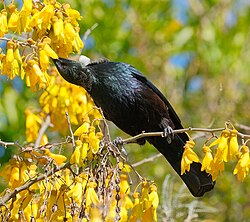
Measuring between 27 and 32 cm in length, the tūī appears black at a distance. However, closer inspection reveals a sophisticated palette of blue, green, and bronze iridescent sheens that shift with the light. They possess brown feathers on their flanks and back, and a lacy collar of white-shafted feathers on the neck.
The most striking feature is the pair of white throat tufts (poi). Due to this appearance, early colonists referred to the bird as the "parson bird," as the white tufts resembled clerical attire.
Distribution and Habitat
Tūī are found throughout New Zealand, with strong populations in the North Island and the coasts of the South Island. They prefer low-altitude broadleaf forests but have been recorded as high as 1,500 metres. They are highly adaptable, thriving in remnant forest patches, exotic plantations, and well-vegetated urban areas, such as Wellington.
While the species is currently secure, populations suffered declines following European settlement due to habitat loss and predation by invasive mammals, including brushtail possums, cats, stoats, and rats. The common myna also competes with tūī for food resources.
Behavior and Ecology
Tūī are known for their territoriality and aggression. Males, in particular, will chase other birds—including larger species like the kākā parrot—away from favored feeding trees using loud flapping and intimidating displays. In the hierarchy of New Zealand honeyeaters, the tūī typically dominates the subordinate New Zealand bellbird.
Their flight is loud and maneuverable, characterized by short, wide wings. During the breeding season in September and October, males perform a dramatic mating display involving a rapid vertical climb followed by a powered dive.
Feeding and Coevolution
The tūī's diet consists mainly of nectar, though they also eat fruit and insects. They have a particular fondness for New Zealand flax; the nectar can sometimes ferment, causing the birds to fly in a disoriented, "drunk" manner. This relationship is a prime example of mutualistic coevolution, where the shape of the tūī's beak has evolved to match the flowers of the flax, kōwhai, and kaka beak, making the tūī their primary pollinator.
Breeding and Nesting
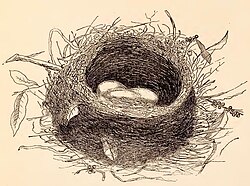
Nests are shallow, untidy cups made of twigs, grasses, and mosses. While both sexes contribute, the female performs most of the construction and is the sole incubator of the eggs (typically a clutch of four) for 14 days. Both parents feed the nidicolous chicks (young that remain in the nest) until they fledge after approximately 20 days.
Vocalizations and Intelligence
The tūī is one of the most complex singers in the avian world. Their calls combine bellbird-like notes with clicks, cackles, groans, and wheezing sounds. Because they are passerines, they possess nine pairs of muscles controlling their syrinx (the sound-producing organ), allowing them to produce two sounds simultaneously.
Their intelligence is reflected in their ability to imitate sounds. Beyond natural calls, tūī have been known to replicate human speech, car alarms, glass shattering, and even classical music.

Summary Table: Tūī Species Overview
| Feature | P. n. novaeseelandiae | P. n. chathamensis |
|---|---|---|
| Distribution | Mainland NZ, Kermadecs, Auckland Is. | Chatham Islands |
| Male Weight | 65–150 g | 89–240 g |
| Female Weight | 58–105 g | 89–170 g |
| Relative Size | Standard | Larger and Heavier |
Frequently Asked Questions
Why is the tūī called the "parson bird"?
Early European colonists gave it this name because the white tufts of feathers on its throat resembled the white clerical collars worn by parsons.
What is the relationship between the tūī and the New Zealand bellbird?
They are the two living species of the honeyeater family in New Zealand. Genetic analysis shows they diverged from a common ancestor approximately 5 million years ago. In nature, tūī are generally dominant and will often chase bellbirds away from food sources.
How does the tūī help the New Zealand environment?
Tūī act as primary pollinators for several native plants, including the kōwhai and New Zealand flax, through a mutualistic relationship where the bird receives nectar and the plant is pollinated.
Can tūī actually talk?
Yes, tūī have a highly developed syrinx and are capable of clear imitation. They can replicate human speech, as well as various mechanical and musical sounds.
What threats do tūī face today?
The primary threats are habitat destruction and predation by introduced mammalian species, such as stoats, rats, cats, and brushtail possums, which prey on eggs and chicks.