Tube Feet: The Hydraulic Powerhouses of Echinoderms
In the diverse world of marine life, echinoderms—such as starfish, sea urchins, and sea cucumbers—possess one of nature's most unique biological tools: tube feet. Technically known as podia, these small, active tubular projections are essential for survival, allowing these creatures to navigate the ocean floor, capture food, and breathe.
These structures are not independent organs but are integral components of the water vascular system, a complex network of hydraulic canals unique to this phylum of animals. While they are most prominent on the oral face (the underside) of the animal, their form and function vary across different species.
Key Facts
- Function: Used primarily for locomotion, feeding, and respiration.
- Mechanism: Operated via hydraulic pressure rather than suction.
- Adhesion: They use a chemical adhesive to stick to surfaces.
- Anatomy: Each foot consists of a water-filled sac (ampulla) and a protruding tube (podium).
- Distribution: Found in starfish, sea urchins, sand dollars, sea cucumbers, brittle stars, and feather stars.
How Tube Feet Work: Structure and Mechanics
The operation of a tube foot is a marvel of biological engineering, relying on the movement of water to create motion. Each individual tube foot is composed of two primary parts: the ampulla and the podium.
The Ampulla
The ampulla is a water-filled sac located inside the animal's body. It is equipped with both circular and longitudinal muscles. When these muscles contract, they squeeze water out of the sac and push it into the connected podium.
The Podium
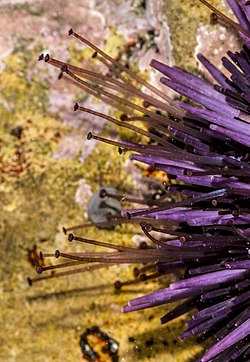
The podium is the external, tube-shaped structure that extends from the body. Unlike the ampulla, it contains only longitudinal muscles. When water is forced into the podium, it elongates, extending the foot outward. Conversely, when the muscles in the podium contract, water is pushed back into the ampulla, causing the podium to shorten.
Contrary to common belief, these feet do not work like suction cups. Instead, they utilize a chemical adhesive to bond securely to the substratum (the surface they are touching).
Diverse Applications Across Species
While the basic hydraulic mechanism is the same, different echinoderms have adapted their podia for specific ecological roles.
Starfish and Brittle Stars
In starfish, tube feet are arranged in grooves along the arms. They are used to move slowly across the seabed and to transport food toward the oral mouth at the center of the body. Interestingly, if a starfish is flipped over, it can use its tube feet to attach one arm to a solid surface and lever itself back into the correct position. In brittle stars, the podia are more discreet, while in feather stars, they serve exclusively for feeding.
Sea Urchins and Sand Dollars
Sea urchins and sand dollars use their podia for movement and attachment. Some species have evolved particularly powerful versions of these structures. For example, the shingle urchin (Colobocentrotus atratus) possesses some of the most powerful podia of all echinoderms, while collector urchins (Tripneustes gratilla) are known for their elongated podia.
Sea Cucumbers
Sea cucumbers (such as Holothuria forskali) also utilize podia on their oral face to navigate the ocean floor and interact with their environment.
The nail starfish (Mithrodia clavigera) is another example of an animal with exceptionally strong podia, highlighting the evolutionary diversity of this hydraulic system.
Summary of Podia Characteristics
| Animal Group | Primary Function | Notable Feature |
|---|---|---|
| Starfish | Locomotion, Feeding | Arranged in grooves along arms |
| Sea Urchins | Locomotion, Attachment | Powerful adhesion (e.g., Shingle Urchin) |
| Sea Cucumbers | Locomotion | Located on the oral face |
| Brittle Stars | General Utility | More discreet than in starfish |
| Feather Stars | Feeding | Specialized feeding function only |
Frequently Asked Questions
Do tube feet work like suction cups?
No. While they allow animals to stick to surfaces, they do not use suction. Instead, they employ a chemical adhesive to attach to the ocean floor or other surfaces.
What is the difference between the ampulla and the podium?
The ampulla is the internal, water-filled sac that acts as the pump, while the podium is the external tube that extends and contracts to provide movement and attachment.
How does a starfish use tube feet to flip itself over?
An inverted starfish will turn one of its arms over, use the tube feet to attach that arm to a solid surface, and then use that point of leverage to pull its body back into the upright position.
Which echinoderm has some of the strongest tube feet?
The shingle urchin (Colobocentrotus atratus) is noted for having among the most powerful podia of all echinoderms.
What is the water vascular system?
The water vascular system is a network of hydraulic canals unique to echinoderms that powers the operation of the tube feet through water pressure.