Triple Alliance: The Complex Military Pact of the Pre-War Era
The Triple Alliance was a pivotal defensive military agreement formed in the late 19th century, binding Germany, Austria-Hungary, and Italy in a mutual security pact. Established on May 20, 1882, this alliance sought to reshape the balance of power in Europe, creating a formidable bloc to counter the influence of other great powers, most notably France. While it appeared strong on paper, the alliance was fraught with internal contradictions and secret diplomatic maneuvers that eventually led to its collapse during the outbreak of World War I.
Key Facts
- Formation Date: May 20, 1882.
- Primary Members: Germany, Austria-Hungary, and Italy.
- Secret Member: Romania (joined October 18, 1883).
- Core Purpose: Mutual defense against attacks by other great powers.
- Duration: 1882 until its expiration in 1915.
- Outcome: Italy and Romania remained neutral at the start of WWI; Italy later joined the Allied Powers.
The Foundations of the Alliance
The Triple Alliance did not emerge in a vacuum but was an expansion of the Dual Alliance, a close military bond between Germany and Austria-Hungary established on October 7, 1879. The architect of this system was German Chancellor Otto von Bismarck, whose primary objective was to maintain the European status quo following the unification of Germany in 1871. Bismarck feared that France, seeking to reclaim the lost territories of Alsace-Lorraine, would find powerful allies. By bringing Austria-Hungary and Italy into a formal pact, he aimed to isolate France and make the other members dependent on German leadership.
Italy's decision to join was driven by a mix of ideological alignment and colonial frustration. The Italian government, then controlled by conservatives, sympathized with the monarchies of Germany and Austria-Hungary. More urgently, Italy felt betrayed by France after the French conquest of Tunisia in 1881—an event the Italian press dubbed the "Slap of Tunis." Seeking protection and support for its own overseas ambitions, Italy set aside its historical enmity with Austria-Hungary to join the bloc.
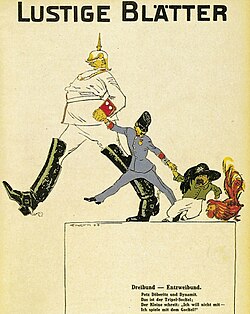
Terms and Internal Tensions
The treaty stipulated that members would provide mutual support if attacked by another great power. Specifically, Germany and Austria-Hungary promised to assist Italy if it were attacked by France without provocation, and Italy promised the same to Germany. However, a critical caveat existed: if war broke out between Austria-Hungary and Russia, Italy was only required to remain neutral.
Despite the formal agreement, the alliance was plagued by deep-seated mistrust, particularly between Italy and Austria-Hungary. Italy's irredentists—nationalists seeking to reclaim Italian-populated districts in Trentino and Istria—viewed these areas as occupied by Austria-Hungary. Conversely, the Austro-Hungarian General Staff maintained contingency plans for a war against Italy as early as 1903.
The Role of Romania
On October 18, 1883, Romania secretly pledged its support to the Triple Alliance. Under King Carol I, a member of the German Hohenzollern Dynasty, Romania sought protection against Russian expansion into Romanian-inhabited regions, such as Bessarabia. This alignment remained a closely guarded secret, known only to the King and a few senior politicians, and was further complicated by Romania's friction with Austria-Hungary over the status of Romanians in Transylvania.
Diplomatic Shifts and the Road to War
As the 20th century progressed, the Triple Alliance began to fray. In 1902, Italy secretly entered into an agreement with France to remain neutral in the event of an attack on either party, effectively hedging its bets. Italy also engaged in the Racconigi Bargain of 1909 with Russia, where Italy acknowledged Russian interests in the Turkish Straits (the Bosporus and Dardanelles) in exchange for Russian recognition of Italian claims in Tripoli and Cyrenaica.
The tension peaked during the Balkan crises. While the alliance required members to consult one another before changing the status quo in the Balkans, Austria-Hungary's unilateral annexation of Bosnia and Herzegovina in 1908 strained these relations. By the time World War I erupted in August 1914, the alliance was a shell of its former self.
| Member | Primary Motivation | Key Conflict/Tension | WWI Outcome |
|---|---|---|---|
| Germany | Isolate France; maintain status quo | Fear of encirclement by Entente | Core of Central Powers |
| Austria-Hungary | Counter Russian influence in Balkans | Territorial disputes with Italy | Core of Central Powers |
| Italy | Protection against France; colonial gains | Irredentism (Trentino/Istria) | Joined Allied Powers (1915) |
| Romania | Fear of Russian expansion | Transylvanian representation | Joined Allied Powers (1916) |
The Collapse of the Pact
When Austria-Hungary declared war in 1914, Italy proclaimed its neutrality, arguing that Austria-Hungary was the aggressor and therefore the defensive nature of the alliance did not apply. After negotiating with both the Triple Alliance and the Triple Entente (the opposing bloc of France, Britain, and Russia), Italy eventually declared war on Austria-Hungary in 1915.
Romania followed a similar path. Despite its secret pledge, it remained neutral in 1914 for the same reason as Italy: Austria-Hungary had taken the offensive. By 1916, Romania joined the conflict against the Central Powers, rendering the original Triple Alliance completely defunct.
Frequently Asked Questions
Why did Italy join the Triple Alliance if it disliked Austria-Hungary?
Italy's primary motivation was a desire for protection against France, especially after France seized Tunisia in 1881. Additionally, the Italian government at the time was led by conservatives who shared ideological ties with the German and Austro-Hungarian monarchies.
What was the "Slap of Tunis"?
The "Slap of Tunis" was a term used by the Italian press to describe the French conquest of Tunisia in 1881. Italy had viewed Tunisia as a potential colony, and the French takeover was seen as a major diplomatic and colonial insult.
Was Romania an official member of the Triple Alliance?
Romania was a secret ally. On October 18, 1883, King Carol I pledged support to the alliance, but this arrangement was kept hidden from the public and most politicians to avoid diplomatic complications.
How did the Triple Alliance differ from the Central Powers?
The Triple Alliance was the pre-war diplomatic agreement (1882–1915) between Germany, Austria-Hungary, and Italy. The Central Powers were the actual wartime coalition (1914–1918) consisting primarily of Germany, Austria-Hungary, the Ottoman Empire, and Bulgaria, after Italy had defected.
Why did Italy eventually leave the alliance to join the Allies?
Italy viewed Austria-Hungary as the aggressor in the 1914 conflict, which voided the defensive obligations of the treaty. Through negotiations with the Triple Entente, Italy was offered territorial gains that outweighed its commitment to the Triple Alliance.