Trident Mission: A Proposed Journey to Neptune's Moon Triton
The outer reaches of our solar system hold some of the most intriguing mysteries in planetary science, with Neptune's largest moon, Triton, standing as a primary target for exploration. The Trident mission was a proposed scientific endeavor designed to return to this distant world to investigate its active geology and potential for habitability.
Since the only previous encounter with the system by Voyager 2 in 1989, scientists have been eager to determine how Triton has evolved. Trident aimed to capitalize on a rare celestial alignment to provide a modern, high-resolution look at this enigmatic moon.
Key Facts
- Primary Target: Triton, a moon of Neptune.
- Principal Investigator: Louise Prockter, Director of the Lunar and Planetary Institute.
- Proposed Launch: October 2025 (with a backup in October 2026).
- Encounter Date: 2038.
- Proposed Launch Vehicles: Atlas V 401 or the Vulcan rocket.
- Closest Approach: Within 500 km (310 mi) of Triton's surface.
Mission Strategy and Orbital Mechanics
Reaching the outer solar system requires immense energy and precise timing. The Trident mission was designed to utilize a gravity assist—a maneuver where a spacecraft uses the gravitational pull of a planet to alter its path and increase its speed—via Jupiter. This specific alignment between Earth and Jupiter occurs only once every 13 years, creating a narrow window for launch.
By using Jupiter as a gravitational slingshot, the spacecraft would have been propelled toward Neptune, culminating in an extended 13-day encounter with Triton in 2038.
Scientific Objectives and Instrumentation
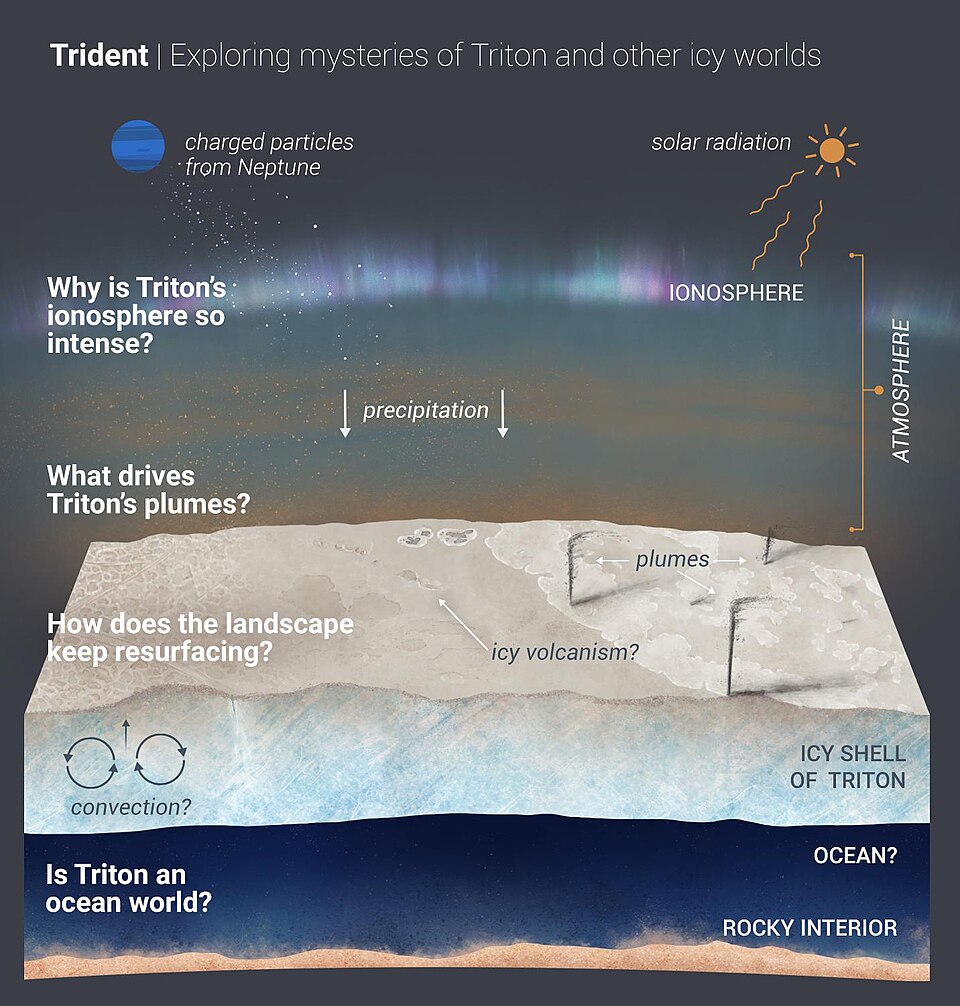
The primary goal of Trident was to assess changes in Triton's surface characteristics and plume activity (jets of gas and dust erupting from the surface) since the 1989 Voyager 2 flyby. Thanks to advances in high-resolution imaging and a unique orbital configuration in 2038, the mission aimed to produce a near-complete map of the moon.
The mission's trajectory was planned to take the spacecraft directly through Triton's thin atmosphere. During this close approach, Trident would have employed two critical instruments:
- Plasma Spectrometer: Used to sample the ionosphere, the ionized part of the upper atmosphere.
- Magnetic Induction Measurements: Used to detect and assess the potential existence of a subsurface internal ocean.
Mission Summary Table
| Feature | Detail |
|---|---|
| Target Body | Triton (Neptune Moon) |
| Launch Window | October 2025 / October 2026 |
| Flyby Year | 2038 |
| Flyby Distance | < 500 km |
| Key Instruments | Plasma spectrometer, Magnetic induction sensors |
| Lead Institution | Lunar and Planetary Institute |
Frequently Asked Questions
Why was the launch window limited to every 13 years?
The mission relied on a specific alignment of Earth and Jupiter to perform a gravity assist, which is necessary to reach Neptune efficiently. This alignment only occurs in this configuration once every 13 years.
What was the purpose of passing through Triton's atmosphere?
Passing through the atmosphere allowed the spacecraft to sample the ionosphere using a plasma spectrometer and get close enough to the surface to perform magnetic induction measurements.
What is the significance of the 1989 Voyager 2 encounter?
Voyager 2 provided the first and only close-up data of Triton. Trident was designed to compare new data against these 1989 observations to see how the moon's plumes and surface have changed over decades.
How would Trident detect an internal ocean?
The mission planned to use magnetic induction measurements, which can reveal the presence of a conductive liquid layer, such as a salty internal ocean, beneath the moon's icy crust.
Who led the Trident mission proposal?
The principal investigator was Louise Prockter, who serves as the director of the Lunar and Planetary Institute in Houston, Texas.