Miranda: The Geologically Chaotic Moon of Uranus
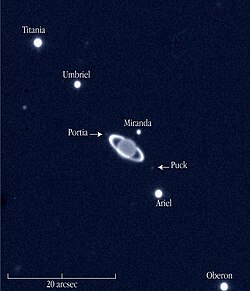
Among the diverse satellites of the ice giant Uranus, Miranda stands out as one of the most visually striking and geologically perplexing bodies in our solar system. Despite its small size—roughly the same surface area as the state of Texas—Miranda possesses a surface scarred by massive cliffs, deep canyons, and strange, crown-like structures known as coronae. For decades, this moon remained a mystery, visible only as a tiny speck of light, until a historic flyby revealed a world of extreme contrasts.
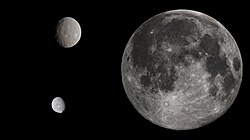
Miranda is one of the smallest objects in the solar system that may be in hydrostatic equilibrium, meaning it is large enough for its own gravity to have pulled it into a roughly spherical shape. However, its surface tells a story of violent upheaval and ancient heat, challenging our understanding of how such a small body could remain geologically active.
Key Facts
- Discovery: Found by Gerard P. Kuiper on February 16, 1948.
- Size: Approximately 470 km in diameter.
- Composition: Likely more than 60% water ice.
- Defining Feature: Home to Verona Rupes, one of the highest cliffs in the solar system.
- Orbit: The closest of Uranus's five round satellites to the planet.
- Exploration: Only visited once by the Voyager 2 probe in January 1986.
Discovery and Nomenclature
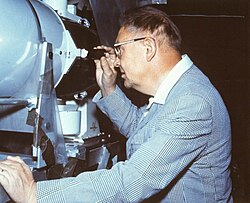
Miranda was discovered on February 16, 1948, by astronomer Gerard Kuiper using the 82-inch Otto Struve Telescope at the McDonald Observatory. This discovery was significant as it was the first new satellite of Uranus found in nearly a century.
Following the tradition of naming Uranian moons after characters from the works of William Shakespeare or Alexander Pope, Kuiper chose the name Miranda after a character in The Tempest. Interestingly, while the four previously discovered moons (Ariel, Umbriel, Titania, and Oberon) were named after fairies, Miranda was the first to be named after a human character.
Orbital Dynamics and Tidal Locking
Miranda orbits Uranus at a distance of approximately 129,000 km. It is tidally locked, meaning its rotation period is synchronous with its orbital period of 34 hours; consequently, it always shows the same face to the planet.
One of Miranda's most unusual characteristics is its orbital inclination of 4.232° relative to Uranus's equator. This is roughly ten times higher than that of other major Uranian satellites. Scientists hypothesize that this anomaly resulted from past secondary resonances—gravitational interactions with other moons—specifically a 3:1 resonance with Umbriel that may have pushed Miranda into its current tilted orbit.
Composition and Internal Structure
With a mean density of 1.148 g/cm³, Miranda is the least dense of Uranus's round satellites. This suggests a composition consisting of over 60% water ice. While it is too small to have retained primordial heat from the formation of the solar system, evidence suggests it underwent significant internal heating.
The leading theory for this heating is tidal heating. During its period of orbital resonance with Umbriel, the varying gravitational pull from Uranus would have caused the moon to flex, generating internal friction and heat. This process may have raised internal temperatures by 20 K, potentially triggering the melting of ice. Recent 2024 research suggests that Miranda may have even hosted a liquid ocean approximately 100 km thick beneath its surface between 100 and 500 million years ago.
The Rugged Geography of Miranda
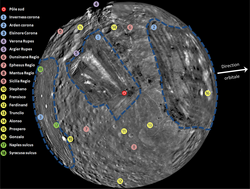
Because the Voyager 2 probe only observed the southern hemisphere during its 1986 flyby, our knowledge of Miranda's geography is limited to that region. The surface is characterized by a mix of ancient impact craters and massive tectonic features.
Coronae and Regiones
Miranda is famous for its coronae—large, complex, crown-like structures. The Inverness Corona, for example, features a distinct white central "chevron" and is surrounded by steep cliffs. These features are thought to be the result of internal upwelling and tectonic stress.
The Great Cliffs: Verona Rupes
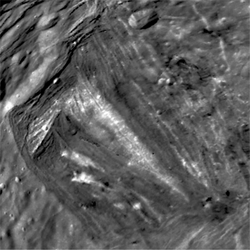
One of the most extreme locations in the solar system is Verona Rupes. This massive cliff reaches heights of 5 to 10 km (3.1 to 6.2 mi) and is associated with complex grabens (depressed blocks of crust) that are 10 to 15 km deep. The sheer scale of these faults suggests a history of intense crustal stretching.
![Close-up view of Verona Rupes, a cliff 5 to 10 km (3.1 to 6.2 mi) high.[46]](/images/df/e0/dfe0ac615edafe4ac522f5dc7c5e558fc3a0eb3a370c64ef125ed6457b8a42a9.jpg)
Impact Craters
Craters on Miranda vary widely in morphology. While some have well-defined borders and ejecta deposits, others are heavily degraded, indicating that the moon's surface has been reshaped over time. Scientists use these craters as "planetary chronometers" to date the terrain; areas with more craters are generally older. Interestingly, no complex craters with central peaks have been observed on Miranda.
Summary of Physical and Orbital Properties
| Property | Value |
|---|---|
| Mean Radius | 235.8 ± 0.7 km |
| Mass | (6.293 ± 0.300) × 1020 kg |
| Mean Density | 1.148 g/cm³ |
| Orbital Period | 1.413 days (approx. 34 hours) |
| Albedo (Reflectivity) | 0.32 |
| Surface Gravity | 0.076 m/s² |
Frequently Asked Questions
Why does Miranda have such a chaotic surface?
The chaos is likely due to tidal heating caused by orbital resonances with other moons, such as Umbriel. This gravitational flexing generated enough internal heat to melt ice and reshape the crust, creating massive cliffs and coronae.
How high is the cliff at Verona Rupes?
Verona Rupes is estimated to be between 5 and 10 kilometers (3.1 to 6.2 miles) high, making it one of the tallest cliffs known in the solar system.
What is Miranda made of?
Miranda is primarily composed of water ice (estimated at over 60%), with silicate rock and organic compounds likely settled in its interior due to internal differentiation.
How was Miranda discovered?
It was discovered by astronomer Gerard P. Kuiper on February 16, 1948, using the 82-inch Otto Struve Telescope at the McDonald Observatory.
Has any spacecraft visited Miranda?
Yes, the Voyager 2 probe performed a flyby on January 24, 1986, coming within 29,000 km of the moon. This remains the only close-up observation of Miranda to date.