Trewartha Climate Classification: A Refined Approach to Global Weather Patterns
The Trewartha climate classification (TCC), also known as the Köppen–Trewartha climate classification (KTC), represents a sophisticated evolution in how geographers categorize the Earth's diverse environments. First published by American geographer Glenn Thomas Trewartha in 1966, this system was designed to address specific deficiencies in the widely used Köppen–Geiger system. By redefining middle latitudes, Trewartha sought to create a classification that aligns more closely with vegetation zoning and genetic climate systems.
While the original Köppen system laid the groundwork, Trewartha's modifications focus on the number of months a location experiences specific temperature thresholds, providing a more nuanced view of how climate influences biological life.
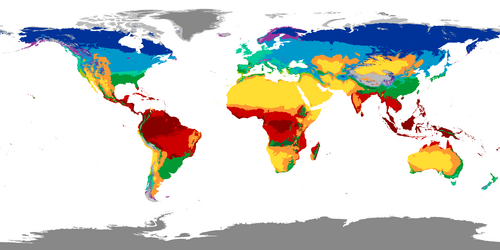
Key Facts
- Origin: Developed by Glenn Thomas Trewartha in 1966 as a modification of the Köppen system.
- Core Metric: Uses the number of months with a mean temperature of 10 °C (50 °F) or higher to define middle latitudes.
- Primary Groups: Categorizes climates into Tropical (A), Dry (B), Subtropical (C), Temperate (D), Boreal (E), and Polar (F).
- Vegetation Alignment: Aims to better reflect the relationship between climate and plant life zones.
- Aridity Calculation: Uses a specific formula involving mean annual temperature and precipitation seasonality to define desert and steppe climates.
The Framework of Climate Groups
The Trewartha system organizes the world into distinct realms based on temperature and precipitation patterns. The classification of middle latitudes is determined by how many months maintain a mean temperature of at least 10 °C (50 °F).
Group A: Tropical Climates
The tropical realm is defined by a frost-free zone where all 12 months average 18 °C (64.4 °F) or higher. This group is subdivided based on precipitation:
- Ar: Tropical Wet (no more than two dry months with less than 60 mm of rain).
- Am: Tropical Monsoon (at least three months with less than 60 mm of rain).
- Aw: Tropical Dry-Winter (dry season occurs during low-sun/short days).
- As: Tropical Dry-Summer (dry season occurs during high-sun/long days).
Group B: Dry Climates
Group B covers arid and semi-arid regions. Unlike other systems, Trewartha uses a specific formula to determine the aridity threshold: 10(T − 10) + 3P, where T is the mean annual temperature and P is the percentage of total precipitation received during the six high-sun months.
- BW (Desert): Precipitation is less than the formula's result.
- BS (Steppe): Precipitation is equal to or greater than the formula, but less than twice the amount.
Group C: Subtropical Climates
Subtropical climates are characterized by having 8 or more months with a mean temperature of 10 °C (50 °F) or higher. There are three primary types:
- Cs: Subtropical Dry Summer (Mediterranean).
- Cf: Subtropical Humid (no dry season).
- Cw: Subtropical Monsoon (dry winters).
Group D: Temperate and Continental Climates
The D group encompasses climates with 4 to 7 months meeting the 10 °C (50 °F) threshold. These are split into two categories:
- Do (Oceanic): The coldest month has a mean temperature of 0 °C (32 °F) or higher.
- Dc (Continental): The coldest month falls below 0 °C. This group can be further divided into Dca (hot summers) and Dcb (cool summers).
Group E: Boreal Climates
Boreal climates feature only 1 to 3 months with an average temperature of 10 °C (50 °F) or higher, resulting in short frost-free periods of 50 to 90 days. Subtypes include:
- Eo (Maritime Subarctic): The coldest month averages above −10 °C (14 °F).
- Ec (Continental Subarctic): At least one month averages −10 °C or below.
Group F: Polar Climates
In polar regions, all months have a mean temperature below 10 °C (50 °F). This group includes:
- Ft (Tundra): At least one month averages above 0 °C (32 °F), allowing for scrub or tundra vegetation.
- Fi (Ice Cap): All months average below 0 °C (32 °F), resulting in permanent ice.
Summary of Climate Classifications
| Group | Climate Type | Temperature Threshold (Months $\ge$ 10 °C) |
|---|---|---|
| A | Tropical | 12 months $\ge$ 18 °C |
| B | Dry | Defined by aridity formula |
| C | Subtropical | 8 or more months |
| D | Temperate | 4 to 7 months |
| E | Boreal | 1 to 3 months |
| F | Polar | 0 months |
The Universal Thermal Scale
To provide even greater detail, the Trewartha system allows for the addition of a third and fourth letter to describe the temperature of the warmest and coldest months. This Universal Thermal Scale uses specific codes:
- i: Severely hot ($\ge$ 35 °C)
- h: Very hot (28 to 34.9 °C)
- a: Hot (22.2 to 27.9 °C)
- b: Warm (18 to 22.1 °C)
- l: Mild (10 to 17.9 °C)
- k: Cool (0.1 to 9.9 °C)
- o: Cold (0 to −9.99 °C)
- c: Very cold (−10 to −24.9 °C)
- d: Severely cold (−25 to −39.9 °C)
- e: Excessively cold ($\le$ −40 °C)
Frequently Asked Questions
How does Trewartha differ from the Köppen system?
The Trewartha system modifies the Köppen system to better align with vegetation zones, specifically by redefining middle latitudes based on the number of months that meet a 10 °C temperature threshold.
What defines a subtropical climate in this system?
In the Trewartha scheme, a subtropical climate (Group C) must have 8 or more months with a mean temperature of 10 °C (50 °F) or higher.
What is the difference between Tundra (Ft) and Ice Cap (Fi) climates?
Tundra climates (Ft) have at least one month with an average temperature above 0 °C, allowing for some vegetation, whereas Ice Cap climates (Fi) have all months averaging below 0 °C.
How is aridity calculated in the Trewartha system?
Aridity is determined using the formula 10(T − 10) + 3P, where T is the mean annual temperature and P is the percentage of precipitation received during the six high-sun months.
What does the 'Do' designation mean?
'Do' refers to an Oceanic temperate climate where the coldest month has a mean temperature of 0 °C (32 °F) or higher.