Trade Winds: The Global Currents That Shaped History and Weather
For centuries, the rhythmic flow of the trade winds—also known as the easterlies—has dictated the movement of ships, the patterns of rainfall, and even the nutrient levels of distant rainforests. These prevailing east-to-west winds flow through Earth's equatorial regions, acting as a massive atmospheric engine that influences both global commerce and local ecosystems.
By understanding how these winds operate, we gain insight into the complex relationship between atmospheric circulation, historical exploration, and the environmental health of our planet.
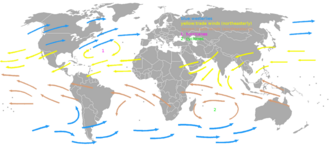
Key Facts
- Direction: They blow from the northeast in the Northern Hemisphere and the southeast in the Southern Hemisphere.
- Mechanism: They are a key component of the Hadley cell, driven by air descending from subtropical ridges.
- Historical Impact: These winds were essential for European colonization and the establishment of transoceanic trade routes.
- Environmental Role: They transport nutrient-rich Saharan dust across the Atlantic to the Amazon and the Caribbean.
- Weather Influence: They act as steering flows for tropical storms and influence rainfall patterns in Africa, Asia, and the Americas.
The Science of Atmospheric Circulation
The trade winds are driven by a large-scale circulation pattern known as the Hadley cell. In this process, surface air flows toward the equator while air at higher altitudes flows toward the poles. Near the equator, this convergence creates a low-pressure area characterized by calm, light, and variable winds known as the doldrums (or the Intertropical Convergence Zone).
Around 30° latitude in both hemispheres, air begins to descend toward the surface, forming subtropical ridges. This descending air is relatively dry because it lost its moisture as it rose over the equator. This warm, dry air is referred to as a superior air mass. When this air mass sits above a warmer, moist maritime tropical air mass, it creates a temperature inversion—a phenomenon where temperature increases with height. In trade wind regions, this is specifically called a trade wind inversion, which prevents shallow cumulus clouds from growing taller.
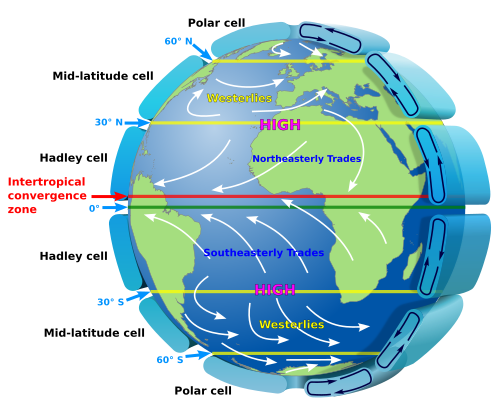
As this air moves from the subtropical high-pressure belts toward the equator, the Coriolis effect—the deflection caused by Earth's rotation—pushes the winds toward the west. This results in the northeasterly winds of the Northern Hemisphere and the southeasterly winds of the Southern Hemisphere.
Historical Navigation and the Age of Sail
The term "trade" originally derived from the 14th-century meaning of a "path" or "track." For maritime explorers, finding these atmospheric tracks was a matter of survival and success. The Portuguese were among the first to master the volta do mar (the "turn of the sea"), recognizing that to return to Europe from West Africa, they had to sail northwest and northeast toward the Azores.
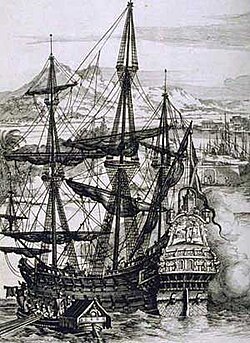
During the Age of Sail, the ability to harness these winds enabled the establishment of trade routes across the Atlantic and Pacific Oceans. However, these winds also dictated the limits of empire-building; for instance, certain vessels, like the Manila galleons, were unable to sail directly into the wind. It wasn't until the 18th century that the term "trade winds" became synonymous with commercial trade, reflecting their role in fueling global merchant fleets.
Environmental and Biological Impacts
The trade winds serve as a global conveyor belt for more than just ships; they are vital for biological health. Every year, millions of tons of Saharan dust, rich in nitrates and phosphates, are transported across the Atlantic. This dust provides essential fertilizers to the nutrient-depleted soils of the Amazon rainforest.
However, this transport can have negative consequences. When Saharan dust reaches the Caribbean and North America, it can suppress rainfall and degrade air quality by increasing airborne particulates. In Florida and the Caribbean, dust outbreaks have been linked to a decline in the health of coral reefs since the 1970s. Furthermore, when the dust makes the sky appear white rather than blue, it often leads to more intense red sunsets.
Summary of Trade Wind Characteristics
| Feature | Northern Hemisphere | Southern Hemisphere |
|---|---|---|
| Primary Direction | Northeast | Southeast |
| Convergence Zone | The Doldrums (Intertropical Convergence Zone) | |
| Cloud Type | Shallow cumulus (capped by inversion) | |
| Key Driver | Hadley Cell / Coriolis Effect |
Frequently Asked Questions
What are the doldrums?
The doldrums, also known as the Intertropical Convergence Zone, is a low-pressure area near the equator where trade winds from both hemispheres meet. It is characterized by calm, light, and variable winds.
How do trade winds affect rainfall?
The strength of the trade winds directly impacts precipitation. When trade winds are weaker, more extensive rainfall typically occurs in neighboring tropical landmasses, such as Central America.
Why does Saharan dust affect the sky color?
When Saharan dust travels over land, it can change the sky's appearance from blue to white and increase the frequency of red sunsets due to the presence of airborne particulates.
What is a trade wind inversion?
A trade wind inversion is a temperature inversion caused by descending, dry air from the subtropical ridge. This layer of warm air sits above cooler air, capping cumulus clouds and preventing them from growing taller.
How do trade winds influence the Amazon rainforest?
The trade winds transport massive amounts of nutrient-rich dust from the Sahara Desert across the Atlantic Ocean, which provides vital phosphorus and other fertilizers to the Amazonian soil.