Trade and Commerce: The Evolution of Global Economic Exchange
Trade is the fundamental economic mechanism by which individuals or entities swap items of value—such as products, resources, or money—to obtain something else they need or desire. At its core, trade involves the transfer of goods and services from a seller to a buyer, typically in exchange for currency.
Modern economic theory suggests that trade is driven by specialization and the division of labor. This occurs when individuals or groups focus on producing a specific aspect of a product, then trade their output for other necessities. On a larger scale, regions trade because they possess a comparative advantage—either real or perceived—in producing certain goods, often due to the availability of scarce natural resources or the capacity for mass production. This allows both parties to benefit by trading at market prices.
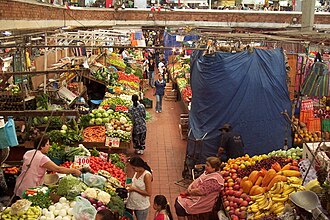
Trade manifests in various forms, from the historical spice and grain trades that helped build the global economy to modern retail trade, where merchandise is sold in small lots for direct consumption via physical stores, mail, or online platforms.
![The caduceus, traditionally associated with Mercury (the Roman patron-god of merchants), continues in use as a symbol of commerce.[17]](/images/bc/2f/bc2f32f8ae9beb3a1a8f922713403748b7cc82d327e0b431c2cc334e556cdf63.webp)
Key Facts
- Etymology: The word "commerce" comes from the Latin commercium, combining cum ("together") and merx ("merchandise").
- Prehistoric Roots: Evidence shows trade networks for ostrich eggshell beads existed 50,000 years ago and obsidian networks 15,000 years ago.
- Trade Openness: Global trade openness peaked between 1815 and 1914, collapsed during the 1930s Great Depression, and has risen since the 1950s to its highest levels in history.
- Ancient Currencies: Before modern money, societies used gift economies or items like Mesoamerican "axe money" (tajadero), which had a fixed value of 8,000 cacao seeds.
The Historical Progression of Trade
Prehistory and Ancient Civilizations
Before the invention of currency, early humans operated within a gift economy. Long-distance networks were established early on; for instance, obsidian—sometimes called "rich man's flint"—was traded as far back as 17,000 BC in some regions.
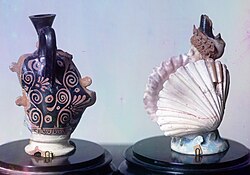
In the Mediterranean and Near East, trade became highly sophisticated. The Romans relied heavily on grain imports to feed their capital, with Egypt serving as the primary supplier, providing roughly one-third of Rome's total needs. The logistics of the Roman grain trade, utilizing ships of 1,200 to 1,300 tons, remained unsurpassed in sophistication until the 19th century.
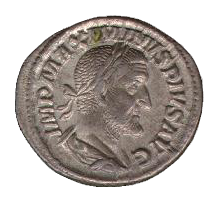
Global Trade Networks
Trade expanded across diverse geographies through specialized routes and maritime networks. The Silk Road connected Europe and Asia, while Austronesian maritime networks facilitated exchange across the Indian Ocean.
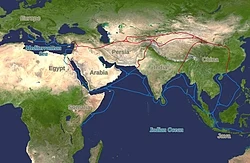
![Austronesian proto-historic and historic maritime trade network in the Indian Ocean[57]](/images/9c/b3/9cb31fd89bc2fc689486d9fbcb94f38faa54d52a95399875e18414bbcf9342df.png)
The Middle Ages to the Industrial Revolution
During the late medieval period, trade routes within Europe became more defined, and the Hanseatic League established powerful port cities like Danzig to control commerce.
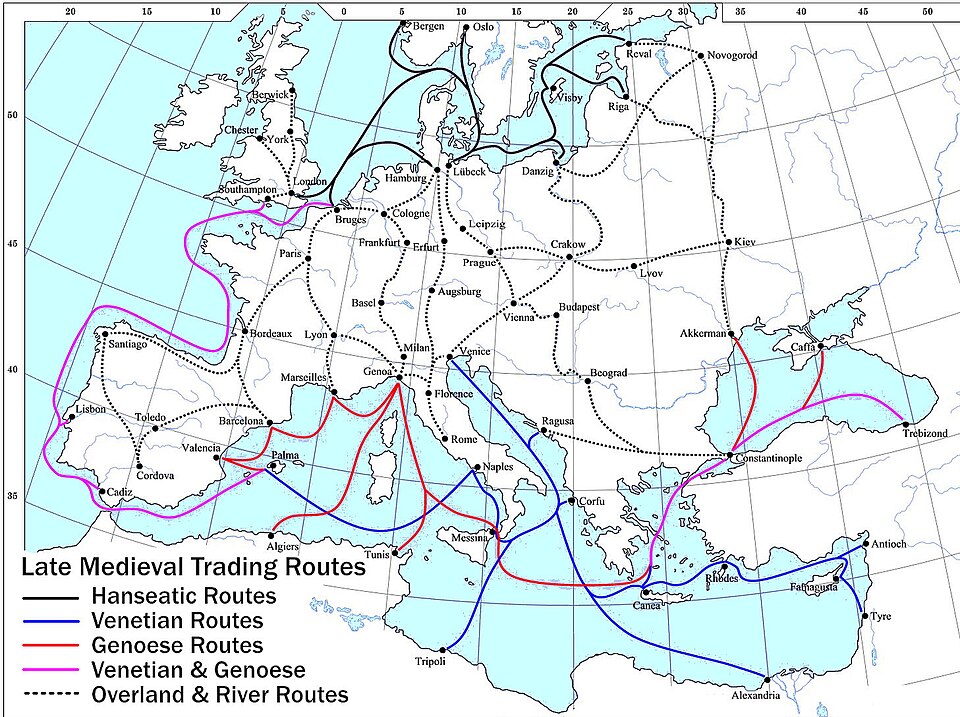
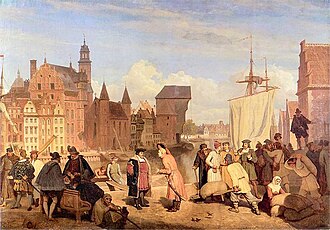
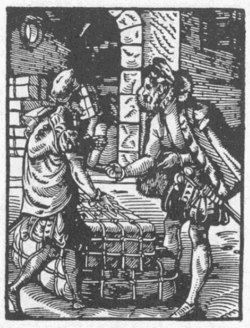
The transition into the Age of Sail and the Industrial Revolution accelerated the movement of goods. By the 19th century, there was a significant increase in openness to free trade, a trend that continued until the outbreak of World War I in 1914.
Modern Trade Dynamics
The 20th century saw volatile shifts in trade policy. After a brief increase in openness in the 1920s, the Great Depression of the 1930s caused a collapse in trade between North America and Europe. However, from the 1950s onward, trade openness grew substantially, despite a temporary slowdown during the 1970s oil crisis.
In the contemporary era, trade is influenced by various perspectives, including protectionism (restricting imports to protect domestic industries) and fair trade (ensuring ethical producers receive fair payment). International trade is now managed through complex frameworks, including the Doha rounds and the integration of major economies like China into the World Trade Organization (WTO).
Trade Summary Table
| Era | Primary Mechanism/Characteristic | Key Examples/Goods |
|---|---|---|
| Prehistory | Gift Economy / Early Networks | Obsidian, Ostrich eggshell beads |
| Ancient History | State-sponsored / Imperial Trade | Egyptian grain to Rome, Silk Road |
| Middle Ages | Trade Leagues / Maritime Hubs | Hanseatic League, Spice trade |
| 19th - 21st Century | Globalized Free Trade / Retail | Mass production, E-commerce, WTO |
![Tajadero or axe money used as currency in Mesoamerica. It had a fixed worth of 8,000 cacao seeds, which were also used as currency.[66]](/images/52/87/52876fc84d43efaab116c753f3f20381254827e27689978d9e57dbfe5e445923.jpg)
Frequently Asked Questions
What is the difference between trade and commerce?
While often used interchangeably, trade specifically refers to the act of swapping goods or services for value, whereas commerce is a broader term derived from the Latin commercium, encompassing the entire system of buying and selling on a large scale.
Why does trade occur between different regions?
Trade occurs because of comparative advantage. Different regions have different natural resources, climate conditions, or production capacities, making it more efficient to produce what they are best at and trade for the rest.
What is a gift economy?
A gift economy is a prehistoric form of exchange where goods and services are given without an explicit agreement for immediate or equivalent reward, preceding the innovation of modern currency.
How has trade openness changed over the last two centuries?
Trade openness increased from 1815 to 1914, crashed during the Great Depression of the 1930s, and has risen steadily since the 1950s to reach the highest levels ever recorded by economists.
What was "axe money"?
Tajadero, or axe money, was a form of currency used in Mesoamerica. It had a standardized value, specifically worth 8,000 cacao seeds, which were also used as a medium of exchange.