Understanding Trachelospermum: The Fragrant Vines of Asia
In the world of ornamental gardening and botany, few climbing plants offer the combination of lush greenery and intoxicating scent found in the genus Trachelospermum. These evergreen woody vines, members of the Apocynaceae (commonly known as the dogbane family), are prized for their ability to transform walls and trellises into cascades of fragrant blooms.
Native to southern and eastern Asia, these plants are more than just garden staples; they are a diverse group of species with a fascinating botanical history and a distinct physical profile that sets them apart from other climbing flora.
Botanical Characteristics
Trachelospermum species are characterized by their vigorous growth habits. These vines can produce long stems that climb to heights of 12 meters or more when supported by trees or other structures.
The foliage consists of opposite, simple leaves that range from broad lanceolate (shaped like a lance head) to ovate (egg-shaped). These leaves typically measure between 2 and 8 cm in length and 0.5 to 4 cm in width, providing a dense, evergreen cover throughout the year.
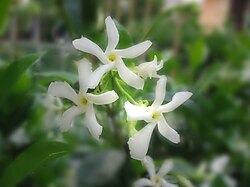
The most striking feature of the genus is its flowers. They are described as salverform—a botanical term meaning the petals are joined at the base to form a narrow tube that opens into a flat, spreading top, similar to the flowers of the Phlox genus. These blooms range from 2.5 to 7 cm in width and appear in shades of white, pale yellow, or purple.
The Meaning Behind the Name
The generic name Trachelospermum is derived from Greek, literally translating to "neck seed." This name refers specifically to the unique shape of the plant's seeds.
A common point of confusion for gardeners is the naming of Trachelospermum jasminoides. While it is frequently associated with jasmine due to its scent and appearance, it is not a "true jasmine" and does not belong to the genus Jasminum.
Species and Distribution
The genus comprises several species distributed across various regions of Asia, from the Himalayas to the islands of Southeast Asia. While some are rare, others, such as T. jasminoides and T. asiaticum, are widely cultivated for their aromatic flowers and attractive foliage.
| Species | Native Range |
|---|---|
| T. asiaticum | China (including Tibet and Taiwan), Japan, Korea, Indochina, Assam, Borneo, W Malaysia |
| T. assamense | Assam, Bhutan |
| T. axillare | China, Himalayas (N + E India, Nepal, Bhutan, Tibet), Thailand, Myanmar |
| T. bodinieri | Tibet, Fujian, Guangdong, Guangxi, Guizhou, Hubei, Hunan, Sichuan, Taiwan, Yunnan, Zhejiang |
| T. brevistylum | Anhui, Fujian, Guangdong, Guangxi, Guizhou, Hunan, Sichuan, Tibet |
| T. dunnii | Guangxi, Guizhou, Hunan, Yunnan, Zhejiang, Vietnam |
| T. inflatum | Java, Sumatra |
| T. jasminoides | Japan, Korea, Laos, Vietnam, and various Chinese provinces (including Taiwan and Tibet) |
| T. lucidum | Himalayas (N Pakistan, N + E India, Nepal, Bhutan, Myanmar, Thailand) |
| T. ninhii | Central Vietnam |
| T. vanoverberghii | Luzon, Philippines |
Key Facts
- Family: Apocynaceae (Dogbane family).
- Origin: Native exclusively to southern and eastern Asia.
- Growth Habit: Evergreen woody vines reaching up to 12m+.
- Flower Shape: Salverform (tube-shaped base with flat petals).
- Etymology: Named "neck seed" in Greek due to seed morphology.
- Common Use: Cultivated primarily for scent and foliage.
Frequently Asked Questions
Is Trachelospermum a type of jasmine?
No. Despite the common name and fragrance of species like T. jasminoides, it is not a true jasmine and does not belong to the genus Jasminum.
How high can these vines grow?
Trachelospermum vines are capable of climbing to 12 meters or more when they have trees or structures to support their growth.
What does "salverform" mean in relation to the flowers?
Salverform refers to a flower structure where the petals are fused at the base to form a tube, which then opens into a flat, spreading top, similar to the appearance of Phlox flowers.
Where is the genus Trachelospermum native to?
All species within the genus are native to southern and eastern Asia, including regions such as China, Japan, Korea, and various Southeast Asian countries.
Which species are most commonly grown in gardens?
Trachelospermum asiaticum and Trachelospermum jasminoides are the species most notably cultivated for their strongly scented flowers and evergreen foliage.