Thunderbird Mythology Across Indigenous North American Cultures
The Thunderbird is a powerful supernatural entity that appears across various Indigenous cultures of North America. From the Pacific coast to the Great Lakes and the Northeastern United States, this legendary creature is often depicted as a force of nature, embodying the power of the storm and serving as a protector of humanity against subterranean or aquatic threats.
Key Facts
- Cosmic Balance: In many traditions, the Thunderbird represents the upper world, often locked in a struggle with underworld creatures.
- Natural Phenomena: The flapping of its wings is said to create thunder, while its eyes or actions produce lightning.
- Regional Presence: Prevalent among Algonquian, Iroquois, Siouan, and Pacific coast tribal groups.
- Protective Role: Frequently portrayed as a guardian that prevents underworld spirits from overrunning the earth.
The Thunderbird in Algonquian and Iroquois Traditions
Among the Algonquian peoples of Eastern Canada (Ontario and Quebec) and the Northeastern United States, as well as the Iroquois peoples surrounding the Great Lakes, the Thunderbird is a central motif. This includes Algonquian-speaking groups in the U.S. Midwest, such as the Ojibwe of Minnesota.
In this cosmological framework, the Thunderbird governs the upper world. Its primary adversary is the underwater panther or the Great Horned Serpent, who rules the underworld. The Thunderbird maintains balance by casting lightning bolts at these underworld creatures.
Visually, the Thunderbird is often depicted in two ways: as a spreadeagled bird with horizontal wings and a profile head, or with a forward-facing head that creates a distinct X-shaped silhouette.
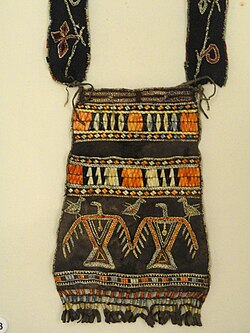
Ojibwe Beliefs
According to Ojibwe tradition, the Thunderbird was created by Nanabozho (a cultural hero and trickster figure) specifically to combat underwater spirits. Beyond this cosmic battle, Thunderbirds served a moral purpose by punishing humans who violated social or ethical rules. These beings resided in the four cardinal directions, arriving in the springtime and migrating south in the autumn once the most dangerous season for underwater spirits had passed.
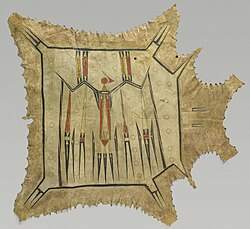
Menominee Folklore
In the folklore of the Menominee of Northern Wisconsin, Thunderbirds dwell on a floating mountain located far to the west. As messengers of the Great Sun, they control the rain and hail. They are characterized by a love of combat, perpetually fighting the Misikinubik (great horned snakes) to prevent them from devouring humankind.
Siouan and Other Tribal Perspectives
The Thunderbird motif also extends to Siouan-speaking peoples, including those traditionally located around the Great Lakes region.
Ho-Chunk Tradition
For the Ho-Chunk people, the Thunderbird is linked to leadership and spiritual guidance. It is believed that a man who experiences a vision of a Thunderbird during a solitary fast is destined to become a war chief of his people.
Arikara Legends
Arikara oral history includes tales of interaction between humans and these creatures. In one account transcribed by ethnographer George Amos Dorsey, a boy named Antelope-Carrier discovers a nest of four young Thunderbirds. The mother Thunderbird warns the boy of a two-headed Serpent that emerges from the lake to prey upon her young.
Pacific Coast Traditions
On the Pacific coast, tribal groups have traditionally shared stories regarding the struggle between the Thunderbird and the Whale. Some researchers have analyzed these myths to determine if they are linked to the Cascadia subduction zone earthquake of 1700, a massive seismic event that triggered a tsunami reaching as far as Japan.
| Culture/Group | Primary Adversary | Key Role or Attribute |
|---|---|---|
| Algonquian/Iroquois | Underwater Panther / Horned Serpent | Controls the upper world; creates thunder and lightning |
| Ojibwe | Underwater Spirits | Created by Nanabozho; enforces moral rules |
| Menominee | Misikinubik (Horned Snakes) | Messengers of the Great Sun; control rain and hail |
| Ho-Chunk | N/A | Appears in visions to designate future war chiefs |
| Arikara | Two-headed Serpent | Protective maternal instincts toward offspring |
| Pacific Coast | Whale | Possible connection to the 1700 Cascadia earthquake |
Frequently Asked Questions
What does the Thunderbird represent in Algonquian mythology?
In Algonquian mythology, the Thunderbird represents the power of the upper world and the forces of the storm, acting as a counterbalance to the creatures of the underworld.
How do the Ojibwe believe Thunderbirds interact with humans?
The Ojibwe believe that Thunderbirds act as moral guardians who punish individuals who break established moral rules.
What is the relationship between the Thunderbird and the Misikinubik?
In Menominee folklore, the Thunderbird and the Misikinubik (great horned snakes) are eternal enemies; the Thunderbird fights them to prevent them from overrunning the earth and eating humans.
Is there a scientific theory linked to Pacific coast Thunderbird stories?
Yes, some studies suggest that stories of the struggle between the Thunderbird and the Whale may be cultural memories of the 1700 Cascadia subduction zone earthquake and the resulting tsunami.
What is the significance of a Thunderbird vision for the Ho-Chunk?
For the Ho-Chunk, seeing a Thunderbird during a solitary fast is a sign that the individual will become a war chief.