Mandan People: A History of Resilience and Adaptation
The Mandan are a Siouan-speaking people whose history is a testament to endurance in the face of environmental shifts, devastating epidemics, and colonial pressure. Once a powerful nation of horticulturalists and traders in the Missouri River Valley, the Mandan played a pivotal role as middlemen in the early North American fur trade before merging with neighboring tribes to ensure their cultural survival.
Origins and Early Settlement
The exact origins of the Mandan remain a subject of scholarly debate. Linguistic evidence suggests a close relationship with the Ho-Chunk (Winnebago) of present-day Wisconsin, a theory supported by Mandan oral histories describing a migration from an eastern location near a lake. Other ethnologists propose that the Mandan, along with the Hidatsa, originated in the mid-Mississippi and Ohio River valleys.
Migration to the Missouri River Valley and the Heart River in present-day North Dakota likely occurred between 1000 CE and the 13th century. This move coincided with the adoption of maize cultivation and a climatic shift toward warmer, wetter conditions that favored agriculture.
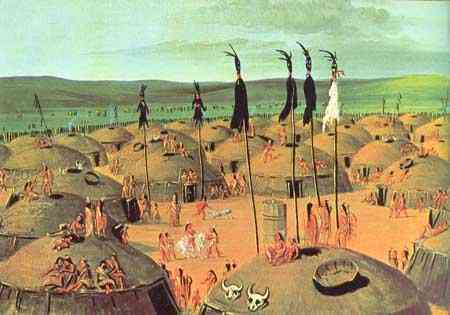
Upon settling, the Mandan established fortified villages. Archaeological findings at sites like Double Ditch Village reveal a pattern of shrinking defensive boundaries—ditches and palisades—as populations declined over time. These fortifications often correlated with periods of drought, which increased intertribal raiding for food.
Social Structure and Expansion
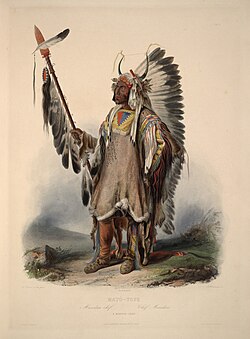
The Mandan were organized into several bands, the largest being the Nup'tadi. Other groups included the Is'tope (those who tattooed themselves), Ma'nana'r (those who quarreled), Nu'itadi (our people), and the Awigaxa. By the 15th century, the Mandan consolidated in North Dakota, reaching their peak influence between 1500 and 1782. Villages like Huff Village became densely populated hubs, housing over 1,000 residents in approximately 115 large lodges.
European Encounters and Trade
The first recorded European visit occurred in 1738 by French Canadian trader Sieur de la Verendrye. He described a prosperous nation of roughly 15,000 people living in nine fortified villages. The Mandan leveraged their position to dictate trade terms, exchanging crops and buffalo products for goods from other Native American groups and Europeans.
In the mid-18th century, the Mandan acquired horses from the Apache, which expanded their hunting territories onto the Plains and enhanced their role as middlemen in the trade of furs, guns, and horses between the French and other regional tribes.
The Impact of Smallpox and Conflict
The late 18th century brought catastrophic change. A smallpox epidemic originating in Mexico City reached the northern plains in 1781, drastically reducing the Mandan population and eliminating several clans. This vulnerability led to increased raids by Lakota Sioux and Crow warriors, forcing the Mandan to consolidate into two villages for mutual defense, often joined by the similarly afflicted Hidatsa.
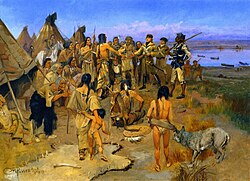
In 1804, the Lewis and Clark expedition wintered near the Mandan villages, establishing Fort Mandan. During this stay, they met Sacagawea and Chief Sheheke (Big White), whom they later took to Washington to meet President Thomas Jefferson.
The Great Epidemic of 1837–1838
While the Mandan had survived previous outbreaks, the epidemic of 1837–1838 was nearly annihilating. An American Fur Company steamboat traveling up the Missouri River introduced the virus to the Mandan, Hidatsa, and Arikara tribes. Of the approximately 1,600 Mandan living in two villages, 90% perished, including the prominent Chief Four Bears.
Survivors estimated between 27 and 150 individuals were left. Oral traditions and some historians blame the American Fur Company and the failure of steamboat crews to quarantine infected passengers. Some scholars further suggest that the lack of vaccine provision by the Commissioner of Indian Affairs reflected a systemic disregard for the tribe's survival.
Intertribal Warfare and Consolidation
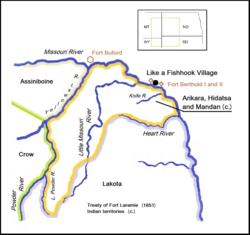
Throughout the 19th century, the Mandan faced persistent conflict, particularly with the Lakota Sioux and occasionally the Arikara. After the 1837 epidemic, the remaining Mandan joined the Hidatsa in 1845 to establish Like-a-Fishhook Village for collective protection. By 1862, the Arikara also joined them, forming a major regional trade center.
Despite their efforts, the Three Tribes faced continued aggression. In 1874, a significant Lakota attack occurred near Like-a-Fishhook Village; although Colonel George Armstrong Custer was present, he failed to prevent the deaths of several tribal members.
Land Loss and the Modern Era
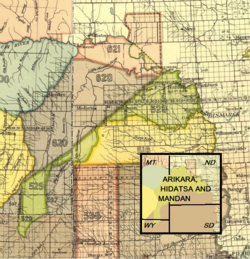
The 19th century saw a steady erosion of Mandan lands. The Fort Laramie Treaty of 1851 recognized 12 million acres for the Three Affiliated Tribes. However, subsequent executive orders in 1870 and 1880 reduced this to 8 million and then 1 million acres, respectively. By 1910, the reservation was further reduced to 900,000 acres across several North Dakota counties.
Under the 1934 Indian Reorganization Act, the Mandan, Hidatsa, and Arikara officially merged to form the Mandan, Hidatsa and Arikara Nation (the Three Affiliated Tribes).
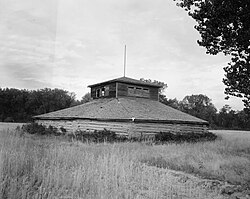
In 1951, the construction of the Garrison Dam by the U.S. Army Corps of Engineers created Lake Sakakawea, flooding significant portions of the Fort Berthold Reservation, including the villages of Elbowoods and Fort Berthold. This forced the relocation of residents to the newly constructed town of New Town.
Key Facts
- Language: Siouan-speaking, with possible ancient links to the Ho-Chunk people.
- Economy: Historically based on maize agriculture and acting as trade middlemen.
- Demographic Collapse: The 1837–38 smallpox epidemic killed approximately 90% of the population.
- Political Union: Now part of the Three Affiliated Tribes (Mandan, Hidatsa, and Arikara Nation).
- Geography: Historically centered in the Missouri and Heart River valleys of North Dakota.
| Period | Key Status/Event | Primary Location |
|---|---|---|
| 1000 CE – 13th Century | Migration and Maize Adoption | Heart River Valley |
| 1500 – 1782 | Population and Influence Peak | Fortified Missouri Villages |
| 1781 & 1837–38 | Devastating Smallpox Epidemics | Upper Missouri River |
| 1845 – 1880s | Consolidation with Hidatsa/Arikara | Like-a-Fishhook Village |
| 1934 – Present | Formation of Three Affiliated Tribes | Fort Berthold Reservation |
Frequently Asked Questions
Where did the Mandan people originally come from?
While their exact origins are unknown, linguistic evidence and oral histories suggest they may have migrated from the Wisconsin area or the mid-Mississippi and Ohio River valleys before settling in North Dakota.
What caused the massive population decline in the 1830s?
A catastrophic smallpox epidemic between 1837 and 1838, likely introduced by traders and passengers on an American Fur Company steamboat, killed roughly 90% of the Mandan population.
Who are the Three Affiliated Tribes?
The Three Affiliated Tribes is the federally recognized nation consisting of the Mandan, Hidatsa, and Arikara people, who merged their governments under the 1934 Indian Reorganization Act.
What was the significance of Like-a-Fishhook Village?
It served as a critical center for mutual defense and trade where the Mandan, Hidatsa, and later the Arikara lived together to protect themselves from Lakota Sioux raids.
How did the Garrison Dam affect the Mandan people?
Completed in 1951, the dam created Lake Sakakawea, which flooded several villages on the Fort Berthold Reservation, forcing residents to relocate to New Town.