Thorfinn the Mighty: The Powerful Earl of Orkney
In the turbulent landscape of the 11th century, few figures loomed as large as Thorfinn Sigurdsson, known to history as Thorfinn the Mighty (Old Norse: Þorfinnr inn riki). A Norse Jarl (Earl) of Orkney, Thorfinn navigated a complex web of kinship and conflict, ruling over a vast maritime empire that bridged the gap between the Norse world and the emerging Kingdom of Scotland.
Born around 1009, Thorfinn was the youngest of five sons born to Jarl Sigurd Hlodvirsson and Olith, the daughter of King Máel Coluim II of Scotland. This dual heritage—Norse by father and Scottish by mother—would define his political trajectory, allowing him to claim authority in both the Northern Isles and the Scottish mainland.
Key Facts
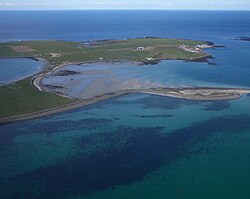
![The Brough of Deerness - a Viking age ecclesiastical ruin here is associated with Thorkel Fosterer.[19]](/images/3e/d2/3ed2cfd32f5f284d1aec35fe3786db28109daa306ac515be69eb560b4980c00d.jpg)
- Full Name: Thorfinn Sigurdsson (Thorfinn the Mighty).
- Titles: Earl of Orkney, Earl of Caithness, and Earl of Sutherland.
- Rule: Held the title from approximately 1016 to 1058, often sharing power with brothers or nephews.
- Lineage: Son of Jarl Sigurd Hlodvirsson and daughter of King Máel Coluim II of Scotland.
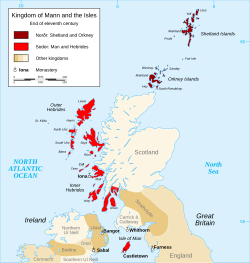
- Territories: Controlled Orkney, Shetland, Caithness, Sutherland, and likely parts of the Hebrides.
Early Life and Rise to Power
![One of two surviving pages of an early version of the Heimskringla known as the "Kringla leaf", which is kept in the National and University Library of Iceland. The text is part of Óláfs saga helga.[63]](/images/6c/19/6c19f9b1374dc4137475bc66e17cf3314b0eb26f5dbb502bb4a528272b7d192b.jpg)
Thorfinn's path to power began in tragedy. His father, Earl Sigurd, was killed at the Battle of Clontarf on April 23, 1014. At the time, five-year-old Thorfinn was being fostered by his maternal grandfather, the King of Scots. While his older half-brothers divided the islands of Orkney and Shetland, King Máel Coluim established Thorfinn as the ruler of Caithness and Sutherland, providing him with Scottish advisors to manage these mainland territories.
As Thorfinn came of age, he sought his share of the islands. His early rule was characterized by joint governance, a common but unstable Norse practice. He initially shared the earldom with his brothers Einar and Brusi. Following Einar's death around 1020, Thorfinn and Brusi continued to rule together.
The Shift to Sole Rule
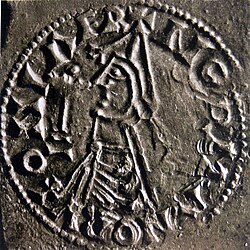
The political landscape shifted in 1030 when King Olaf was overthrown by the Danish King Cnut the Great at the Battle of Stiklestad. In the ensuing chaos, Orkney faced raids from both Norwegians and Danes. To ensure the islands' defense, Brusi agreed to grant Thorfinn the "King's third" of the territory. Upon Brusi's death between 1030 and 1035, Thorfinn finally became the sole ruler of the Orkney earldom, serving as a vassal to the King of Norway while remaining responsible to the King of Scots for his mainland holdings.
Expansion and the Kingdom of the Isles
![Modern statue in Bremen Cathedral of Archbishop Adalbert of Hamburg, who may have met with Earl Thorfinn and who appointed Bishop Thorulf of Orkney.[50]](/images/f4/f6/f4f631e7a3e41d9290efb01857171c00e7da9c2a7100c945584da393df9938ff.jpg)
Thorfinn's ambitions extended far beyond the Northern Isles. Around 1034, he is said to have conquered the Hebrides, effectively becoming the de facto ruler of the Kingdom of the Isles. This expansion was aided by instability in Dublin, where the kingship shifted between figures like Echmarcach mac Ragnaill and Imar mac Arailt.
Alongside his nephew, Rögnvald Brusason, Thorfinn conducted wide-ranging raids across the Irish Sea and England. One of their most significant military achievements was a major victory at Vatzfjorðr, believed by some historians to be Loch Vatten on the west coast of Skye.
Conflict with Karl Hundason
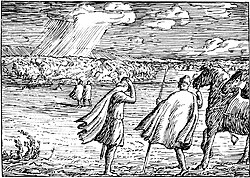
Thorfinn's reign was not without domestic strife. He engaged in a protracted war with a figure known as Karl Hundason. The identity of Hundason remains a subject of historical debate; candidates include King Duncan I, a son of Kenneth III, or even MacBeth. Some scholars suggest Hundason was actually the son of Thorfinn's own brother, Hundi, though others dismiss this as a saga embellishment.
Faith, Diplomacy, and Legacy
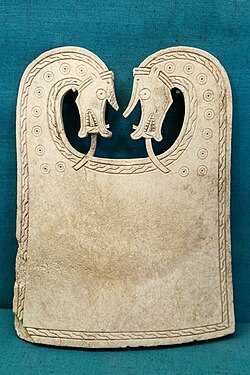
As his power grew, Thorfinn's relationship with the church evolved. While the Orkneyinga Saga suggests the first Bishop of Orkney was installed late in his reign, records indicate that Henry of Lund (known as "the Fat") was appointed prior to 1035. The bishopric during this era fluctuated in its allegiance between the Archbishops of York and Hamburg-Bremen.
![St. Magnus Church, Birsay. The site is a possible location for Thorfinn's "Christ Kirk".[50]](/images/7f/69/7f69df80575ceb4588cbf4fb790f8b16ae2c16f69a6368014253fb03ce1ace3f.jpg)
Thorfinn's diplomatic reach was equally impressive. In 1020, he became the first Earl of Orkney known to have visited the royal court in Norway. He also maintained complex ties with the Scottish crown, potentially acting as an ally to his grandfather in Fife.
The Mystery of His Death
The exact date of Thorfinn's death is not explicitly recorded, but historians propose approximately 1058 based on circumstantial evidence. In that year, Magnus Haraldsson led an expedition to Orkney, likely to restore order after Thorfinn's passing. Furthermore, Thorfinn's widow, Ingibiorg Finnsdottir, later married King Malcolm III of Scotland, bearing him sons born around 1060, which suggests Thorfinn had passed away by the late 1050s.
Summary of Thorfinn's Rule
| Period | Governance Status | Key Co-Rulers / Associates |
|---|---|---|
| c. 1016 – 1020 | Joint Rule | Brusi and Einar Sigurdsson |
| 1020 – 1031 | Joint Rule | Brusi Sigurdsson |
| 1031 – 1036 | Sole Rule | N/A |
| 1036 – 1046 | Joint Rule | Rögnvald Brusason |
| 1046 – c. 1058 | Sole Rule | N/A |
Frequently Asked Questions
Why was Thorfinn called "the Mighty"?
He earned this epithet due to the vast extent of his territories, which included Orkney, Shetland, Caithness, and Sutherland, as well as his successful expansion into the Hebrides and the Kingdom of the Isles.
What is the Orkneyinga Saga?
The Orkneyinga Saga is a primary historical source that chronicles the lives of the Earls of Orkney. While it provides vivid detail, modern historians note that it contains embellishments intended to legitimize later Norse leaders.
Who was Thorfinn's father?
Thorfinn was the son of Jarl Sigurd Hlodvirsson, who was killed at the Battle of Clontarf in 1014.
How did Thorfinn's Scottish heritage help him?
Because his mother was the daughter of King Máel Coluim II of Scotland, Thorfinn was able to claim and rule mainland territories like Caithness and Sutherland, bridging the gap between Norse and Scottish political spheres.
When did Thorfinn the Mighty die?
While some sources suggest dates as late as 1064 or 1065, circumstantial evidence regarding the marriage of his widow and the expedition of Magnus Haraldsson suggests he likely died around 1058.