The Tropics: Geography, Climate, and Ecosystems of the Torrid Zone
The tropics, also known as the tropical or torrid zone, are the regions of Earth surrounding the equator where the Sun can shine directly overhead. Unlike the temperate or polar regions, where the Sun never reaches a 90-degree angle relative to the surface, the tropics are defined by this unique astronomical relationship. This positioning ensures that the region receives the highest amount of solar energy throughout the year, resulting in the planet's highest average temperatures.
Because the Sun remains high in the sky year-round, the tropics experience minimal seasonal temperature variation. In these regions, the traditional concepts of "winter" and "summer" are less about temperature shifts and more about changes in precipitation and daylight hours.
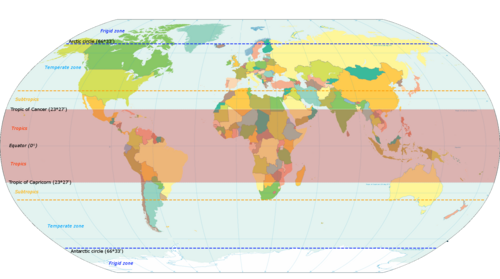
Key Facts
- Boundaries: Defined by the Tropic of Cancer (North) and the Tropic of Capricorn (South) at approximately ±23.4°.
- Surface Area: The tropics cover 39.8% of Earth's surface and 36% of its landmass.
- Population: Home to 40% of the world's population as of 2014, projected to reach 50% by 2050.
- Solar Energy: Receives the most solar radiation due to the high angle of the Sun.
- Climate Drivers: Seasons are primarily defined by rainfall rather than temperature.
Astronomical Foundations
The boundaries of the tropics are determined by the Earth's axial tilt (currently around 23.4°). The width of the tropical zone is exactly twice this tilt. The northern boundary is the Tropic of Cancer, and the southern boundary is the Tropic of Capricorn. These lines mark the northernmost and southernmost latitudes where the Sun can be a subsolar point—meaning it is directly overhead.
The term "tropic" originates from the Ancient Greek word tropē, meaning "to turn." This refers to the points where the Sun appears to "turn back" or change direction in its seasonal migration across the sky. While these boundaries were historically linked to the constellations of Cancer and Capricorn, the precession of the equinoxes has shifted these alignments over millennia.
![Relationship of Earth's axial tilt (ε) to the tropical and polar circles: the Tropic of Cancer is a subsolar point only at the June solstice, and the Tropic of Capricorn is only at the December solstice[9]](/images/62/dd/62ddf46b1815a7a30e835ac28e9b0c7ad88989382d01b955001fdfd35c501035.webp)
Climate and Seasonal Patterns
Tropical climates are diverse, ranging from lush rainforests and monsoons to arid deserts and high-altitude snow-capped mountains. Many of these areas are characterized by a wet season (or rainy/green season) and a dry season. Under the Köppen climate classification, a wet-season month is defined as having an average precipitation of 60 mm (2.4 in) or more.
The wet season often brings improved air and freshwater quality and triggers significant vegetation growth, which boosts crop yields. However, it also brings challenges, including soil erosion, river flooding, and an increased incidence of malaria when high temperatures coincide with heavy rains.
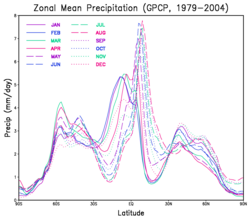
Variations in Tropical Weather
It is a common misconception that all areas within the geographical tropics have a "tropical climate." Many regions are classified as dry (arid or semi-arid), such as the Sahara Desert, the Atacama Desert, and the Australian Outback. Additionally, high-altitude regions like Mount Kilimanjaro and the Andes maintain alpine tundra and snow-capped peaks despite their tropical latitude.
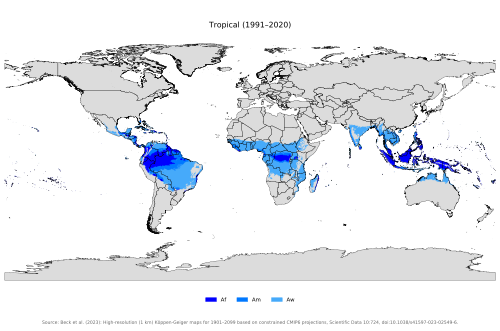
Ecosystems and Biodiversity
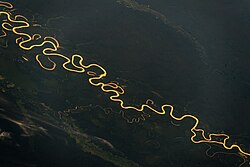
The tropics are renowned for their immense biodiversity and species endemism (species found nowhere else on Earth). These ecosystems include tropical rainforests, seasonal forests, savannahs, and grasslands. Notable examples of high-biodiversity areas include the Amazon rainforest, the rainforests of Costa Rica and Nicaragua, and the dry deciduous forests of Madagascar.
In biogeography, the region is split into two main divisions: the Paleotropics (Africa, Asia, and Australia) and the Neotropics (the Caribbean, Central America, and South America). Together, these are referred to as the Pantropic.
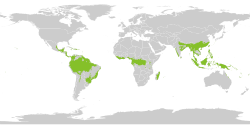
Tropical soils, particularly in rainforests, are often nutrient-poor. This makes these ecosystems highly vulnerable to slash-and-burn deforestation, a practice often used in shifting cultivation agricultural systems.
Representative Tropical Flora
The tropics support a wide array of specialized plant life. Common flora associated with these regions include:
- Fruits: Bananas, citrus fruits, dragon fruit, jackfruit, papaya, and stone fruits like mangoes and avocados.
- Cash Crops: Coffee, cacao, and rubber.
- Ornamentals and Others: Orchids, bamboo, ferns, palm trees, and the giant water lily.
Climate Change and the Future
The tropics have warmed by approximately 0.7–0.8 °C over the last century. While this is slightly below the global average, the region is heavily influenced by the El Niño-Southern Oscillation (ENSO), which creates significant natural variability. Climate models predict further warming of 1–2 °C by 2050 and 1–4 °C by 2100.
Global warming is causing tropical weather conditions to expand into the subtropics. This shift is bringing more extreme weather events, such as intense storms and heatwaves, which may eventually render certain parts of the tropics uninhabitable.
Summary of Tropical Characteristics
| Feature | Detail |
|---|---|
| Latitudinal Range | ± 23°26′09.0″ (Tropic of Cancer to Tropic of Capricorn) |
| Surface Coverage | 39.8% of Earth's surface |
| Primary Seasonal Driver | Precipitation (Wet vs. Dry) |
| Biogeographic Divisions | Paleotropics and Neotropics |
| Temperature Trend | Warmed 0.7–0.8 °C over the last century |
Frequently Asked Questions
What defines the boundaries of the tropics?
The tropics are bounded by the Tropic of Cancer in the North and the Tropic of Capricorn in the South. These boundaries correspond to the Earth's axial tilt, currently approximately 23.4°.
Do all tropical regions have rainforests?
No. While rainforests are common, the tropics also include deserts (like the Sahara), savannahs, grasslands, and even snow-capped alpine mountains.
How do seasons work in the tropics?
Unlike temperate zones that have four temperature-based seasons, the tropics generally have a wet season and a dry season, with very little variation in temperature throughout the year.
What is the difference between the Paleotropics and Neotropics?
The Paleotropics encompass the tropical regions of Africa, Asia, and Australia, while the Neotropics cover the Caribbean, Central America, and South America.
How is climate change affecting the tropics?
The tropics are experiencing a general warming trend and an expansion of tropical weather patterns into the subtropics, leading to more frequent and intense heatwaves and storms.