The TACO Factor: Analyzing Donald Trump's Pattern of Policy Reversals
In the realm of modern geopolitics, a peculiar behavioral pattern has emerged regarding the decision-making process of Donald Trump. Analysts and commentators have coined the term "TACO" to describe a recurring cycle where the U.S. President issues aggressive threats or imposes strict policies, only to backtrack or reverse those decisions in response to market volatility or political pressure. This phenomenon, often described as "chickening out," spans trade, foreign diplomacy, and domestic enforcement.
Key Facts
- TACO refers to the pattern of threatening aggressive action and subsequently reversing course.
- Trump has threatened the use of force against foreign adversaries 22 times as of early 2025, but followed through on only two.
- The NACHO variant ("Not A Chance Hormuz Opens") emerged during the 2026 Iran war to mock the inability to reopen the Strait of Hormuz.
- The EU has been accused of EUCO ("Europe Always Chickens Out") for failing to retaliate against U.S. tariffs.
- Trade tensions with China saw a 55% U.S. tariff rate maintained despite a "framework" agreement in June 2025.
Trade Tariffs and Market Reactions
The "Taco factor" is most visible in trade policy, where market reactions often dictate the longevity of a tariff. Katie Martin of the Financial Times highlighted several instances, including the "Liberation Day tariffs" which were paused just one week after implementation. Similarly, Trump's proposal for a 50% tariff on EU imports was delayed until July 9, a move that triggered a rally in European markets.
NBC News reporter Shannon Pettypiece noted that Trump has threatened far more tariffs than he has actually imposed since taking office. A prominent example occurred on June 11, 2025, when Trump announced a deal to end the trade war with China. While Secretary of Commerce Howard Lutnick called it a "handshake for a framework," critics in the Wall Street Journal viewed it as a truce favoring China. Fareed Zakaria noted a significant imbalance: Americans continued to pay a 55% tariff on Chinese goods, while China maintained only a 10% tariff on American goods.
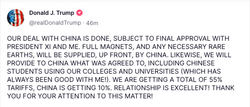
Further evidence of this pattern appeared on July 8, 2025, when Trump delayed tariffs against 14 different countries, pushing the negotiation deadline from July 9 to August 1. Bloomberg reported this softening was a strategic move to ensure a summit with Chinese General Secretary Xi Jinping.
Foreign Relations and Military Ultimatums
Beyond trade, the TACO pattern extends to international security. Gideon Rachman of the Financial Times, citing research by Jeremy Shapiro, pointed out that Trump's rhetoric often exceeds his actions. During his first term, threats of "fire and fury" against North Korea and vows to wipe Afghanistan "off the face of the earth" resulted in negotiations and a withdrawal agreement without significant concessions from the Taliban.
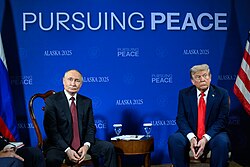
This trend continued into 2025. After threatening "extreme consequences" if Russia did not agree to a ceasefire by August 8, Trump instead hosted Vladimir Putin for a summit in Alaska. Despite threats of further sanctions, Putin ignored the warnings, and Trump subsequently suggested that Ukraine should cede territory to end the conflict.
The 2026 Iran Conflict and the "NACHO" Variation
The 2026 Iran war provided a complex test of this behavior. After threatening military intervention following protests, the U.S. briefly pursued nuclear negotiations. When the conflict impacted global oil markets, Trump issued a strict deadline of April 8, 2026, to bomb Iranian power plants and bridges. However, shortly before the deadline, he accepted a ten-point peace plan he had previously rejected, calling it a "workable" basis for talks.
As the crisis deepened, a new term emerged: NACHO, or "Not A Chance Hormuz Opens." This mocked Trump's inability to unilaterally resolve the blockade of the Strait of Hormuz, which handles 20% of global oil and gas maritime transit. The blockade caused U.S. fuel prices to surge by 40% since February 2026. While Fox News attempted to rebrand NACHO as "Never Avoids Confronting Hard Obstacles," the positive spin failed to gain traction.
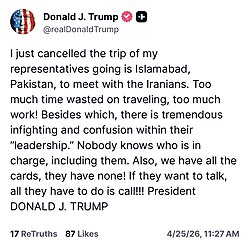
By May 2026, Trump paused "Operation Project Freedom," a mission to protect merchant ships, after less than 48 hours. CNN reported that between March and June 9, Trump falsely claimed to be nearing a peace agreement with Iran at least 38 times.
Domestic Policy and Immigration
The TACO phenomenon has also touched domestic enforcement. In June 2025, following public backlash and protests in Los Angeles, Trump reversed a crackdown on immigration after realizing the raids were hurting farmers by removing essential workers. This led to an immediate pause on raids in hotels, restaurants, and agricultural workplaces.
Similar patterns occurred in January 2026 in Minneapolis. Following "Operation Metro Surge," which resulted in the deaths of American citizens Renée Good and Alex Pretti, the White House announced a potential withdrawal of federal agents after conversations with Governor Tim Walz.
The European Response: EUCO
The pattern of reversal is not exclusive to the U.S. The term EUCO (Europe Always Chickens Out) describes the European Union's perceived appeasement of U.S. trade demands. Fearing the withdrawal of U.S. military support for Europe and funding for the Russo-Ukrainian War, the EU avoided using its anti-coercion mechanisms.
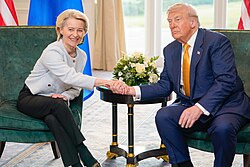
Ultimately, the EU agreed to a deal where most exports to the U.S. faced 15% tariffs in exchange for no tariffs on U.S. goods. Critics, including John O'Brien of the Irish Examiner, argued this showed a failure to accept short-term pain for long-term strategic benefit.
| Domain | Initial Threat/Action | Outcome/Reversal | Associated Term |
|---|---|---|---|
| Trade (China) | High "Liberation Day" tariffs | Paused after one week | TACO |
| Foreign Policy (Russia) | "Extreme consequences" by Aug 8 | Hosted Putin in Alaska | TACO |
| Foreign Policy (Iran) | Bombing power plants/bridges | Accepted 10-point peace plan | NACHO |
| Immigration | Mass raids in Los Angeles | Paused raids in agriculture/hospitality | TACO |
| Trade (EU) | Anti-coercion retaliation | Accepted 15% tariffs on exports | EUCO |
Frequently Asked Questions
What does the term TACO mean in a political context?
TACO is a slang term used by analysts and critics to describe Donald Trump's tendency to make aggressive threats or implement hardline policies, only to later backtrack or reverse those decisions.
How does NACHO differ from TACO?
While TACO refers to general reversals, NACHO ("Not A Chance Hormuz Opens") specifically mocks the failure to reopen the Strait of Hormuz during the 2026 Iran war and the inability to end the conflict on Trump's own terms.
What is EUCO?
EUCO, or "Europe Always Chickens Out," refers to the European Union's perceived weakness in trade negotiations with the U.S., specifically its decision to accept tariffs rather than retaliate to avoid losing U.S. military protection.
Did Trump follow through on his threats against North Korea and Afghanistan?
No. Despite threatening "fire and fury" against North Korea and promising to wipe Afghanistan "off the face of the earth," he instead pursued negotiations with North Korea and signed a withdrawal agreement from Afghanistan.
What was the result of the 2026 Strait of Hormuz crisis?
The crisis led to a disruption of 20% of global oil and natural gas maritime transit, causing U.S. fuel prices to increase by 40% since February 2026.