The Progressive Party of 1912: Roosevelt's Bull Moose Challenge
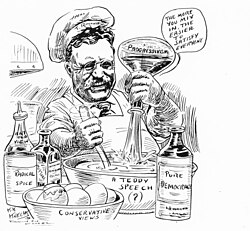
The United States presidential election of 1912 stands as one of the most volatile periods in American political history. At its center was Theodore Roosevelt, who broke away from the Republican establishment to form the Progressive Party—famously known as the Bull Moose Party. This movement represented a significant attempt to reshape the American political landscape through progressive reforms, though it ultimately served as a catalyst for a Democratic victory.
Roosevelt's campaign was characterized by high energy but limited financial backing. Many business interests that had supported him in 1904 either remained neutral or shifted their support to other candidates. Furthermore, Roosevelt faced a significant cultural hurdle: he was challenging the unwritten "no third term" rule, having already served nearly two full terms as president.
Key Facts
- Election Result: Roosevelt won 27% of the popular vote (4.1 million votes), placing second ahead of incumbent William Howard Taft (23%).
- The Split: The division between Roosevelt and Taft allowed Democrat Woodrow Wilson to win with 42% of the vote.
- Historic Performance: This was the best showing by any third party since the modern two-party system was established in 1864.
- The "Bull Moose" Origin: The party's emblem was inspired by Roosevelt's claim that he was "fit as a bull moose" after surviving an assassination attempt.
- Political Impact: The Republican split helped Democrats gain 63 U.S. House seats and 10 U.S. Senate seats.
The 1912 Campaign and the Assassination Attempt
The 1912 campaign was a grueling battle of endurance. Roosevelt's efforts were most visible in Ohio, where he traveled 1,800 miles and delivered 75 speeches to sweep the state's primary. In contrast, William Howard Taft traveled 3,000 miles and gave over 100 speeches, but failed to match Roosevelt's momentum in his own home state.
On October 14, 1912, the campaign took a dramatic turn in Milwaukee, Wisconsin. Roosevelt was shot by John Flammang Schrank. The bullet was slowed by a steel eyeglass case and a 50-page folded copy of his speech, titled "Progressive Cause Greater Than Any Individual," which he carried in his jacket pocket.
Displaying remarkable tenacity, Roosevelt refused immediate hospitalization because he was not coughing blood—a sign, based on his knowledge of anatomy, that his lung had not been penetrated. He famously told the crowd, "I don't know whether you fully understand that I have just been shot, but it takes more than that to kill a Bull Moose," and proceeded to speak for 90 minutes. Medical exams later confirmed the bullet had lodged in his chest muscle without penetrating the pleura (the membrane surrounding the lungs). Doctors decided to leave the bullet in place, and Roosevelt carried it for the rest of his life.
Election Outcomes
Despite the drama, Roosevelt fell short of the presidency. He secured 88 electoral votes, while Woodrow Wilson dominated with 435, and Taft trailed with 8. While Roosevelt was the only third-party candidate to outpoll a major party candidate, the split in the Republican vote was the essential factor in Wilson's victory.
State and Local Operations
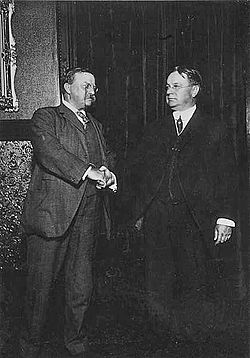
The Progressive Party's strength was concentrated in the North and West, particularly in New York, Ohio, Indiana, Illinois, and Massachusetts. In California, the party was led by Governor Hiram Johnson, a close Roosevelt ally who served as the vice presidential nominee.
| Metric | Result |
|---|---|
| Popular Vote (Roosevelt) | 27% (4.1 Million) |
| Electoral Votes (Roosevelt) | 88 |
| U.S. House Seats Won | 9 |
| Governorships Won | 0 |
| Local Offices Won | Approximately 250 |
Beyond the presidency, hundreds of candidates ran as Progressives. This included 21 candidates for governor and over 200 for U.S. Representative. Some ran under various labels, such as "Bull Moose Republicans" or the "Washington Party" in Pennsylvania.
The Decline and Dissolution (1914–1918)
The party's influence began to wane shortly after the 1912 election. By 1914, while 138 candidates ran for the U.S. House as Progressives, only five were elected. However, some individual successes remained; Hiram Johnson was re-elected as Governor of California as a Progressive, and Gifford Pinchot placed second in Pennsylvania's Senate race with 24% of the vote.
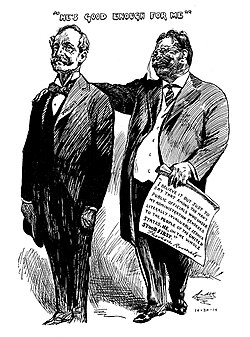
The final collapse occurred around the 1916 election. The Progressive Party attempted to reconcile with the Republicans to facilitate a unified ticket. When the Republicans refused to nominate Roosevelt, the Progressives nominated him again with John M. Parker as his running mate. However, Roosevelt refused the nomination and instead endorsed the Republican candidate, Charles Evans Hughes.
By 1918, the party had effectively vanished. All remaining Progressives in Congress rejoined the Republican Party, with the exception of Whitmell Martin, who joined the Democrats. Many former Progressives eventually found a political home in the 1930s within President Franklin D. Roosevelt's New Deal Democratic coalition.
Frequently Asked Questions
Why was the Progressive Party called the "Bull Moose Party"?
The name came from Theodore Roosevelt's assertion that he was "fit as a bull moose" after surviving an assassination attempt during his 1912 campaign.
How did the Republican split affect the 1912 election?
The split between Theodore Roosevelt and William Howard Taft divided the Republican vote, which directly enabled Democrat Woodrow Wilson to win the presidency.
What happened to the bullet that hit Theodore Roosevelt?
The bullet lodged in Roosevelt's chest muscle. Because it did not penetrate the pleura, doctors determined it was safer to leave it in place than to remove it, and he carried it for the rest of his life.
Did any Progressives win major offices?
While no Progressives won governorships in 1912, they elected nine members to the U.S. House and approximately 250 people to local offices. Hiram Johnson later won re-election as Governor of California as a Progressive.
When did the Progressive Party officially end?
The party disintegrated following the 1916 election after Roosevelt endorsed Charles Evans Hughes. By 1918, no candidates ran for governor, senator, or representative under the Progressive label.