The Platters: Pioneers of the Early Rock and Roll Era
Formed in Los Angeles in 1952, The Platters emerged as one of the most successful and influential vocal groups of the early rock and roll era. By blending the sophisticated traditions of Tin Pan Alley—the collection of music publishers and songwriters in New York City—with the burgeoning energy of rhythm and blues, they created a distinctive sound that appealed to a massive, diverse audience.
Throughout their career, the group became known by the branding tag "Many Voices One Name," reflecting a history of numerous lineup changes. Despite these shifts, their impact on music history is undeniable, marked by 40 charting singles on the Billboard Hot 100 between 1955 and 1967, including four number-one hits.
Key Facts
- Founded: 1952 in Los Angeles, California.
- Genres: Rhythm and blues, doo-wop, traditional pop, and rock and roll.
- Major Achievements: Inducted into the Rock and Roll Hall of Fame (1990) and the Vocal Group Hall of Fame (1998).
- Chart Success: 40 Billboard Hot 100 singles and four No. 1 hits.
- Legacy: The first rock and roll era group to achieve a Top Ten album in the United States.
Band Formation and Early Years
The group began as a teenage ensemble consisting of Alex Hodge, Gaynel Hodge, Curtis Williams, Joe Jefferson, and Cornell Gunter, managed by Federal Records A&R man Ralph Bass. The lineup evolved quickly; Tony Williams replaced Gunter, and Herb Reed joined in 1953 following his discharge from the U.S. Army.
The group's iconic name was born from a moment of domestic inspiration. While the members were brainstorming names at the Hodges' kitchen table, Mrs. Hodge pushed aside several 78 rpm records to make room for a plate of cookies, remarking that the records looked like "platters." Herb Reed immediately seized the idea, naming the group The Platters.
After initial struggles with Federal Records, the group was coached by music entrepreneur Buck Ram. Ram refined the lineup, adding female vocalist Zola Taylor and replacing Alex Hodge with Paul Robi in 1954, creating the "classic" incarnation of the band.
The Era of Charting Hits
The Platters' breakthrough came in the summer of 1955 with "Only You," which topped the R&B charts for seven weeks and became a pop Top Ten hit. This was followed by "The Great Pretender," written by Buck Ram in a Las Vegas hotel washroom, which became their first national No. 1 hit and spent 11 weeks atop the R&B chart.
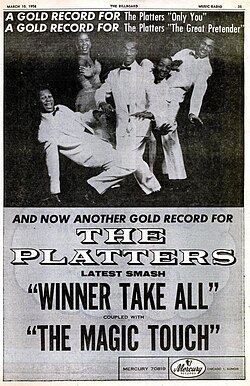
The group's success grew as they mastered the art of updating older standards. Their version of Jerome Kern's "Smoke Gets in Your Eyes" topped both American and British charts, despite initial concerns from Kern's widow that the song would be turned into a "rock and roll" record. Other notable hits included "(You've Got) The Magic Touch" (No. 4), "Enchanted" (No. 12), and "I'm Sorry" (No. 11).
Their cultural footprint extended to cinema, appearing in the first major rock and roll motion picture, Rock Around the Clock, where they performed their signature hits.
Changing Lineups and Internal Conflict
The group's stability fractured in 1960 when lead singer Tony Williams left for a solo career. He was replaced by Sonny Turner, but the transition sparked a legal battle with Mercury Records, which refused to release new material without Williams. This period began a long cycle of splintering, with members like Zola Taylor and Paul Robi eventually departing and being replaced by various singers, including Sandra Dawn and Nate Nelson.
By the late 1960s and 70s, the group's identity became mired in conflict. Multiple versions of The Platters toured simultaneously, led by former members Williams, Robi, and Taylor. Buck Ram attempted to maintain control by forming the "Buck Ram Platters," which saw a brief chart resurgence in 1966–67 with hits like "I Love You 1000 Times" and "Washed Ashore."
Legal Battles Over the Legacy
The proliferation of "fake" Platters groups led to decades of litigation. Legal disputes involved various entities, including Jean Bennett's Personality Productions and several former members. A significant battle occurred between Paul Robi and Buck Ram, with Robi winning the right to use the name shortly before his death in 1989.
Eventually, Herb Reed—the only member to appear on every original recording through 1969—established Herb Reed Enterprises to protect the trademark. Through a series of judgments in 2011 and 2014, Reed's companies were declared to have superior rights to the name, successfully suing other groups (such as those led by Monroe Powell) to ensure they identified themselves as "tributes" or "salutes" rather than the official act.
| Era/Lineup | Key Members | Primary Label |
|---|---|---|
| Original (1952–1953) | Cornell Gunter, Alex Hodge, Gaynel Hodge, Curtis Williams, Joe Jefferson | Federal |
| Federal (1953–1954) | Tony Williams, Alex Hodge, Gaynel Hodge, David Lynch, Herb Reed | Federal |
| Mercury Classic (1955–1959) | Tony Williams, Herb Reed, David Lynch, Paul Robi, Zola Taylor | Mercury |
| Mercury Late (1959–1965) | Sonny Turner, Herb Reed, Paul Robi, Zola Taylor, David Lynch, Barbara Randolph | Mercury |
| Musicor (1966–1970) | Sonny Turner, Herb Reed, Paul Robi, David Lynch, Nate Nelson, Sandra Dawn, Bob White | Musicor |
| Official (2024) | Lance Bernard Bryant, Omar Ross, Jovian Ford, Brittany Michelle Wallace | N/A |
Frequently Asked Questions
How did The Platters get their name?
The name was suggested by Herb Reed after Mrs. Hodge pushed aside several 78 rpm records on a kitchen table, noting that they looked like "platters."
Who was the lead singer during their most successful period?
Tony Williams was the lead tenor during the group's most successful era (1955–1959), providing the distinctive voice for hits like "Only You" and "The Great Pretender."
Why were there so many different versions of The Platters?
Following the departure of key members and disputes with manager Buck Ram, various former members formed their own groups, leading to decades of legal battles over the trademark and the right to perform under the name.
What is the significance of "Smoke Gets in Your Eyes"?
The song demonstrated the group's ability to successfully adapt traditional standards into a rock and roll style, topping both the American and British charts despite initial controversy from the composer's widow.
Who eventually won the legal rights to the name?
Herb Reed and his companies obtained judgments declaring their rights to the name superior to all others, including those of Jean Bennett and various tribute acts.