The Creation of Adam: Michelangelo's Masterpiece in the Sistine Chapel
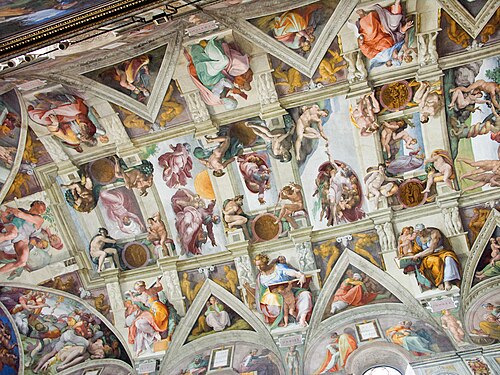
The Creation of Adam (Italian: Creazione di Adamo), also known as The Creation of Man, is one of the most iconic works of Western art. Painted by the Italian master Michelangelo between 1508 and 1512, this massive fresco is a central component of the Sistine Chapel's ceiling in Vatican City. The work illustrates the Biblical narrative from the Book of Genesis, capturing the precise moment God breathes life into Adam, the first human.
As part of a larger, complex decorative scheme, this panel is the fourth in a chronological series depicting episodes from Genesis. It stands as a testament to Michelangelo's mastery of the human form and his deep understanding of both theology and anatomy.
Key Facts
- Artist: Michelangelo
- Date: Completed c. 1512
- Medium: Fresco (painted on ceiling plaster)
- Dimensions: 280 cm × 570 cm (9 ft 2 in × 18 ft 8 in)
- Location: Sistine Chapel, Vatican City
- Subject: The creation of the first man as described in Genesis
Historical Context and Commission
Michelangelo's journey to the Sistine Chapel began in 1505 when Pope Julius II invited him back to Rome. Initially, the artist was commissioned to create a monumental tomb for the Pope, featuring forty statues. However, this project was plagued by interruptions and was never finished to Michelangelo's satisfaction, though it produced the famous figure of Moses (1516).
During this period, Michelangelo was tasked with painting the Sistine Chapel ceiling. Historical accounts suggest that Bramante, an architect working on St. Peter's Basilica, may have influenced the Pope to assign this task to Michelangelo. Bramante reportedly hoped the artist would fail, as fresco painting was a medium in which Michelangelo was then unfamiliar.
Despite these challenges, Michelangelo completed the vast composition, which covers over 500 square metres and features more than 300 figures. The ceiling is organized into three main groups: the creation of the world, the creation and fall of man, and the story of Noah. Supporting the ceiling are pendentives featuring twelve prophets and Sibyls—prophetic women from the Classical world.
Composition and Symbolism
The painting depicts God as an elderly man with a white beard, enveloped in a swirling cloak. Adam is shown on the lower left, completely naked and inert. The focal point of the work is the near-touching index fingers of God and Adam. God's outstretched arm imparts the spark of life, while Adam's mirroring pose reflects the Biblical verse, "Let us make humankind in our image, according to our likeness" (Gen. 1:26).
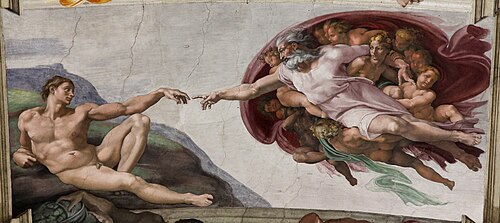
The small gap—approximately 3/4 inch (1.9 cm)—between the two fingers is often interpreted by scholars as a symbol of the unattainability of divine perfection by humanity. Additionally, the figure protected by God's left arm is widely believed to be Eve, with the surrounding figures representing the unborn souls of the entire human race, though this interpretation is debated due to theological conflicts regarding the pre-existence of souls.
Scientific and Anatomical Interpretations
Because of Michelangelo's extensive study of human anatomy, many researchers have proposed that the painting contains hidden scientific meanings.
The Human Brain Hypothesis
In 1990, physician Frank Meshberger noted that the shapes surrounding God closely resemble an anatomically accurate cross-section of the human brain. He identified features such as the Sylvian fissure (a deep fold in the cerebrum), the brain stem, the pituitary gland, and the optic chiasm. Later studies, such as those by I.A. Pireev, suggest the work reflects Aristotle's "three-ventricle" theory of perception, interpreting the scene as the emergence of human intelligence.
The Birth Process and Hidden Ribs
Other theories suggest the red cloak surrounding God is a "uterine mantle," shaped like a human uterus, with the green scarf representing an umbilical cord. This would explain why Adam is depicted with a navel, despite being created rather than born. Furthermore, some analysts have pointed out a concealed rib on the left side of Adam's torso, which may represent the rib used to create Eve.
Preliminary Studies and Influence
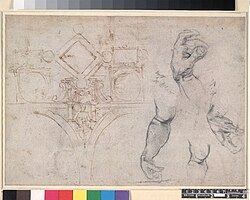
Michelangelo's meticulous planning is evident in two surviving sketches held by the British Museum. One is a study of arms and hands from 1508, and the other is a study of a reclining male nude from 1511. The latter was executed in red chalk, a medium that allowed Michelangelo to create a unique, shimmering skin surface.
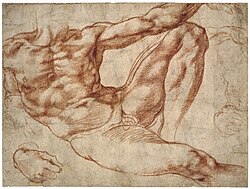
The physical inspiration for Adam's torso is believed to be the Belvedere Torso, a fragmentary Roman copy of an ancient Greek sculpture. Michelangelo frequently looked to classical statuary to perfect his depiction of the human physique.
Summary of Artwork Details
| Attribute | Detail |
|---|---|
| Artist | Michelangelo |
| Period | High Renaissance (1508–1512) |
| Technique | Fresco on ceiling plaster |
| Key Figures | God, Adam, and surrounding angels/figures |
| Primary Theme | The transmission of life from Creator to Man |
| Anatomical Theories | Human brain, uterus, and Eve's rib |
Frequently Asked Questions
Why is there a gap between the fingers of God and Adam?
While the gap creates a powerful sense of anticipation, many scholars believe it symbolizes the inherent distance between the divine and the human, suggesting that divine perfection is unattainable for mankind.
Did Michelangelo actually intend to paint a brain?
This is a subject of ongoing debate. While physicians have noted striking similarities to neuroanatomy, art historians are divided on whether this was a conscious scientific statement or a coincidental result of Michelangelo's general anatomical expertise.
What is a fresco?
A fresco is a technique of mural painting executed upon freshly laid, or "wet," lime plaster. This allows the pigments to become an integral part of the wall or ceiling as the plaster dries.
Who is the woman behind God in the painting?
The most widely accepted theory is that she is Eve. Other suggestions include the Virgin Mary, Sophia (the personification of wisdom), or a personified human soul.
How long did it take to paint the Sistine Chapel ceiling?
The entire ceiling, which includes The Creation of Adam and several other panels, took approximately four years to complete, from 1508 to 1512.