Michelangelo: The Definitive Master of the High Renaissance
Michelangelo di Lodovico Buonarroti Simoni (1475–1564) stands as one of the most influential figures in the history of Western art. A true Renaissance man—a polymath skilled in multiple disciplines—he achieved unparalleled mastery as a sculptor, painter, architect, and poet. While born in the Republic of Florence, much of his professional life was spent in Rome, where he worked under the patronage of several popes and the powerful Medici family.
His work, deeply inspired by the ideals of classical antiquity, bridged the gap between the High Renaissance and Mannerism (a style characterized by artificiality and emotional tension). Because of the extensive surviving records of his sketches and correspondence, Michelangelo remains one of the most well-documented artists of the 16th century.
Key Facts
- Full Name: Michelangelo di Lodovico Buonarroti Simoni.
- Lifespan: March 6, 1475 – February 18, 1564 (aged 88).
- Primary Disciplines: Sculpture, painting, architecture, and poetry.
- Defining Movements: High Renaissance and Mannerism.
- Most Famous Works: The statue of David, the Sistine Chapel ceiling, and the Pietà.
- Key Patrons: The Medici family and various Popes, including Julius II, Leo X, and Clement VII.
Early Life and Artistic Foundations
![Speculation exists that this might be a drawing by Michelangelo portraying Tommaso dei Cavalieri.[83][84]](/images/46/26/46265a39cffe550e045a75565e980e435ad4bc9d699397235621480492ccc96c.jpg)
Michelangelo's journey began in Caprese, Florence. At age 13, he entered the workshop of Domenico Ghirlandaio, a master of fresco (painting on wet lime plaster), perspective, and portraiture. His talent was recognized early; by 1489, he was one of the two best pupils sent by Ghirlandaio to serve Lorenzo de' Medici, the de facto ruler of Florence.
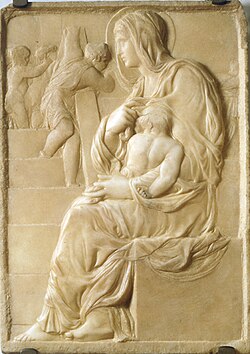
During his youth, Michelangelo attended the Platonic Academy, a Humanist center where he was influenced by philosophers like Marsilio Ficino and Pico della Mirandola. This intellectual environment shaped his outlook and led to early works such as the Battle of the Centaurs and the Madonna of the Stairs.
The Master Sculptor
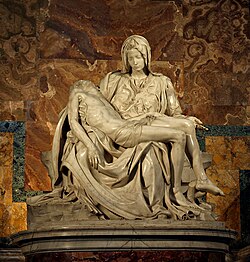
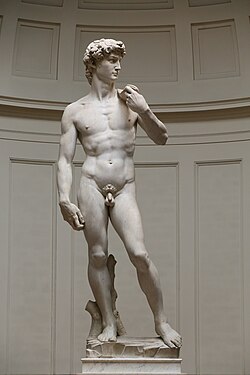
Though he excelled in many fields, Michelangelo viewed himself primarily as a sculptor. His early career in Rome produced the Pietà, a heartbreaking depiction of the Virgin Mary cradling the dead body of Christ, and the monumental David, which became a symbol of Florentine freedom and a pinnacle of Renaissance sculpture.
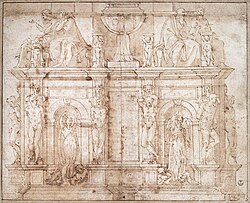
His sculptural ambitions extended to massive projects, most notably the Tomb of Pope Julius II. This project, which spanned decades, included the powerful figure of Moses. Later in life, he created the Medici Chapel in the Basilica of San Lorenzo, featuring allegorical figures representing Night, Day, Dusk, and Dawn.
The Sistine Chapel and Painting
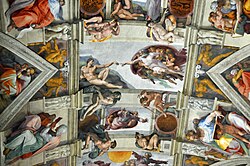
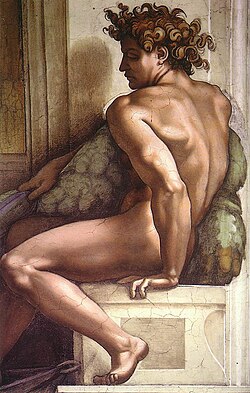
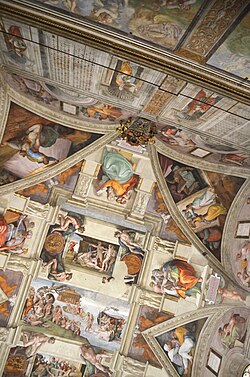
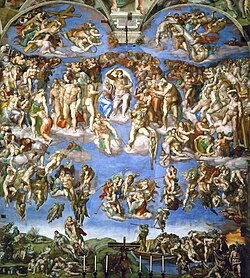
Despite his preference for sculpture, Michelangelo was commissioned by Pope Julius II to paint the ceiling of the Sistine Chapel between 1508 and 1512. This monumental task took approximately four years and includes the iconic Creation of Adam. He returned to the chapel decades later (1534–1541) to paint The Last Judgment on the altar wall.
Architectural Legacy and Final Years
In his later years, Michelangelo focused heavily on architecture. He designed the vestibule of the Laurentian Library in Florence, utilizing dynamic forms that are now seen as precursors to Baroque architecture. His final great architectural achievement was the design of the dome of St Peter's Basilica in Rome.
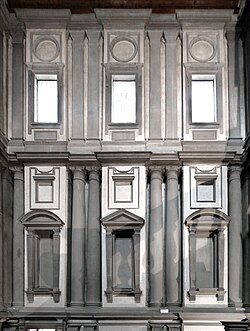
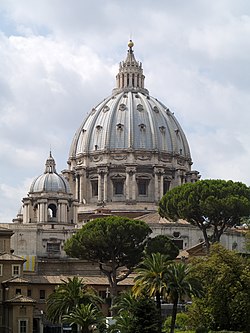
Michelangelo's relationship with the Medici family was complex. He supported the Florentine Republic and was even sentenced to death by Pope Clement VII (a Medici) during the city's political turmoil. He is believed to have hidden in a small chamber beneath the Medici chapels, where he created numerous charcoal drawings.
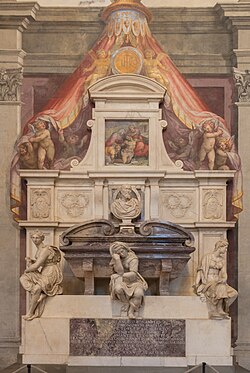
Michelangelo died in Rome in 1564 at the age of 88. Per his request, he was buried in Florence at the Basilica of Santa Croce in a tomb designed by Giorgio Vasari.
Summary of Notable Works
| Work | Date(s) | Category | Location/Note |
|---|---|---|---|
| Pietà | 1498–1499 | Sculpture | St Peter's Basilica |
| David | 1501–1504 | Sculpture | Florence |
| Sistine Chapel Ceiling | 1508–1512 | Painting | Vatican City |
| Moses | 1513–1515 | Sculpture | Tomb of Julius II |
| The Last Judgment | 1536–1541 | Painting | Sistine Chapel |
| St Peter's Dome | 1546–1564 | Architecture | Vatican City |
Frequently Asked Questions
Was Michelangelo primarily a painter or a sculptor?
Although he is world-famous for the Sistine Chapel paintings, Michelangelo considered himself primarily a sculptor. He often viewed his painting commissions as distractions from his true passion for carving marble.
What is the significance of the 'Renaissance Man' label?
The term refers to an individual with expertise across diverse fields. Michelangelo embodied this by achieving mastery in sculpture, painting, architecture, and poetry, alongside his contemporary Leonardo da Vinci.
How did the Medici family influence his career?
The Medici family were his earliest and most consistent patrons. They provided him with an education at the Platonic Academy and commissioned major works like the Medici Chapel, though his relationship with them was often strained by political conflicts.
What is Mannerism in the context of Michelangelo's work?
Mannerism was a stylistic shift away from the balanced proportions of the High Renaissance toward more elongated figures and emotional, dynamic compositions, which can be seen in Michelangelo's later works.
Where is Michelangelo buried?
He is buried in the Basilica of Santa Croce in Florence, Italy, in a monumental tomb designed by Giorgio Vasari.