Syrian Ba'athist Flags: A History of Symbolism and Arab Unity
The flags of Ba'athist Syria are more than mere national markers; they are visual records of the country's political ambitions and its long-standing pursuit of Arab unity. Since the 1963 coup d'état, the Syrian Arab Republic has utilized various iterations of the red, white, and black triband, each reflecting a different era of diplomatic alignment and ideological shift.
Key Facts
- The red-white-black horizontal triband has been the consistent base for Ba'athist Syrian flags.
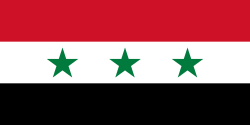
- Three green stars originally symbolized the unity of Egypt, Syria, and Iraq, as well as the Ba'athist pillars of unity, freedom, and socialism.
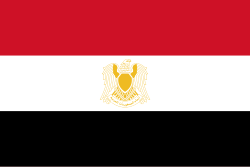
- The Hawk of Quraish was used between 1972 and 1980 during the Federation of Arab Republics.
- The two-star flag, readopted in 1980, was originally the flag of the United Arab Republic (1958–1961).
- The 2012 Constitution formally defined the flag's dimensions and colors in Article 6.
The Era of Three Stars (1963–1972)
Following the Ba'athist coup d'état in 1963, the Revolutionary Command Council adopted a new national flag on March 8, 1963. This design featured a horizontal triband of red, white, and black with three green stars centered in the white band.
The design was born from negotiations in Cairo between the Ba'athist governments of Syria and Iraq, who sought to form a union with Egypt. Although the Iraqi government was overthrown in November 1963, causing the union process to fail, both nations kept the three-star design. These stars represented the intended federation of Egypt, Syria, and Iraq, and mirrored the three pillars of Ba'athism: Waḥda (unity), Ḥurriyya (freedom), and Ishtirākiyya (socialism).
The Federation of Arab Republics (1972–1980)
On January 1, 1972, President Hafez al-Assad introduced a new flag to mark Syria's entry into the Federation of Arab Republics, alongside Egypt and Libya. In this version, the green stars were replaced by the Hawk of Quraish, a symbol associated with the tribe of the Prophet Muhammad.
While the hawk bore a ribbon with the name of the federation, Syria's version differed from those of Egypt and Libya by omitting the country's name from the coat of arms. This flag remained the official symbol of the state during the 1973 Yom Kippur War. Despite the federation dissolving in 1977, Syria continued to fly this flag until March 29, 1980.
The Return to the Two-Star Flag (1980–2024)
On March 30, 1980, Syria transitioned to a two-star flag. This design was not new; it had been adopted in 1958 during Syria's membership in the United Arab Republic (UAR), a union with Egypt that lasted until 1961. By readopting the UAR flag, the Syrian government aimed to signal its enduring commitment to Arab unity, even though it was no longer part of a formal state union.
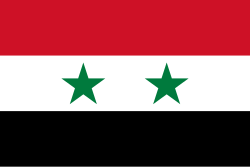
Over time, the flag became a point of contention. During the Syrian civil war, the two-star flag became closely associated with the Ba'ath Party and the government of Bashar al-Assad, leading to disputes over its representation.
Constitutional Definition
The specifications of the flag were codified in Article 6 of the 2012 Constitution of Syria. The law defines the flag as a rectangular shape with a width equal to two-thirds of its length, consisting of three equal horizontal bands of red (top), white (middle), and black (bottom), with two five-pointed green stars centered in the white band.
Summary of Ba'athist Syrian Flags
| Period | Key Symbol | Political Context | Significance |
|---|---|---|---|
| 1963–1972 | Three Green Stars | Proposed Egypt-Syria-Iraq Union | Unity, Freedom, and Socialism |
| 1972–1980 | Hawk of Quraish | Federation of Arab Republics | Alliance with Egypt and Libya |
| 1980–2024 | Two Green Stars | Post-UAR Readoption | Commitment to Arab Unity |
Frequently Asked Questions
What do the three stars on the 1963 flag represent?
The three stars represented the proposed union between Egypt, Syria, and Iraq, as well as the three core pillars of Ba'athism: unity, freedom, and socialism.
What is the Hawk of Quraish?
The Hawk of Quraish is a symbol of the tribe of Muhammad and served as the central emblem of the Syrian flag from 1972 to 1980 during the Federation of Arab Republics.
Why did Syria use a flag from 1958 in the 1980s?
Syria readopted the flag of the United Arab Republic (UAR) to demonstrate its continued ideological commitment to the concept of Arab unity.
How is the flag described in the 2012 Syrian Constitution?
Article 6 describes the flag as a red, white, and black horizontal triband with two five-pointed green stars in the middle, with a width that is two-thirds of its length.
Why did the flag become disputed during the Syrian civil war?
The flag became a symbol of political division because it was strongly associated with the Ba'ath Party and the government of Bashar al-Assad.