Syrian Arab Army
The Syrian Arab Army (SAA) is the primary land warfare branch of the Syrian Armed Forces. Founded on August 1, 1945, the army has evolved through decades of regional conflict and internal strife to its current form. Headquartered in Damascus, the army operates under the motto "Guardians of the Homeland" (حُمَاةَ الديار) and maintains a force size of approximately 100,000 personnel.
From its early years to the complex dynamics of the 21st century, the SAA has been central to Syria's national security and its involvement in numerous Middle Eastern crises.
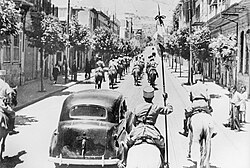
Key Facts
- Founded: August 1, 1945.
- Commander-in-Chief: President Ahmed al-Sharaa.
- Minister of Defense: Major General Murhaf Abu Qasra.
- Chief of the General Staff: Major General Ali Noureddine Al-Naasan.
- Primary Role: Land warfare.
- Headquarters: Damascus.
- Current Size: Approximately 100,000 personnel.
Historical Engagements
The Syrian Arab Army has a long history of participation in both domestic and international conflicts. Its operational history is marked by several major wars and interventions.
Early and Mid-Century Conflicts
Following its inception, the army was involved in the 1948 Arab–Israeli War and various reprisal operations. It also played a role in the First Iraqi–Kurdish War and the Six-Day War.
Late 20th Century Operations
Between 1970 and 2010, the SAA engaged in the War of Attrition, the Yom Kippur War (October War), and the events of Black September. A significant portion of its operational focus during this era was the Lebanese Civil War and the subsequent 1982 Lebanon War, where it utilized advanced equipment such as French-made MILAN anti-tank guided missiles (ATGMs).
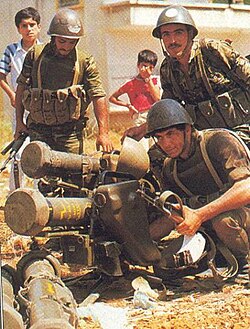
The Syrian Civil War and Beyond
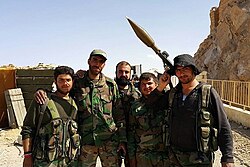
The army faced immense challenges during the Syrian civil war, including significant defections and impaired strength. However, it remained active in major operations such as the siege of Nubl and al-Zahraa and the 2016 Palmyra offensive. More recently, the army has been involved in 2024 offensives in Aleppo, Hama, Deir ez-Zor, and Homs, as well as clashes in Western and Southern Syria extending into 2025.
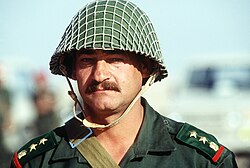
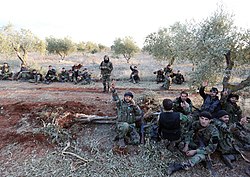
Organizational Structure
The structure of the Syrian Arab Army has undergone several transformations. Historically, the army was organized into three Corps (Falaq), each containing 3 to 4 divisions. A standard division typically consisted of 5,000 to 15,000 men divided into brigades or regiments.
Unit Composition
- Mechanized Division: Typically includes 3 mechanized battalions (105 IFVs each) and 1 armored battalion (41 tanks), totaling roughly 3,500 soldiers.
- Armored Division: Typically includes 3 armored battalions (105 tanks each) and 1 mechanized battalion (31 IFVs), totaling roughly 2,500 soldiers.
- Regiments (Fawj): Approximately 1,500 men, categorized as either Light Infantry or Artillery.
Modern Command (July 2026)
As of July 2026, the army is organized into regional corps to manage various sectors of the country:
- Northern Syria Corps: Led by Brigadier General Awad al-Jassem.
- Coastal Syria Corps: Led by Brigadier General Munir al-Sheikh.
- Central Syria Corps: Led by Brigadier General Haythem al-Ali.
- Eastern Syria Corps: Led by Brigadier General Ahmed al-Jassem.
- Southern Syria Corps: Led by Brigadier General Omar Jaftashi.
Military Equipment and Capabilities
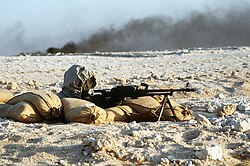
The SAA maintains a diverse arsenal of armored vehicles and artillery. As of mid-2010, the inventory included approximately 9,300 armored fighting vehicles, consisting of 4,950 main battle tanks and 3,950 infantry fighting vehicles (IFVs) and armored personnel carriers (APCs).
Artillery and Anti-Aircraft Systems
The army's firepower is supported by over 2,030 towed artillery pieces and 500+ self-propelled artillery pieces (122mm and 152mm). Air defense is bolstered by 4,184 MANPADS (Man-Portable Air-Defense Systems) and over 1,225 anti-aircraft guns.
Missile Arsenal
Syria possesses a wide range of surface-to-surface missiles with varying ranges and precision levels.
| Missile Name | Range (km) | Warhead Mass (kg) | Type |
|---|---|---|---|
| SS-1C Scud-B | 300 | 1000 | SRBM |
| SS-1D Scud-C / Golan-1 | 600 | 770 | SRBM |
| Fateh-110 (Tishreen) | 300 | 500 | SRBM |
| SS-21 Scarab | 70–120 | 420 | SRBM |
| Zelzal-2 | 210 or 400+ | 600 | SRBM |
Frequently Asked Questions
When was the Syrian Arab Army founded?
The Syrian Arab Army was founded on August 1, 1945.
Who is the current Commander-in-Chief?
The Commander-in-Chief is President Ahmed al-Sharaa.
What is the primary role of the SAA?
The primary role of the Syrian Arab Army is land warfare.
What are the standard colors for SAA uniforms?
Service uniforms are typically Khaki or Olive, while combat uniforms are Green, Black, or Khaki.
What is the range of the Fateh-110 missile?
The Fateh-110 (also known as Tishreen or M-600) has a range of 300 kilometers.