Sun of May: The Solar Symbol of Argentina and Uruguay
The Sun of May (Spanish: Sol de Mayo) is a powerful national emblem shared by Argentina and Uruguay. Featured prominently on their flags and coats of arms, this golden solar disc serves as a visual reminder of the struggle for independence in the Río de la Plata region. Named after the May Revolution of 1810—the pivotal event that sparked the independence process from Spanish rule—the symbol has evolved from a military insignia into a standardized icon of national identity.
While popular belief often links the symbol to Inti, the solar deity of the Incas, historical evidence suggests a different lineage. No contemporary sources from the era of its creation confirm an Inca origin; instead, the design is widely considered a descendant of the "sun in splendour," a common motif in European heraldry. This traditional design features a golden disc with a human face, surrounded by alternating straight and flaming rays.
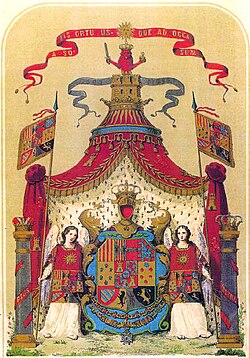
Key Facts
- Origin: Named after the May Revolution of 1810 in the Viceroyalty of the Río de la Plata.
- Design: A golden disc with a face and alternating straight and flaming rays.
- Argentina's Version: Features 32 rays and was standardized based on the 1813 Potosí coins.
- Uruguay's Version: Features 16 rays, adhering to European heraldic conventions.
- Legalization: Both countries standardized their designs in the mid-20th century (Argentina in 1944, Uruguay in 1952).
The Evolution of the Sun in Argentina
First Official Uses
The sun first appeared as a military insignia in late 1810. However, its first formal institutional use was in 1813 on the seal of the Constituent Assembly of the United Provinces of the Río de la Plata. This seal eventually became the basis for Argentina's national coat of arms.
During this period, the Assembly ordered a redesign of Spanish real coinage produced at the Mint of Potosí. The new coins featured the assembly's seal on the obverse and the sun in its entirety on the reverse. These coins established the 32-ray design, doubling the 16 rays typically found in European heraldry.
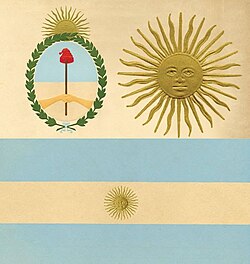
Integration into the National Flag
In 1818, under Supreme Director Juan Martín de Pueyrredón, the sun was officially added to the "flag of war" to distinguish national warships from merchant vessels. For much of the 19th century, a strict distinction existed: the version with the sun represented the state and military, while civilians and merchant ships used a version without the sun.
Because early legislation did not specify the sun's exact appearance, designs varied wildly. Some were intricate and ornate, while others were simple. During the era of Juan Manuel de Rosas, the sun was occasionally depicted in red to signal adherence to the Federalist cause. It was not until 1944, through Decree 10302/44, that the design was officially standardized to match the 1813 Potosí coins. Finally, in 1985, Law 23,208 eliminated the distinction between civilian and state flags, making the sun-emblazoned flag the sole national symbol for all citizens.
The Sun of May in Uruguay
Adoption and Early Variations
Uruguay emerged as an independent state in 1828 following the Cisplatine War. Drawing on the symbolism of Argentine independence, Uruguay adopted a flag featuring the Sun of May in the upper left corner. Initially, the flag had nine light blue and nine white stripes (representing the nine original departments), later reduced to four blue stripes and five white ones.
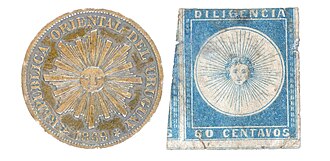
For over a century, the Uruguayan sun lacked a rigid legal definition, leading to a variety of "radiant sun" styles. These often featured a faceted disc with numerous straight rays of varying lengths, appearing on everything from the first postage stamps of 1856 to the façade of the Teatro Solís.

Standardization and Heraldry
In the early 20th century, Uruguay began aligning its symbols with European heraldic standards. A 1908 decree introduced a design by Miguel J. Coppetti, featuring 16 alternating straight and flame-like rays. This design was notably similar to a carved sun found on the chair of General Juan Antonio Lavalleja.

While the coat of arms changed first, the flag's sun remained varied until the 1920s. By the 1930 World Cup, the flag already resembled its modern form. The process was finalized on February 18, 1952, when a decree officially mandated the golden sun with 16 alternating rays set within a white square.
Comparison of National Solar Symbols
| Feature | Argentina | Uruguay |
|---|---|---|
| Number of Rays | 32 | 16 |
| Ray Style | Alternating straight and flaming | Alternating straight and flaming |
| Primary Influence | 1813 Potosí Coinage | European Heraldry |
| Standardization Year | 1944 | 1952 |
| Flag Position | Center of the white band | Upper left white square |
Frequently Asked Questions
Does the Sun of May represent the Inca god Inti?
While it is widely claimed in later Argentine historiography that the sun represents Inti, the solar god of the Incas, there are no contemporary sources from the 1810s to confirm this. The design more likely stems from the "sun in splendour" motif used in European heraldry.
Why does the Argentine sun have 32 rays?
The 32-ray design was established by the first national coins minted in Potosí in 1813. This was a departure from the standard 16 rays found in European heraldic traditions.
Was the Argentine flag always the same for everyone?
No. Until 1985, there was a legal distinction: the flag with the sun was reserved for the state and military (the "greater flag"), while civilians and merchant vessels were required to use the version without the sun.
How does the Uruguayan Sun of May differ from the Argentine one?
The primary differences are the number of rays (16 in Uruguay versus 32 in Argentina) and its placement on the flag (a white square in the upper left corner for Uruguay, and the center of the white band for Argentina).
What is the significance of the "flaming" rays?
The alternating straight and flaming (or wavy) rays are a standard convention of European heraldry used to represent the two different types of solar light: the light of the sun (straight) and the heat of the sun (flaming).