Argentine National Flag: History, Design, and Symbolism
The national flag of Argentina, known in Spanish as the bandera Argentina, is one of the most recognizable symbols of South American identity. Characterized by its striking triband of baby blue and white, the flag serves as a powerful emblem of the nation's journey toward sovereignty and independence.
Created by General Manuel Belgrano, the flag first flew in the city of Rosario on February 27, 1812, during the Argentine War of Independence. While its adoption was initially met with resistance from the First Triumvirate, it eventually became the definitive symbol of the state, evolving through various political eras to reach its current standardized form.
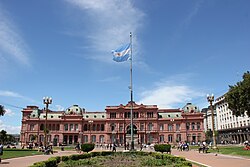
Key Facts
- Designer: Manuel Belgrano.
- First Raised: February 27, 1812, in Rosario.
- Official Proportions: 5:8 (or 10:16).
- Core Colors: Baby blue (sky blue) and white.
- Central Emblem: The Sun of May (Sol de Mayo).
- Flag Day: June 20, commemorating Belgrano's death.
Design and Specifications
The Argentine flag consists of three equally wide horizontal bands. The top and bottom bands are baby blue, while the central band is white. In the center of the white stripe sits the Sun of May, a golden yellow emblem representing the Inca sun god, Inti.
The Sun of May
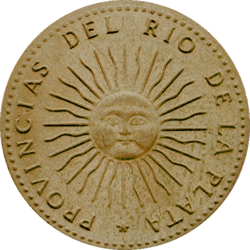
Added to the design in 1818 by Juan de Dios Rivera Túpac, the Sun of May is a golden-yellow disc featuring a human face. It is surrounded by 32 rays—16 straight and 16 wavy. Since 1978, the sun's dimensions have been strictly specified: the outer diameter is 25 cm (equal to 5/6 of the white stripe's height), and the inner diameter is 10 cm.
Shape, Size, and Proportions
The official proportions of the flag were defined in 2002 by the Instituto Argentino de Normalización y Certificación as 5:8. This puts Argentina among a small group of nations, including Poland and Sweden, that utilize this specific ratio. Previously, from 1978, the official size was 0.9 by 1.4 meters.
Official Color Palette
The colors are precisely defined using the CIE 1976 standard to ensure consistency across different mediums, from textiles to digital displays.
| Color | Hex Code | RGB | CMYK | Pantone (Print) |
|---|---|---|---|---|
| Sky Blue | #74ACDF | 116, 172, 223 | 100%, 68%, 0%, 37% | 284 C / 284 U |
| Yellow | #F6B40E | 246, 180, 14 | 0%, 18%, 100%, 0% | 1235 C / 116 U |
| Brown | #85340A | 133, 52, 10 | 16%, 0%, 10%, 24% | 483 C / 483 U |
Historical Evolution
From Spanish Rule to Independence
Following the May Revolution of 1810, the United Provinces of the Río de la Plata initially continued using the Spanish flag, as the government claimed to act on behalf of King Ferdinand VII. This practice ended after the formal declaration of independence on July 9, 1816, when the blue and white colors created by Belgrano were officially adopted.
The Belgrano and Artigas Eras
General Manuel Belgrano's commitment to the new colors was steadfast. Despite orders from the First Triumvirate to abandon the flag, Belgrano led his troops in swearing allegiance to the banner in 1813 at the Salado River. Parallel to this, the Artigas flag was used by the League of the Free Peoples, featuring a design by José María de Roo that eventually included a diagonal red stripe to distinguish it from opposing forces.
Political Shifts and Color Variations
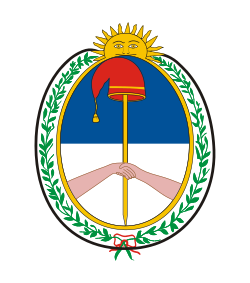
Throughout the 19th century, the flag's appearance shifted with political tides. Under Juan Manuel de Rosas (1829–1835), the blue was changed to turquoise to differentiate the Federalist Party from the Unitarians. Later, the State of Buenos Aires used a version featuring the Greater Coat of Arms of Argentina until the country unified in 1861.
Modern Usage and Traditions
In the 20th century, the flag's design was further standardized. A significant legal change occurred in 1985 with Law 23,208, which granted both government institutions and private individuals the right to use the official flag featuring the Sun of May.
To honor the flag's creator, June 20 is celebrated as Flag Day. This national holiday is often commemorated at the National Flag Memorial in Rosario, a massive complex inaugurated in 1957.
Frequently Asked Questions
Who designed the Argentine flag?
The flag was designed by General Manuel Belgrano and first raised on February 27, 1812.
What does the Sun of May represent?
The Sun of May is a golden emblem representing the Inca sun god, Inti, and was added to the flag in 1818.
Why are the colors blue and white?
While there are multiple interpretations, the colors were chosen by Manuel Belgrano and were officially recognized as the national colors by the Congress of Tucumán in 1816.
Can private citizens use the flag with the sun?
Yes. While older decrees restricted the sun emblem to government use, Law 23,208 passed in 1985 allows both individuals and government entities to use the official flag with the sun.
What is the official proportion of the flag?
The official proportion is 5:8 (or 10:16), as defined by the Instituto Argentino de Normalización y Certificación in 2002.