Subak: The Ancient Korean Art of Hand Striking
Subak (Korean: 수박; Hanja: 手搏) is a historical Korean martial art and combat sport that dates back to antiquity. Literally translating to "hand striking" or "bare-hand fighting," Subak represents a hybrid approach to combat, blending powerful striking with sophisticated grappling techniques. While it once held a prominent place in Korean military training and royal entertainment, much of its original technical detail remains a subject of scholarly debate due to the fragmentary nature of surviving records.
From the murals of ancient tombs to the annals of royal courts, Subak served as both a practical method of warfare and a competitive sport. Today, it exists as a point of cultural study and a focus for modern revival movements seeking to reclaim Korea's ancestral fighting traditions.
Key Facts
- Origin: Korea, with records spanning the Three Kingdoms, Goryeo, and Joseon periods.
- Combat Style: A hybrid system featuring striking, throws, and joint locks.
- Etymology: Derived from su (hand) and bak (to strike/fight).
- Historical Status: Used in military examinations and as royal court entertainment.
- Modern Status: Subject of reconstruction efforts, notably through Songdo Subak.
Etymology and Meaning
The term Subak is composed of the characters su (hand) and bak (to strike or fight). While it specifically translates to "hand striking," historical usage suggests it was often a general descriptive term for unarmed combat rather than a strictly defined system. Interestingly, the same Chinese characters are read as Shoubo in Mandarin, which also served as a general term for hand-to-hand combat in ancient China.
Because the name emphasizes the hands, some modern practitioners focus heavily on open-hand strikes. However, historical evidence indicates that the art was broader in scope, encompassing a full range of hand-to-hand engagement.
Historical Evolution
Ancient and Goryeo Periods
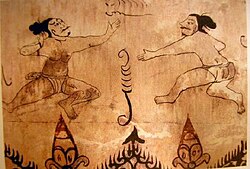
Evidence of Subak appears as early as the Three Kingdoms period. Murals in Goguryeo tombs, such as the Muyongchong and Anak Tomb No. 3, depict figures in unarmed combat believed to be Subak. During the Goryeo dynasty (918–1392), the art became more formalized as Subakhui (organized matches). It was highly valued in military circles; for instance, the military figure Yi Ui-min rose to prominence partly due to his mastery of the art.
The Joseon Dynasty and Decline
In the early Joseon dynasty (1392–1897), Subak remained integrated into the state's military infrastructure, appearing in the Gyeongguk Daejeon (legal codes) as part of military examinations. Kings frequently observed Subak competitions as a form of public entertainment. However, by the late Joseon period, the art began to decline. It was briefly mentioned in the 1790 manual Muyedobotongji and the 1798 encyclopedia Jaemulbo, the latter of which compared Subak and Gakryeok to the then-contemporary Taekkyeon.
Techniques and Combat Style
Subak is characterized as a full-contact hybrid art. Unlike arts that focus solely on one distance, Subak integrated:
- Striking: Various hand strikes and punches.
- Grappling: The use of throws and joint locks to neutralize opponents.
Due to the lack of continuous technical manuals, the exact choreography of these moves is uncertain, leading to various modern interpretations of how the strikes and locks were executed.
Songdo Subak and Modern Revival
In recent decades, a movement known as Songdo Subak has emerged, claiming to preserve a lineage from the Kaesong (Songdo) region. This revival is associated with Song Chang-ryeol, who learned the art during the Japanese colonial period. His son, Song Jun-ho, later systematized the practice, introducing solo training, partnered drills, and a "Subak dance"—a series of choreographed movements intended to preserve traditional expression.
The legitimacy and continuity of Songdo Subak are subjects of ongoing debate. However, the movement has gained significant institutional attention. In 2025, archival materials were submitted to the National Heritage Administration of Korea for nomination to the UNESCO Memory of the World Committee for Asia and the Pacific, and the lineage was considered for Intangible Cultural Heritage designation in 2026.
Comparative Analysis: Taekkyeon and Sumo
The Taekkyeon Connection
The relationship between Subak and Taekkyeon is a point of academic contention. Some scholars believe Subak was an earlier name for the striking arts that eventually evolved into Taekkyeon. Others argue they were distinct, with Subak emphasizing hand techniques and Taekkyeon focusing more on kicking. While Taekkyeon has achieved UNESCO recognition, the precise ancestral link to Subak remains unproven.
Influence on Japanese Sumo
Some historical perspectives suggest that Subak is a predecessor to ancient Japanese Sumo. This theory posits that horse-riding Koreans who founded the Yamato Imperial Line brought Subak to Japan. Both arts shared similarities in attire (loincloths) and a hybrid focus on strikes and grappling. While Japan classifies ancient Sumo as wrestling, Korea traditionally viewed Subak as a broader combat art, as the role of folk wrestling was filled by Gakjeo (modern-day Ssireum).
| Feature | Subak | Taekkyeon | Sumo (Ancient) |
|---|---|---|---|
| Primary Focus | Hybrid (Striking/Grappling) | Kicking/Fluidity | Grappling/Pushing |
| Key Techniques | Hand strikes, Throws, Locks | Rhythmic footwork, Kicks | Throws, Shoving |
| Historical Status | Military/Royal Sport | Folk Art/UNESCO Heritage | Ritual/Professional Sport |
| Origin | Korea | Korea | Japan (influenced by Korea) |
Frequently Asked Questions
What does the word Subak mean?
Subak literally means "hand striking" or "bare-hand fighting," derived from the Hanja characters for hand (su) and strike/fight (bak).
Is Subak the same as Soo Bahk Do?
No. While they share a similar pronunciation, Soo Bahk Do is a modern martial art and is not historically linked to the ancient Korean practice of Subak.
How does Subak differ from Taekkyeon?
Historically, Subak is associated more with hand strikes and grappling, whereas Taekkyeon is renowned for its rhythmic footwork and emphasis on kicking. Whether one evolved into the other remains a subject of debate.
What is the relationship between Subak and Sumo?
Some theories suggest Subak influenced ancient Sumo, as both involved striking and grappling and were practiced by early inhabitants of the region, including the horse-riding Koreans who influenced the Yamato line.
Is Subak still practiced today?
While the original continuous lineage was lost, revival movements like Songdo Subak attempt to reconstruct the art based on transmitted knowledge and historical records.