Stone Age Industries: Classifying Ancient Lithic Technology
In the study of the Stone Age, archaeologists use specific frameworks to categorize the tools left behind by early humans. One of the most critical concepts in this field is the industry (also known as a technocomplex). Unlike industrial archaeology, which focuses on modern industrial sites, a Stone Age industry is a typological classification used to group stone tools based on how they were made and what they look like.
What Defines a Lithic Industry?
An industry consists of various lithic assemblages—groups of stone tools found together—that share common technological or morphological (shape-based) characteristics. Rather than focusing on a single tool, an industry encompasses a range of implements produced using a similar method.
For example, the Acheulean industry is characterized by the symmetrical reduction of a bifacial core (a stone worked on both sides), which produces large flakes. This specific manufacturing process resulted in a variety of tools, including scrapers, cleavers, and the iconic hand-axes.
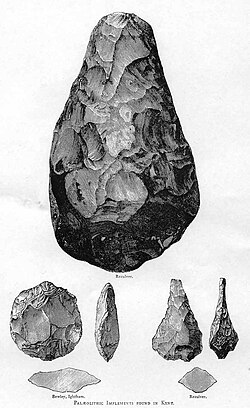
Typically, these industries are named after a type site, the location where these specific characteristics were first identified. The Mousterian industry, for instance, takes its name from the site of Le Moustier. However, naming does not always follow this pattern. The Langdale axe industry was recognized as a distinct type before the production center at Great Langdale was identified. In that case, the site was eventually confirmed through petrography (the geological analysis of rocks) and the discovery of debitage, which are the waste flakes left over from tool production.
Industries vs. Archaeological Cultures
It is important to distinguish between an industry and an archaeological culture, as they represent different levels of taxonomic classification.
- Archaeological Cultures: These are defined by a broader range of artifact types and are generally linked to a specific cultural tradition.
- Industries: These are defined by the basic elements of lithic production. Because these techniques were fundamental, they may have been used by many unrelated human groups across vast geographical areas and over hundreds of thousands of years.
The scale of an industry is often immense; Acheulean tools have been discovered across Africa, France, and China. Because of this, shifts from one lithic industry to another are often viewed as markers of major milestones in human evolution, such as advancements in cognitive ability or the replacement of one human species by another.
However, modern science has added complexity to this view. Ancient DNA studies have revealed periods of population stasis and change in Europe that are not always reflected in the existing cultural and industrial taxonomic frameworks. This suggests that a single industry can encompass tools created by several different cultures.
Key Facts
- Industry Definition: A classification of stone tools based on shared manufacturing techniques and shapes.
- Acheulean Example: Known for bifacial core reduction, producing hand-axes, cleavers, and scrapers.
- Geographic Reach: Some industries, like the Acheulean, span multiple continents, including Africa, Asia, and Europe.
- Naming Convention: Most are named after a type site (e.g., Mousterian from Le Moustier).
- Taxonomic Rank: Industries rank higher than archaeological cultures because they represent broader technological traditions.
| Feature | Lithic Industry (Technocomplex) | Archaeological Culture |
|---|---|---|
| Primary Basis | Technological production methods | Range of diverse artifact types |
| Scope | Very wide geographical and temporal range | Specific cultural traditions |
| Human Association | May be used by many unrelated groups | Linked to a distinct group or tradition |
| Evolutionary Significance | Often reflects cognitive or species shifts | Reflects social or regional traditions |
Frequently Asked Questions
How does a lithic industry differ from industrial archaeology?
Lithic industries refer to the typological classification of Stone Age tools based on production methods. Industrial archaeology is the study of modern industrial sites and remains.
What is a type site in archaeology?
A type site is the specific location where the defining characteristics of a particular industry or culture were first observed and described, serving as the standard for that classification.
What is the significance of the Acheulean industry?
The Acheulean industry is significant because its tools, created via symmetrical bifacial reduction, are found across Africa, Europe, and Asia, marking a widespread technological stage in human evolution.
Can one industry include multiple cultures?
Yes. Because industries are defined by basic production techniques that could be used by various unrelated groups over vast time periods, a single industry can encompass several different archaeological cultures.
What is petrography and how is it used in tool study?
Petrography is the geological analysis of rocks. In archaeology, it is used to identify the source of the stone used in tools, such as confirming that Langdale axeheads originated from the Great Langdale quarry.