Starlings: The Science and Behavior of the Sturnidae Family
The Sturnidae, commonly known as starlings, are a diverse family of medium-sized passerines (perching birds) found across Europe, Asia, Africa, northern Australia, and the tropical Pacific islands. Comprising 128 species divided into 36 genera, this family includes the well-known common starling as well as the larger mynas of Asia and the iridescent glossy starlings of Africa.
While many species are native to their respective regions, several European and Asian starlings have been introduced to North America, Hawaii, and New Zealand. In these new environments, they often compete with native birds and are classified as invasive species.
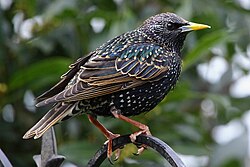
Key Facts
- Species Diversity: 128 species across 36 genera.
- Size Range: From the 15 cm Kenrick's starling to the 50 cm white-necked myna.
- Plumage: Often characterized by structural iridescence rather than pigment.
- Social Behavior: Famous for massive, synchronized flocking events called murmurations.
- Vocal Ability: Highly skilled mimics capable of imitating 15–20 different avian species.
Physical Characteristics
Starlings vary significantly in size and weight. The smallest in body length is Kenrick's starling at 15 cm (6 in), while the lightest is Abbott's starling at 34 g (1.25 oz). At the other end of the spectrum, the Nias hill myna can reach 36 cm (14 in) and weigh up to 400 g (14 oz) in domestication. The white-necked myna is the longest species, measuring up to 50 cm (19.5 in), though much of this length is attributed to its elongated tail.
One of the most striking features of the family is their iridescence—a shimmering color effect caused by the physical structure of the feathers rather than chemical pigments. Some species also possess crests, erectile feathers, or brightly colored bare skin on the face. In the Bali myna, these colors result from light scattering off parallel collagen fibers. Most species show little sexual dimorphism, with only 25 species exhibiting noticeable plumage differences between males and females.
Distribution and Habitat
The distribution of starlings varies by continent, with different species adapting to specific environments:
- Asia: Predominantly forest birds, with 39 species favoring evergreen forests and 24 inhabiting open or human-modified areas.
- Africa: More likely to be open-area specialists, with 33 species favoring savannahs and open woodlands compared to 13 forest species.
- Europe: Dominated by the highly adaptable European starling, which occupies diverse open habitats, including urban areas, orchards, and farmlands.
Migration and Introduction
Migration patterns vary; some species, like Shelley's starling, are fully migratory, while others, like the white-shouldered starling, are only migratory in certain parts of their range.
The presence of the European starling in North America is the result of intentional introduction between the 1870s and 1890s by acclimatization societies. While a popular legend suggests Eugene Schieffelin introduced them to ensure all birds mentioned by William Shakespeare existed in the U.S., evidence shows the birds were present by the mid-1870s, predating Schieffelin's 1890 release in Central Park.
Behavior and Social Dynamics
Starlings are renowned for their intelligence and vocal flexibility. They can imitate 15–20 different bird species, typically preferring calls that are simple in frequency and common in their environment. These imitations can even develop into local dialects.
Their social nature is most apparent during the nonbreeding season, when they gather in massive communal roosts numbering in the thousands.
The Science of Murmuration
The mesmerizing, fluid movement of starling flocks is known as murmuration. While early theories suggested "thought-transference," modern research from Princeton University and Italian physicists has debunked the idea of a single leader. Computer simulations reveal that each bird synchronizes its movement with its seven closest neighbors based on three parameters: attraction, repulsion, and angular alignment.
This synchronization is most efficient when the flock forms a "pancake" shape. Murmurations can last from a few seconds to 45 minutes and involve thousands—or even millions—of birds. In Denmark, these massive gatherings are known as the "Black Sun" (Sort sol).
Diet and Ecology
Starlings are opportunistic feeders. While many consume insects and fruits, some species exhibit more unusual behaviors; for example, Micronesian starlings have been observed feeding on the eggs of seabirds.
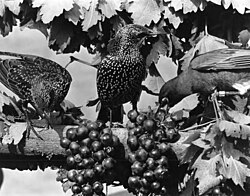
In agricultural settings, starlings can become pests. In California and other regions, they are known to cause significant damage to ripening grapes.
Taxonomy and Classification
The family Sturnidae was first introduced by Constantine Samuel Rafinesque in 1815. They belong to the superfamily Muscicapoidea, making them close relatives of the Mimidae (mockingbirds and thrashers), which occupy a similar ecological niche in the Americas.
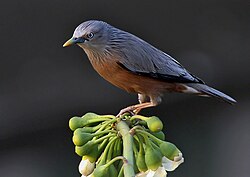
Current phylogenetic studies identify two major clades: one consisting of larger, often drabber "atypical mynas" from Asia and the Pacific, and another consisting of smaller, often metallic-colored species common in Africa and the Palearctic.
| Region | Primary Habitat | Notable Characteristics | Example Species |
|---|---|---|---|
| Asia | Evergreen Forests / Open Areas | Larger sizes, some with crests | Nias hill myna, White-necked myna |
| Africa | Savannah / Open Woodlands | High iridescence (Glossy starlings) | Hildebrandt's starling, Superb starling |
| Europe | Eclectic / Human-modified | Highly adaptable, widespread | Common starling |
Frequently Asked Questions
Why do starlings form murmurations?
Murmurations are the result of individual birds synchronizing their movements with their seven nearest neighbors using attraction, repulsion, and angular alignment, creating a cohesive flock that moves efficiently in a pancake shape.
How do starlings get their shiny colors?
The iridescent colors of starlings are structural, meaning they are created by the physical arrangement of the feathers reflecting light, rather than by chemical pigments.
Are starlings invasive in North America?
Yes, the European starling was introduced to North America in the late 19th century and is now considered an invasive species because it competes with native birds for habitat.
Can starlings actually talk or mimic sounds?
Starlings are excellent mimics. They can imitate 15 to 20 different bird species and occasionally other sounds, often developing local dialects based on the sounds most common in their area.
What is the difference between a starling and a myna?
Mynas are essentially a group of larger starling species, primarily found in Asia. While they belong to the same family (Sturnidae), mynas are often larger and have different habitat preferences.