St. Charles Streetcar Line: The World's Oldest Continuously Operating Street Railway
In the heart of New Orleans, Louisiana, a green-painted icon glides through the city's lush medians, connecting the bustling Central Business District to the historic uptown neighborhoods. The St. Charles Streetcar Line (officially Route 12) is more than just a transit link; it is a living museum. Having operated since 1835, it holds the prestigious title of the oldest continuously operating streetcar line in the world.
Operated by the New Orleans Regional Transit Authority (RTA), the line is a favorite for both daily commuters and tourists. Its significance is recognized nationally, as it is listed on the National Register of Historic Places and designated as a National Historic Landmark—a distinction it shares with only one other moving street railway in the U.S., the San Francisco cable car system.
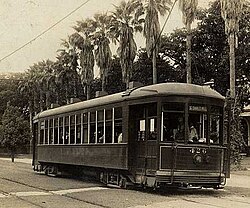
Key Facts
- Established: September 26, 1835.
- Route Length: 6.6 miles (10.6 km).
- Status: National Historic Landmark and National Register of Historic Places.
- Rolling Stock: 900 series (vintage 1923–24) and 457 series (ADA-compliant replicas).
- Power: 600 V DC overhead electrification.
- Track Gauge: 5 ft 2.5 in (1,588 mm).
Route and Geography
The line begins uptown at the intersection of South Carrollton Avenue and South Claiborne Avenue. From there, it travels through the Carrollton neighborhood toward the Mississippi River levee before turning onto St. Charles Avenue. The route passes several major landmarks, including Audubon Park, Tulane University, and Loyola University New Orleans, winding through the scenic Garden District.
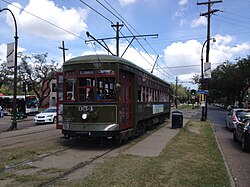
The journey concludes at Canal Street in the New Orleans Central Business District, bordering the French Quarter. For much of its 6.6-mile length, the streetcar operates in the neutral ground—the local term for the grassy central median—though it runs in the curbside lane through the downtown portion and along Carondelet Street.
A Journey Through Transit History
The line's origins date back to 1831, with construction beginning in 1833 as the New Orleans and Carrollton Railroad. When service launched in 1835, it utilized steam locomotives supplied from England. However, as the surrounding areas became more urbanized, the noise and soot of steam engines became unwelcome, leading the city to switch to horse- and mule-drawn cars.
The late 19th century was a period of intense experimentation. Before electrification, the line tested various propulsion methods, including overhead cable systems and the innovative "Lamm Fireless Engine" developed by Dr. Emile Lamm. The transition to electric power finally occurred on February 1, 1893.
Throughout the 20th century, the line evolved. It was merged into New Orleans Public Service Incorporated (NOPSI) in 1922 and saw its route modified in 1950 to accommodate the construction of the Pontchartrain Expressway. In 1983, the RTA took over operations from NOPSI.
Resilience and Modernization
The line faced a major crisis in 2005 when Hurricane Katrina and subsequent levee breaches forced a total suspension of service. Restoration began in stages, with the full route back in operation by June 2008.
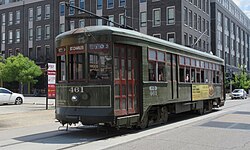
In recent years, the RTA has focused on accessibility. Because the historic Perley Thomas cars could not be modified without destroying their heritage value, the RTA introduced renovated 457 series replica cars equipped with wheelchair lifts. Following a 2017 consent decree, accessible service officially began on December 1, 2020, with six rebuilt stops. In May 2024, the Federal Transit Administration awarded the RTA $5.5 million to further expand these accessible platforms.
Technical Operations and Rolling Stock
The St. Charles line operates 24 hours a day. Peak service (7 a.m. to 10 p.m.) sees cars arriving every nine minutes, while "night owl" service (midnight to 6 a.m.) operates on 36-minute intervals.
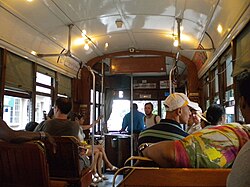
The fleet is primarily composed of the 900 series, 35 streetcars built between 1923 and 1924 by Perley A. Thomas Car Works. To meet ADA (Americans with Disabilities Act) requirements, the line also utilizes seven 457 series replica cars. These replicas maintain the traditional green livery but feature modern wheelchair lifts.
Line Summary
| Feature | Detail |
|---|---|
| Owner/Operator | New Orleans Regional Transit Authority (RTA) |
| Line Number | 12 |
| Termini | S. Carrollton & S. Claiborne to Carondelet & Canal |
| Number of Stations | 61 |
| Electrification | 600 V DC Overhead Line |
| Depot | Carrollton Transit Station |
Frequently Asked Questions
Is the St. Charles streetcar wheelchair accessible?
Yes. While the vintage 900 series cars are not accessible, the RTA operates 457 series replica cars equipped with wheelchair lifts. Additionally, six major stops have been rebuilt to provide ADA-compliant access.
How often do the streetcars run?
Service is 24/7. During the day (7 a.m. to 10 p.m.), cars typically run every nine minutes. Early morning and late night service runs every 18 minutes, and the midnight-to-6 a.m. window operates every 36 minutes.
What makes this streetcar line historically significant?
It is the oldest continuously operating streetcar line in the world, having begun service in 1835. It is also one of only two moving streetcar systems in the U.S. designated as a National Historic Landmark.
What is the "neutral ground" mentioned in the route description?
In New Orleans, the "neutral ground" refers to the median strip between opposing lanes of traffic. Much of the St. Charles line runs within this greenery-filled space.
Which universities are served by the line?
The streetcar provides direct access to both Tulane University and Loyola University New Orleans.