Spanish Civil WarFrancisco FrancoSecond Spanish RepublicNationalistsRepublicans

Spanish Civil War: The Conflict That Shaped Modern Spain

Spanish Civil War (1936–1939) The Spanish Civil War was a brutal conflict fought from July 17, 1936, to April 1, 1939. Serving as a prelude to World War II, this war pitted the democratic...

Spanish Civil War (1936–1939)

The Spanish Civil War was a brutal conflict fought from July 17, 1936, to April 1, 1939. Serving as a prelude to World War II, this war pitted the democratically elected government of the Second Spanish Republic against a Nationalist military uprising. The struggle was not merely a local conflict but a global ideological battleground where fascism, communism, and democracy clashed on Spanish soil.

The war concluded with a Nationalist victory, leading to the establishment of the Spanish State under the authoritarian rule of General Francisco Franco, which lasted for decades.
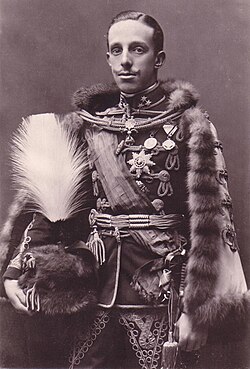
On 12 April 1931, the Republicans won the elections and the Second Spanish Republic was proclaimed two days later. King Alfonso XIII went into exile.

Key Facts

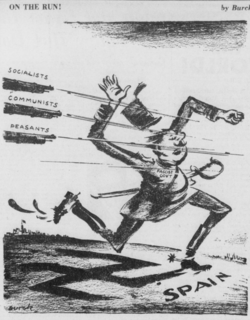
"On the Run!" Daily Worker October 10, 1934
  • Duration: July 17, 1936 – April 1, 1939 (986 days).
  • Primary Belligerents: The Republicans (loyal to the Republic) and the Nationalists (insurgents).
  • Outcome: Nationalist victory and the end of the Second Spanish Republic.
  • Key Leader: General Francisco Franco led the Nationalist forces.
  • Foreign Involvement: Significant support for Nationalists from Nazi Germany and Fascist Italy; support for Republicans from the Soviet Union and international volunteers.
  • Human Cost: Death toll estimates vary widely, ranging from 500,000 to over 2 million people.

The Road to Conflict: Background and Origins
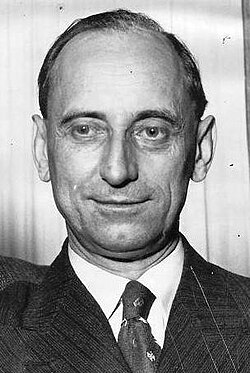
Casares Quiroga was the prime minister in the two months leading up to the coup.

The roots of the war lay in deep social and political divisions within Spain. Following the dictatorship of Primo de Rivera and the subsequent restoration of the monarchy, the Second Spanish Republic was proclaimed in 1931 after Republicans won the elections. King Alfonso XIII was forced into exile.

The Republic's early years were marked by volatility. A left-wing government held power from 1931 to 1933, followed by a right-wing government from 1933 to 1935. Tensions escalated further when the Popular Front, a coalition of left-wing parties, won the 1936 elections.
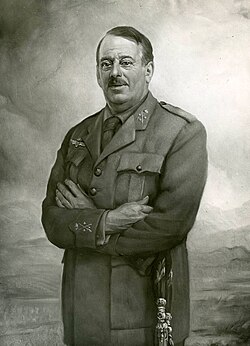
General José Sanjurjo, the leader of the failed 1932 military coup. Having been granted amnesty in 1934 by the right-wing government of the Republic, he was one of the leaders of the 1936 coup.

The Military Coup

In July 1936, a group of military officers launched a coup d'état to overthrow the Republic. While the coup failed to seize the entire country immediately, it split Spain into two zones. General Emilio Mola served as the chief planner of the operation, while General Francisco Franco emerged as the primary leader of the Nationalist forces.
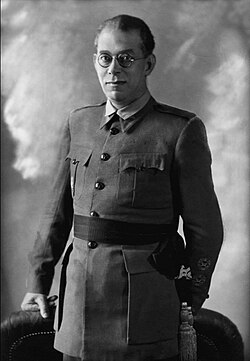
General Emilio Mola was the chief planner of the coup.

The assassination of José Calvo Sotelo, a prominent fascist-leaning conservative, acted as a major catalyst that accelerated the move toward open warfare.
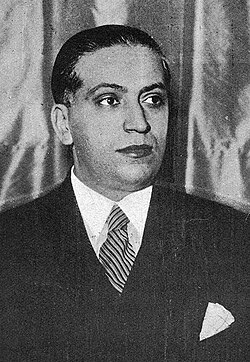
The assassination of José Calvo Sotelo, prominent fascist-leaning parliamentary conservative, was a major catalyst for the coup.

The Combatants

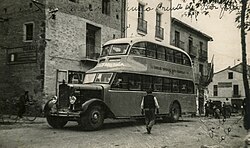
Bus servise requisitioned by the CNT and the UGT, 1936

The Republicans

The Republican side consisted of a diverse and often fractured coalition. This included the Spanish Republic's official government, the People's Army, and various leftist organizations such as the UGT (General Union of Workers) and the CNT-FAI (anarchist syndicalists). The intellectual leadership was largely provided by Manuel Azaña.
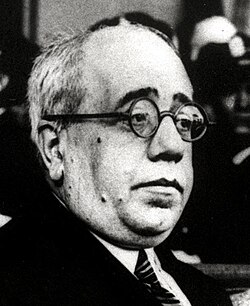
Manuel Azaña was the intellectual leader of the Second Republic and headman of the Republican side during most of the Civil War.

In addition to official forces, the International Brigades—volunteers from around the world—joined the fight to stop the spread of fascism. These included the Lincoln Battalion from the US and the Etkar André battalion.
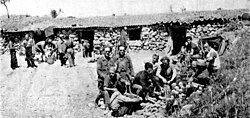
The Etkar André battalion of the International Brigades

The Nationalists

The Nationalist side was more unified, comprising the National Army, the Spanish Military Union, and the Falange (a fascist party). They were supported by the Requetés (traditionalist Catholics) and the Army of Africa.
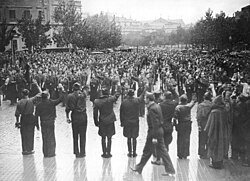
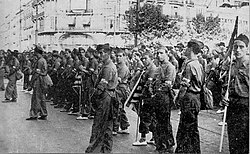
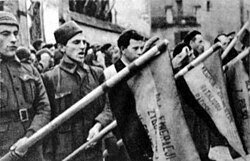
Militias of the Falange in Zaragoza, October 1936

Course of the War

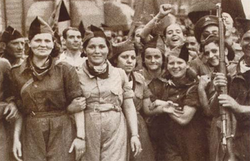
Women from the FAI during the Spanish Social Revolution.

The war progressed through several critical phases, characterized by shifting territorial control and extreme violence.

1936–1937: Initial Struggles and the Siege of Madrid

Early in the war, the Nationalists advanced rapidly, but the Republicans managed to repel the siege of Madrid despite heavy bombing. This period also saw the Spanish Social Revolution, particularly in Catalonia, where workers and peasants seized control of land and factories.
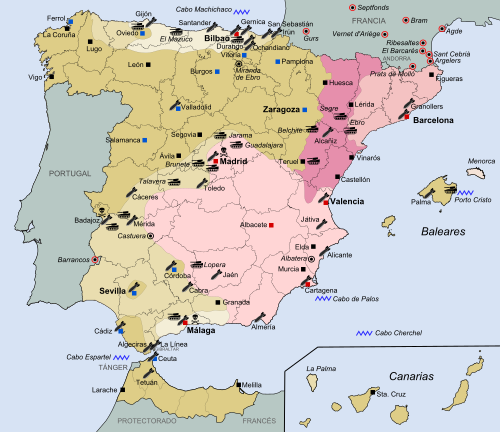
General map of the Spanish Civil War (1936–39). Key Initial Nationalist zone – July 1936 Nationalist advance until September 1936 Nationalist advance until October 1937 Nationalist advance until November 1938 Nationalist advance until February 1939 Last area under Republican control Main Nationalist centres Main Republican centres Land battles Naval battles Bombed cities Massacres Concentration camps Refugee camps

1938–1939: The Nationalist Advance

By 1938, the Nationalist forces had gained the upper hand, splitting the Republican zone in two. The bombing of Guernica became a global symbol of the war's brutality, illustrating the devastating impact of aerial warfare on civilian populations.
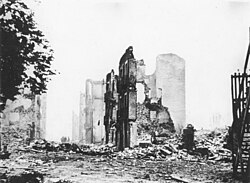
Ruins of Guernica
Ruins of Guernica

By February 1939, the Nationalists controlled nearly all of Spain. On April 1, 1939, Franco declared the end of the war, though small pockets of resistance continued for a short time.
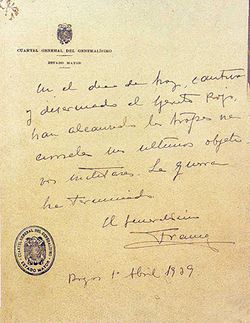
Franco declares the end of the war, though small pockets of Republicans fought on.

Foreign Intervention and Logistics

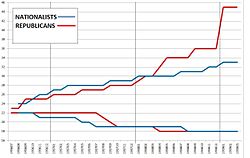
Republican and Nationalist conscription age limits

The conflict was an internationalized war. The Nationalists received critical military aid from Italy (including 70,000–75,000 troops) and Germany (including the Condor Legion). The Republicans relied on the Soviet Union for technicians and pilots, as well as support from various international volunteers.
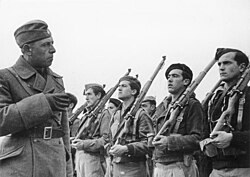
German officer from the Condor Legion instructing Nationalist infantry soldiers, Ávila

Comparison of Initial Military Strength (1936)
Category Republicans Nationalists
Infantry 450,000 600,000
Aircraft 350 600
Tanks 200 290
Foreign Troops ~60,000 Volunteers ~90,000 (Italy/Germany)

Atrocities and Human Cost

Republican forces during the battle of Irún in 1936

Both sides committed severe war crimes. The Red Terror involved executions and torture carried out by Republican factions, such as the Paracuellos massacre. Conversely, the Nationalist side engaged in systematic executions and mass killings in their wake.
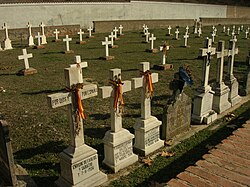
Victims of the Paracuellos massacre committed by the Republicans. The Republicans committed many acts of torture, murder, and war crimes throughout the war known as the Red Terror (Spain).

The death toll remains a subject of historical debate. Estimates range from a low of 500,000 to as high as 2 million deaths, including combatants and civilians.
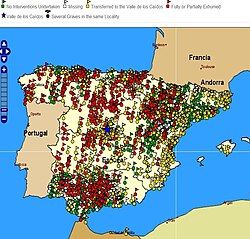
Spanish Civil War grave sites. Location of known burial places. Colours refer to the type of intervention that has been carried out. Green: No Interventions Undertaken so far. White: Missing grave. Yellow: Transferred to the Valle de los Caídos. Red: Fully or Partially Exhumed. Blue star: Valle de los Caídos. Source: Ministry of Justice of Spain

Frequently Asked Questions

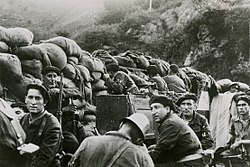
Republican volunteers at Teruel, 1936
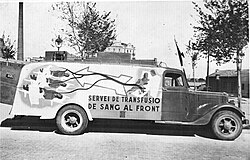
A mobile blood-transfusion service for front-line operations in Catalonia.
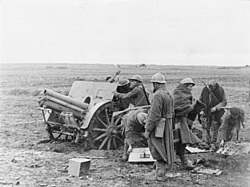
Italian troops manning a 10 cm howitzer at Guadalajara, 1937
Polish volunteers in the International Brigades
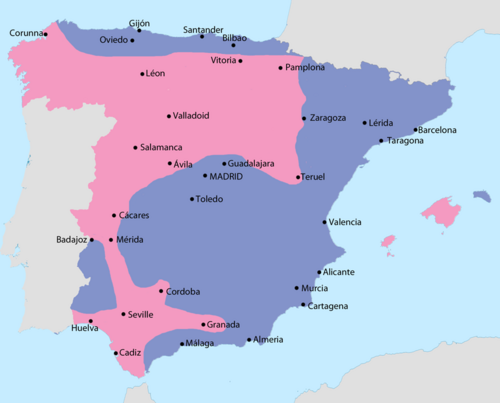
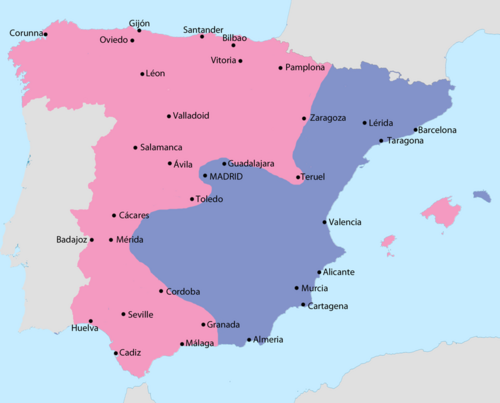
Map showing Spain in September 1936: Area under Nationalist control Area under Republican control
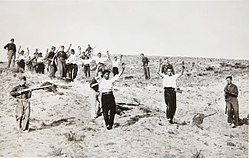
Surrender of Republican soldiers in the Somosierra area, 1936
Leonese anarchist Buenaventura Durruti was fatally shot after he arrived in Madrid to reinforce the morale of the Republicans during an unsuccessful Francoist siege in Madrid.[267] His funeral, headed (in the image) by Lluís Companys, president of the Generalitat of Catalonia, and Joan García i Oliver, Minister of Justice of the Spanish Republic, was in Barcelona.[268]
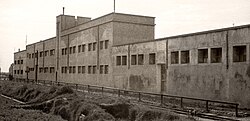
Alginet weapons factory
Map showing Spain in October 1937: Area under Nationalist control Area under Republican control
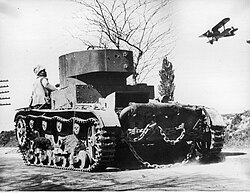
Republican T-26 tank on the Aragon front, November 1937.
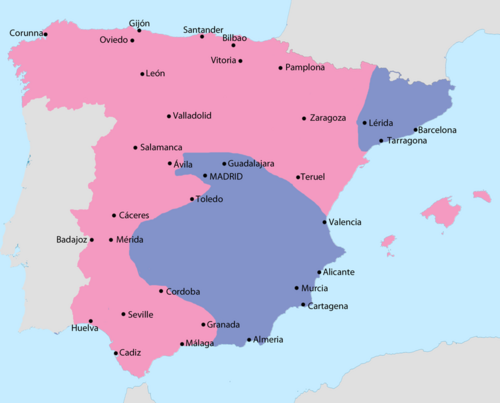
Map showing Spain in July 1938: Area under Nationalist control Area under Republican control
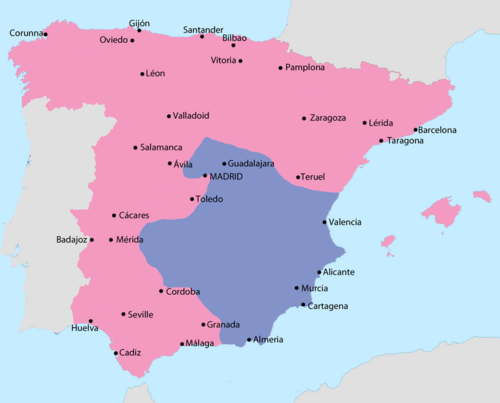
Map showing Spain in February 1939: Area under Nationalist control Area under Republican control
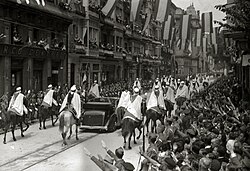
Franco arriving in San Sebastian in 1939
Children preparing for evacuation, some giving the Republican salute. The Republicans showed a raised fist whereas the Nationalists gave the Roman salute.[note 4]
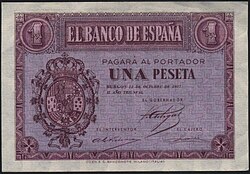
One-peseta Nationalist note, 1937
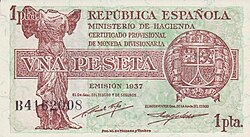
One-peseta Republican note, 1937
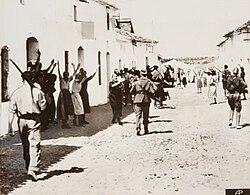
Women pleading with Nationalists for the lives of prisoners, Constantina, 1936
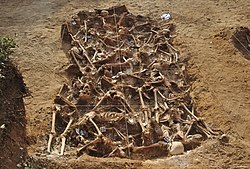
Twenty-six republicans were assassinated by Franco's Nationalists at the beginning of the Spanish Civil War, between August and September 1936. This mass grave is located at the small town of Estépar, in Burgos Province. The excavation occurred in July–August 2014.
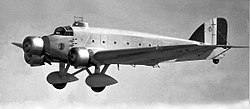
Nationalist SM.81 aircraft bomb Madrid in late November 1936.
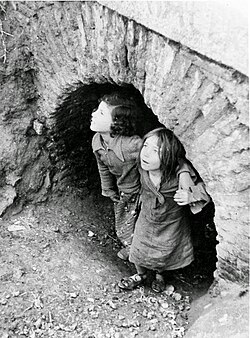
Children take refuge during the Francoist bombing over Madrid (1936–1937). Republicans managed to repel the siege despite the bombing.
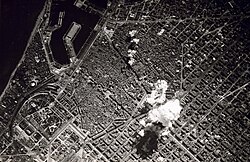
Bombing in Barcelona, 1938
The Puente Nuevo bridge, Ronda. Both Nationalists and Republicans are claimed to have thrown prisoners from the bridge to their deaths in the canyon.[428]
"Execution" of the Sacred Heart of Jesus by Communist militiamen. The photograph in the London Daily Mail had the caption "Spanish Reds' war on religion".[433]
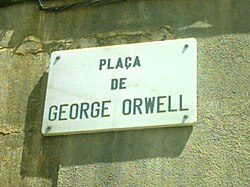
In Catalonia, a square near the Barcelona waterfront named Plaça de George Orwell
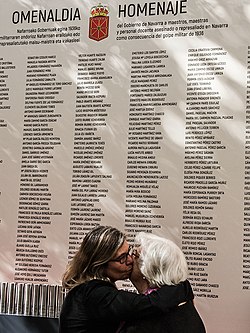
Tribute and plaque in memory of murdered or persecuted teachers, Navarre, 1936 and later

Who won the Spanish Civil War?

The Nationalist forces, led by General Francisco Franco, won the war, resulting in the end of the Second Spanish Republic and the start of Franco's dictatorship.

What were the International Brigades?

The International Brigades were units composed of volunteers from various countries who traveled to Spain to support the Republican government against the Nationalist uprising.

Why was the bombing of Guernica significant?

The bombing of Guernica was one of the first instances of saturation bombing of a civilian population, serving as a grim precursor to the aerial tactics used in World War II.

What was the "Red Terror"?

The Red Terror refers to the acts of torture, murder, and war crimes committed by Republican forces and leftist militias during the conflict.

How did foreign powers influence the war?

Nazi Germany and Fascist Italy provided the Nationalists with essential troops, aircraft, and equipment. The Soviet Union provided the Republicans with military advisors, aircraft, and tanks.

References

  1. The POUM fought in the Spanish Civil War from 17 July 1936 until 16 June 1937, when the POUM was illegalized and suppressed by the Popular Front Republican government led by Prime Minister Juan Negrín, with the government suppression of the POUM supported by Joseph Stalin, the Comintern and the PCE.
  2. Despite not being part of the Popular Front nor of the Catalan Government, Estat Català supported the Generalitat and raised its own milita to contribute to the Republican war effort.
  3. The Euzko Gudarostea fought in the Spanish Civil War from 17 July 1936 until it surrendered to the Italian Corpo Truppe Volontarie in the Santoña Agreement on 24 August 1937.
  4. The only party under Francisco Franco from 1937 onward, a merger of the other factions on the Nationalist side.
  5. 1936–1937, then merged into FET y de las JONS