South American Languages: A Diverse Linguistic Landscape
South America is a continent of profound linguistic diversity, shaped by millennia of indigenous habitation, centuries of colonial influence, and waves of global migration. The linguistic map of the region is generally divided into three primary categories: the languages of former colonial powers, a vast array of indigenous tongues, and various languages introduced by immigrant populations.
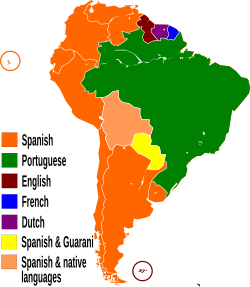
While Spanish is the most spoken language across the Americas as a whole, Portuguese holds the title of the most spoken language within the South American continent, followed closely by Spanish.
Key Facts
- Portuguese is the most spoken language in South America, primarily due to Brazil's population.
- Spanish is the second most spoken and serves as a primary official language in most other nations.
- Quechua is the most spoken indigenous language, with over 7.7 million speakers.
- Guaraní holds joint official status with Spanish in Paraguay.
- Brazil hosts approximately 135 confirmed indigenous languages.
- Brazil also possesses the largest Japanese community outside of Japan.
Major Languages and Speaker Statistics
The linguistic dominance of Portuguese and Spanish is complemented by several indigenous languages that maintain substantial speaker bases and, in some cases, official status. For example, Aymara and Quechua are vital to the cultural and administrative fabric of the Andean regions.
| Language | Estimated Speakers | Primary Countries |
|---|---|---|
| Portuguese | 215,754,600 | Brazil, Argentina, Paraguay, Uruguay, Venezuela |
| Spanish | 214,265,000 | Argentina, Bolivia, Chile, Colombia, Ecuador, Paraguay, Peru, Uruguay, Venezuela, Brazil |
| Quechua | 7,735,620 | Bolivia, Ecuador, Peru, Argentina, Chile, Colombia |
| English | 6,925,850 | Falkland Islands, Guyana, Colombia |
| Guarani | 6,162,790 | Bolivia, Paraguay, Argentina, Brazil |
| Hunsrik | 3,000,000 | Brazil, Argentina, Paraguay |
| Aymara | 1,677,100 | Bolivia, Peru, Chile |
Indigenous Languages and Official Status
Indigenous languages are not merely historical artifacts but living tools of communication. In several nations, they are granted co-official status, meaning they are legally recognized alongside the colonial language for government and administrative use.
Regional Distribution
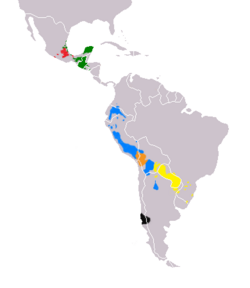
- Quechua: Predominant in Bolivia, Ecuador, and Peru, with presence in Argentina, Chile, and Colombia.
- Guaraní: Centered in Paraguay, with smaller populations in Argentina and Bolivia.
- Aymara: Spoken primarily in Bolivia and Peru, and to a lesser extent in Chile.
- Wayuu: Found in northern Colombia and northwest Venezuela.
- Mapudungun: Spoken in small pockets of southern Chile and Argentina.
Legal Recognition by Country
The approach to indigenous languages varies by nation. In Bolivia, Quechua, Aymara, and Tupi Guarani are co-official with Spanish. Paraguay grants joint official status to Guarani. In Colombia, over 60 aboriginal languages are constitutionally recognized as official within their respective territories. Ecuador utilizes Spanish, Northern Quechua, and Shuar for intercultural relations, while Peru recognizes Quechua and Aymara as co-official in areas where they predominate.
In Brazil, the agency Funai works to protect native people and their traditions, supporting the roughly 135 confirmed indigenous languages spoken mainly in the North and Central-West regions. Additionally, the Polynesian language Rapa Nui is spoken on Easter Island, Chile.
Linguistic Classification
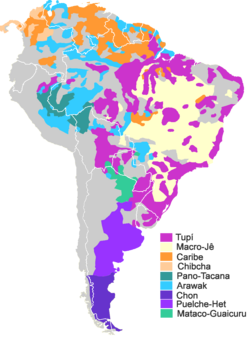
The indigenous languages of South America are categorized into several complex families and groups. These classifications help linguists understand the migration and evolution of peoples across the continent.
Primary Language Families
- Macro-Chibchan: Includes Chibchan (such as Arhuaco and Cuna-Cueva), Misumalpan, and Paezan.
- Andean-Equatorial: Encompasses the Andean group (including Quechua and Aymara) and the Zaparoan and Simacu groups.
- Macro-Tucanoan: Includes the Tucano and Puinave groups.
- Equatorial: Comprises the Arawak and Tupi families.
- Ge-Pano-Carib: Includes Macro-Gê (such as Kaingang) and Macro-Panoan (such as Tacana-Pano).
Non-Indigenous and Immigrant Languages
Beyond the colonial and native tongues, South America hosts a variety of languages brought by immigrants. In Brazil, German and Italian dialects—specifically Hunsrik, Talian, and East Pomeranian—hold co-official status in certain cities and are taught in schools. Talian is recognized as a heritage language in Rio Grande do Sul and Santa Catarina, while East Pomeranian is a cultural heritage language in Espírito Santo.
In the northern part of the continent, English is the official language of Guyana (where an English-based creole is most common) and the Falkland Islands. Dutch is the official language of Suriname, while French is official in French Guiana.
Other notable immigrant languages include:
- Japanese: Significant communities exist in Brazil, Peru, and Bolivia.
- Caribbean Hindustani: Spoken by Indo-Guyanese and Indo-Surinamese populations, though it is nearly extinct in Guyana.
- Surinamese-Javanese: Spoken by approximately 14% of Suriname's population.
- Sranan Tongo: An English-based creole that serves as a lingua franca in Suriname.
- Welsh: Spoken in the towns of Trelew and Rawson in Argentine Patagonia.
Frequently Asked Questions
Which is the most spoken language in South America?
Portuguese is the most spoken language on the South American continent, primarily due to the large population of Brazil, followed closely by Spanish.
What are the most prominent indigenous languages?
The most prominent indigenous languages are Quechua, Guarani, and Aymara, all of which have millions of speakers and varying levels of official recognition.
Do any countries have more than two official languages?
Yes, Bolivia recognizes Spanish, Quechua, Aymara, and Tupi Guarani as official languages.
What is Sranan Tongo?
Sranan Tongo is an English-based creole language that serves as one of the lingua francas of Suriname, alongside Dutch.
Are there European languages other than Spanish and Portuguese spoken officially?
Yes, English is official in Guyana and the Falkland Islands, Dutch is official in Suriname, and French is official in French Guiana. Additionally, certain German and Italian dialects have co-official status in specific Brazilian municipalities.