Sooty Shearwater: The Master of Long-Distance Migration
The Sooty shearwater (Ardenna grisea) is a medium-large seabird belonging to the family Procellariidae. Known for its incredible endurance and vast migratory range, this species is a marvel of the natural world. In New Zealand, it is known by the Māori name tītī and is traditionally harvested as muttonbird, a practice shared with its close relatives, the wedge-tailed and Australian short-tailed shearwaters.
Key Facts
- Scientific Name: Ardenna grisea
- Conservation Status: Near Threatened (IUCN 3.1)
- Migration: One of the longest known migrations, covering up to 74,000 km annually.
- Diet: Primarily fish and squid.
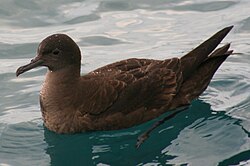
- Appearance: Dark chocolate-brown plumage with a silvery underwing stripe.
- Breeding: Nests in burrows on small islands in the South Pacific and South Atlantic.
Taxonomy and Classification
Formally described in 1789 by German naturalist Johann Friedrich Gmelin, the sooty shearwater was originally named Procellaria grisea. While James Cook and John Latham had described the bird earlier, Gmelin provided the first valid scientific name. The species is now classified under the genus Ardenna, established by Ludwig Reichenbach in 1853. The specific epithet grisea is derived from medieval Latin for "grey".
Based on phylogenetic analysis of mitochondrial DNA, the sooty shearwater is closely related to the great shearwater (A. gravis) and the short-tailed shearwater. These three blunt-tailed, black-billed species were moved into the Ardenna genus to distinguish them from smaller shearwaters.
Physical Description and Behavior
Sooty shearwaters measure between 40 and 51 cm in length, with a wingspan ranging from 94 to 110 cm. They are characterized by a "shearing" flight—a powerful, direct motion where the bird dips from side to side on stiff wings, often with the wingtips nearly touching the water's surface. This silhouette often makes them resemble small albatrosses.
While they appear black in poor light, their plumage is actually a deep chocolate-brown. A distinguishing feature is the silvery strip running along the center of the underwing. On breeding grounds, they are highly vocal, producing loud coos and croaks at night, though they remain largely silent while at sea.
Distribution and Epic Migrations
The species is divided into two primary breeding populations: one in the South Pacific (around New Zealand, southeast Australia, the Auckland Islands, and Phillip Island) and another in the South Atlantic (Falkland Islands, Tierra del Fuego, and Tristan da Cunha). Breeding begins in October, with an incubation period of approximately 54 days and a chick-rearing phase lasting 86 to 109 days.
These birds are legendary long-distance migrants. Following a circular route, they travel north in March–May to reach subarctic waters by June–July, before returning south in September–October. In the Atlantic, they cover over 14,000 km from the Falkland Islands to the coast of Norway. In the Pacific, tagging experiments have revealed that birds from New Zealand may travel a staggering 74,000 km in a single year, averaging over 500 km per day as they visit Alaska, Japan, and California.

Ecology and Conservation
Sooty shearwaters are opportunistic feeders, diving up to 68 meters deep for fish and squid. They frequently follow whales to catch disturbed prey or trail fishing boats for scraps. To avoid predators like skuas and large gulls, they nest in burrows lined with plant material and only visit these sites under the cover of darkness.
In New Zealand, the indigenous Māori population harvests approximately 250,000 chicks annually for food and oil. However, recent reports from 2022 suggest that climate change may be impacting this cultural practice. Due to declining numbers in recent decades, the IUCN currently classifies the sooty shearwater as Near Threatened.
| Feature | Details |
|---|---|
| Length | 40–51 cm |
| Wingspan | 94–110 cm |
| Primary Diet | Fish and Squid |
| Annual Migration | Up to 74,000 km |
| Nesting Habit | Burrows in small islands |
| Conservation Status | Near Threatened |
The Inspiration for Hitchcock's 'The Birds'
A strange event in August 1961 may have influenced cinema history. Thousands of sooty shearwaters appeared on the shores of North Monterey Bay, California, exhibiting erratic behavior—flying into objects, regurgitating anchovies, and dying in the streets. This incident caught the attention of Alfred Hitchcock, who, along with a story by Daphne du Maurier, used it as inspiration for his 1963 thriller The Birds.
Modern scientific analysis suggests the birds were not "crazed" by nature, but poisoned. Surveys found toxin-producing algae in 79% of the plankton consumed by local wildlife. Experts believe leaky septic tanks from a 1960s housing boom fueled these toxic algal blooms, leading to the mass poisoning event.
Frequently Asked Questions
How can you tell a sooty shearwater apart from other shearwaters?
In the Atlantic, it is the only large, all-dark shearwater with a silvery stripe on the underwing. In the Pacific, it is very similar to the short-tailed shearwater and can be difficult to distinguish from a distance.
What is a "muttonbird"?
Muttonbird is the common name for shearwaters (including the sooty, wedge-tailed, and Australian short-tailed species) that are harvested for food and oil, particularly by the Māori people in New Zealand.
How far do sooty shearwaters migrate?
They are among the world's longest-distance migrants. Some individuals breeding in New Zealand have been tracked traveling up to 74,000 km in a year, reaching as far north as Alaska and Russia.
Why are sooty shearwaters classified as Near Threatened?
Their population numbers have been declining in recent decades, leading the IUCN to designate them as Near Threatened to highlight the need for monitoring and conservation.
What do sooty shearwaters eat?
Their diet consists mainly of fish and squid. They are known to dive deep (up to 68m) or follow whales and fishing vessels to find food more easily.