Shearwaters: Masters of the Pelagic Winds
Shearwaters are medium-sized, long-winged seabirds belonging to the petrel family Procellariidae. These specialized avian navigators are found in marine environments globally, though they are most prevalent in cold and temperate waters. Outside of their breeding seasons, they are strictly pelagic, meaning they spend their lives on the open ocean, far from land.
Key Facts
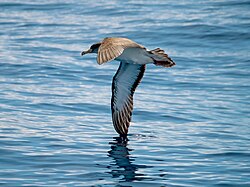
- Flight Technique: They use a unique "shearing" method, gliding close to the water to minimize energy expenditure.
- Migration: Some species, like the sooty shearwater, perform some of the longest animal migrations on Earth.
- Physicality: They possess short legs and webbed feet, making them clumsy on land but efficient swimmers.
- Diet: Their primary food sources include fish and squid, often obtained through diving.
- Taxonomy: The group comprises 31 accepted species divided into three genera: Calonectris, Ardenna, and Puffinus.
Physical Characteristics and Flight
As tubenose birds (birds with tubular nostrils), shearwaters are built for a life at sea. They typically range from 25 to 56 cm in length, with wingspans spanning 58 to 125 cm and weights between 150 and 1,000 g. While most exhibit a counter-shaded appearance—black or brown above and white or pale below—the Buller's shearwater is a notable exception with its pale grey and black patterning.
The group is named for its distinctive "shearing" flight. By flying extremely close to the ocean surface, they use the wind gradients to cut through wave fronts, allowing them to move across the sea with minimal active flapping. Some smaller species, such as the Manx shearwater, exhibit a cruciform flight pattern, holding their long wings straight out from their bodies.
Taxonomy and Diversity
Modern genomic studies have identified shearwaters as a monophyletic clade (a group consisting of a common ancestor and all its descendants) within the Procellariidae family. They are considered sister to a group of petrels in the Procellaria, Bulweria, and Pseudobulweria genera.
The 31 recognized species are categorized into three primary genera:
- Calonectris: Includes four large species, such as Cory's and Scopoli's shearwaters.
- Ardenna: Contains seven medium-to-large species, including the Great and Sooty shearwaters.
- Puffinus: The largest genus with 20 smaller species, including the Manx and Little shearwaters.
| Genus | Typical Size | Number of Species | Example Species |
|---|---|---|---|
| Calonectris | Large | 4 | Cory's shearwater |
| Ardenna | Medium to Large | 7 | Sooty shearwater |
| Puffinus | Small | 20 | Manx shearwater |
Behavior and Life Cycle
Epic Migrations
Shearwaters are among the world's most prolific migrants. The sooty shearwater is particularly renowned, traveling over 14,000 km from the Falkland Islands to the North Atlantic, or from New Zealand to the North Pacific. One recorded individual from New Zealand covered 64,000 km in a single year. Similarly, short-tailed shearwaters perform a massive "figure of eight" loop from Tasmania to the Arctic Ocean.
Their commitment to the ocean is absolute; for example, the Yelkouan shearwater avoids flying over land entirely. During its migration to the Black Sea, it will fly an additional 1,000 km to circumvent the Peloponnese rather than crossing the 6 km Isthmus of Corinth.
Breeding and Nesting
Because their short legs make them awkward on land, shearwaters only visit remote islands and coastal cliffs to breed. To avoid predators, they are nocturnal at their colonies, arriving under the cover of darkness to nest in burrows. Each female lays a single white egg. In Australia and New Zealand, the practice of "muttonbirding" involves harvesting chicks from these burrows for food.
Feeding and Metabolism
Shearwaters feed primarily on squid and fish. They are opportunistic hunters that often follow whales or fishing boats to scavenge disturbed prey. Some species are capable of diving to depths of 70 m. Interestingly, they have a high rate of excretion, defecating every four to ten minutes—roughly five percent of their body mass per hour—usually while in flight.
Frequently Asked Questions
Why are they called "shearwaters"?
They derive their name from their unique flight technique, where they fly very close to the water's surface, appearing to "shear" or cut through the waves with their wingtips.
How long do shearwaters live?
They are long-lived birds. One Manx shearwater was recorded as the oldest known wild bird in the world at the time, surviving at least 55 years after being ringed as an adult.
Do shearwaters ever fly over land?
Generally, they avoid land except for breeding. Some species, like the Yelkouan shearwater, will go to great lengths to avoid flying over land entirely, even if it significantly increases their travel distance.
What do shearwaters eat?
Their diet consists mainly of oceanic food such as fish and squid, which they capture by diving into the water.
Where do they nest?
Shearwaters nest in burrows on remote islands or coastal cliffs, visiting these sites only at night to minimize the risk of predation.