Socialist Party of Ukraine: A History of Political Shifts and Decline
The Socialist Party of Ukraine (SPU) emerged during the turbulent transition of Ukraine toward independence in the early 1990s. Founded as a left-wing alternative following the prohibition of communist parties, the SPU navigated decades of shifting alliances, internal schisms, and evolving ideologies before its eventual ban in 2022.
Creation and Early Ideology
Following Ukraine's independence on August 24, 1991, the Chairman of the Verkhovna Rada (Ukraine's parliament), Leonid Kravchuk, signed decrees disbanding and subsequently prohibiting communist parties. This led to the collapse of the communist-majority faction, known as the "group of 239," led by Oleksandr Moroz.
In response, Moroz called for the creation of a new left-wing entity. The SPU was officially founded in Kyiv on October 26, 1991, with Moroz elected as its leader. By November 1992, the party's program established it as the successor to the Communist Party of Ukraine, aiming to achieve socialism through people's democracy (a system emphasizing grassroots participation and social ownership).
The 1990s: Growth and Power Struggles
The party's early years were marked by volatility. In 1993, the formation of the Communist Party of Ukraine (KPU) triggered a mass exodus, with approximately 40,000 members—half of the SPU's membership—leaving to join the KPU.
Despite this loss, the SPU found success in the 1994 parliamentary elections, winning 14 seats. Through alliances with other groups, such as the Peasant Party of Ukraine (SelPU), the SPU's faction grew to 25 deputies. This influence allowed Oleksandr Moroz to be elected Chairman of the Verkhovna Rada.
During this era, Moroz clashed frequently with President Leonid Kuchma. While Kuchma sought to increase presidential power and create a unitary state, Moroz advocated for a parliamentary republic and decentralization. These tensions eventually led to a compromise in June 1996 with the adoption of a semi-presidential republican constitution.
Internal Fractures and Alliances
The party was not without internal strife. In February 1996, Nataliya Vitrenko and Volodymyr Marchenko were expelled over disputes regarding socialist ideals, leading them to form the Progressive Socialist Party of Ukraine. Later, in the 1998 elections, the SPU formed an alliance with the Peasant Party called "For Truth, For the People, For Ukraine" (later known as Left Center), securing 8.55% of the vote.
The 2000s: From Revolution to Crisis
In the early 2000s, the SPU became a vocal opponent of President Kuchma. Moroz played a pivotal role in the "Cassette Scandal" (Kuchmagate), where he released recordings allegedly proving Kuchma's involvement in the disappearance of journalist Georgiy Gongadze.
The SPU participated in the 2004 Orange Revolution, a series of protests against fraudulent presidential election results. After the victory of Viktor Yushchenko, the SPU joined the coalition government for the first time, securing three ministerial portfolios: Education and Science, Internal Affairs, and Agrarian Affairs.
However, the party's reputation suffered a devastating blow during the 2006 political crisis. Despite initial agreements to form an "orange" coalition with Yushchenko and Yulia Tymoshenko, Moroz pivoted to support the Anti-Crisis Coalition alongside the Party of Regions. This move was viewed by many as a betrayal, leading to the resignation of high-ranking members like Yuriy Lutsenko.
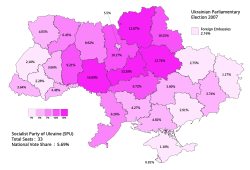
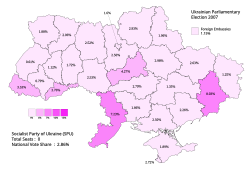
The fallout was immediate. In the 2007 snap elections, the party's support collapsed, receiving only 2.86% of the vote—just missing the 3% threshold required to enter parliament.
The 2010s: Decline and Legal Battles
The 2010s were characterized by electoral failure and leadership disputes. After Moroz stepped down in 2010, the party struggled with internal power struggles between figures like Vasyl Tsushko, Petro Ustenko, and Mykola Rudkovsky. By the 2012 parliamentary elections, the SPU failed to win any representation, garnering only 0.46% of the vote.
Following the 2014 Revolution of Dignity, the party became embroiled in a legal battle over its leadership. A disputed congress in June 2014 saw Mykola Rudkovsky elected as leader, but the State Register refused to recognize the results. This prevented the party from participating in the 2014 and 2015 elections.
In a surprising ideological shift in 2018, a faction of the party adopted a pro-European and Atlanticist stance, advocating for membership in the EU and NATO. They introduced a new logo featuring a yellow fist on a crimson background.
Key Facts
- Founded: October 26, 1991, in Kyiv.
- Key Leader: Oleksandr Moroz, who served as Chairman of the Verkhovna Rada.
- Peak Influence: Part of the executive branch following the 2004 Orange Revolution.
- Turning Point: The 2006 shift to the Anti-Crisis Coalition, which damaged its public image.
- Final Status: Banned by the Ukrainian government in June 2022.
Summary of Electoral Performance
| Election Year | Outcome/Vote Share | Key Result |
|---|---|---|
| 1994 Parliamentary | 14 seats | Became 4th largest party |
| 1998 Parliamentary | 8.55% (as bloc) | Secured Speaker of Parliament |
| 2002 Parliamentary | 6.9% | Won 20 proportional seats |
| 2007 Parliamentary | 2.86% | Failed to enter parliament |
| 2012 Parliamentary | 0.46% | No representation |
Russian Invasion and Banning
On June 15, 2022, the Eighth Administrative Court of Appeal banned the Socialist Party of Ukraine. The Security Service of Ukraine and the Ministry of Justice cited pro-Russian activities and the continued influence of Illia Kyva as the primary justifications. All party property was transferred to the state, and a final appeal by the party was dismissed by the Supreme Court of Ukraine on October 18, 2022.
Frequently Asked Questions
Who founded the Socialist Party of Ukraine?
The party was founded by Oleksandr Moroz on October 26, 1991, following the prohibition of communist parties in Ukraine.
What was the "Anti-Crisis Coalition" controversy?
In 2006, the SPU broke its agreement with "orange" allies (Yushchenko and Tymoshenko) to join a coalition with the Party of Regions. This was widely perceived as a betrayal, leading to a collapse in voter support.
Did the SPU ever hold government power?
Yes, following the Orange Revolution in 2004, the SPU joined the coalition government and held three ministerial portfolios in the central government.
Why was the Socialist Party of Ukraine banned?
The party was banned in 2022 due to allegations of anti-Ukrainian and pro-Russian activities, as well as the influence of figures like Illia Kyva.
What was the party's ideological shift in 2018?
In 2018, a faction of the party moved away from its socialist roots to adopt a pro-European and Atlanticist position, supporting membership in NATO and the European Union.